
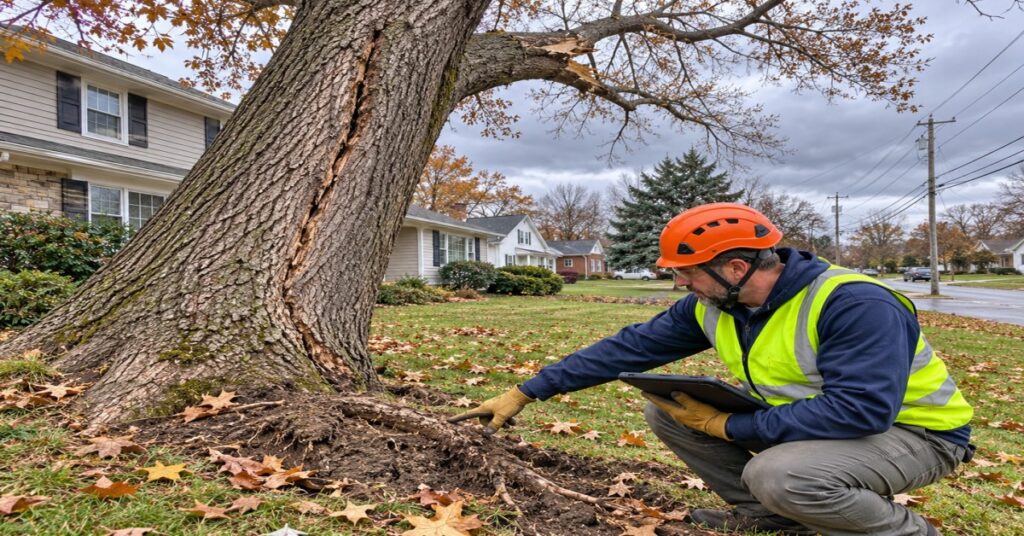
Western New York homeowners face intense weather every season. Fierce Lake Erie wind gales, sudden freeze-thaw swings, and heavy lake-effect snow test mature residential canopies across the region. From historic oak and maple streets in Amherst, Williamsville, and Clarence to dense yards in Tonawanda, Cheektowaga, and Getzville, understanding storm damage tree risk buffalo ny protects families, roofs, and power lines. Mature shade trees boost curb appeal. However, hidden internal decay, saturated clay soil, or weak branch unions can turn a backyard tree into an acute hazard within minutes.
Why Proactive Tree Risk Triage Matters in Western New York
Evaluating storm damage tree risk buffalo ny requires looking deeper than green summer foliage. Most catastrophic failures during Western New York windstorms stem from structural defects that developed silently over years. Common culprits include root-plate lifting in compacted suburban clay, codominant V-shaped trunks with included bark, and basal fungal conks signaling heartwood rot. This homeowner safety guide explains how International Society of Arboriculture (ISA) risk protocols work. You will also learn how to spot early warning signs and when structural pruning, cabling, or precision crane removal makes the safest financial sense.
📋 Table of Contents: Buffalo Homeowner Storm Risk & Safety Guide
- 1. Why Western New York Weather and Clay Soils Amplify Storm Tree Failure
- 2. How the ISA TRAQ Risk Rating Framework Evaluates Residential Trees
- 3. 7 Critical Structural Defects That Signal High Storm Damage Tree Risk
- 4. Pre-Storm Mitigation Through Structural Pruning, Cabling, and Root Care
- 5. Post-Storm Emergency Safety Protocol and Utility Power Line Rules
- 6. Precision Crane Tree Removal and Homeowners Insurance Claim Rules
- 7. Frequently Asked Questions About Storm Tree Risk in Buffalo NY
Why Western New York Weather and Clay Soils Amplify Storm Tree Failure
Tree risk in Erie County cannot be measured with generic national yard checklists. Buffalo’s microclimate creates unique mechanical stresses on hardwood and evergreen root systems. Throughout autumn and early winter, strong southwest winds funnel off Lake Erie across flat suburban terrain. These gales exert thousands of pounds of wind-sail force against tall silver maples, red oaks, willows, and white pines.
Lake Erie Wind-Sail Force & Wet Foliage Loads
Early autumn storms often bring heavy rain or wet snow before deciduous trees drop their leaves. Canopy weight can double or triple overnight under these conditions. When high gusts strike leaf-heavy crowns, leverage at the trunk base spikes dramatically. This combination magnifies storm damage tree risk buffalo ny across older residential neighborhoods.
Glacial Clay Soil Saturation & Freeze-Thaw Splits
Beneath the turf, regional soil geology compounds the physical hazard. Much of Amherst, Clarence, Getzville, and Tonawanda sits atop dense glacial lake-plain clay with slow drainage. Prolonged autumn rains or rapid spring snowmelt oversaturate this heavy clay. Waterlogged soil loses the friction that normally anchors structural roots.
When 50-to-70 mph gusts hit a tall canopy rooted in wet clay, the root plate can pivot like a lever. Turf lifts on the windward side while critical tension roots snap underground. Rapid Western New York freeze-thaw swings also expand trapped moisture inside bark seams and trunk cracks. Ice acts like a hydraulic wedge, splitting weak branch unions apart before spring arrives. Recognizing these local forces helps homeowners manage storm damage tree risk buffalo ny before midnight emergencies strike.
How the ISA TRAQ Risk Rating Framework Evaluates Residential Trees
Professional arborists never guess whether a tree will survive the next Lake Erie gale. Instead, certified specialists apply standardized protocols from the International Society of Arboriculture Tree Risk Assessment Qualification (ISA TRAQ). Under ISA TRAQ guidelines, overall storm damage tree risk buffalo ny depends on three distinct factors. Evaluators measure the likelihood of structural failure, the likelihood of target impact, and the severity of potential damage.
Target Proximity vs. Structural Soundness
A hollow maple standing in an open three-acre field in rural Clarence presents a low overall risk. No people, vehicles, or buildings occupy its strike zone. Conversely, a mature oak with a cracked V-crotch overhanging a Williamsville bedroom roof or electrical drop poses an extreme risk. Even green summer foliage does not offset a compromised union above a high-value target. Use the triage matrix below to see how certified arborists categorize storm damage tree risk buffalo ny during property inspections:
| ISA Risk Level | Typical Structural & Site Indicators | Recommended Homeowner Action |
|---|---|---|
| Low Risk | Balanced crown structure, visible flared root collar, minor dead twigs under 2 inches, and no targets in strike zone. | Schedule dormant pruning every 3 to 5 years and monitor visually after major weather events. |
| Moderate Risk | Overextended limbs near gutters, tight codominant V-forks without splits, or dense unthinned wind-sail canopy. | Book crown thinning, deadwood removal, or dynamic steel cabling before autumn wind or winter snow. |
| High Risk | Fungal shelf conks at root flare, deep vertical frost cracks, severed anchor roots, or dead scaffold limbs over driveway. | Arrange an urgent on-site arborist inspection within days for weight reduction or sectional removal. |
| Extreme Risk | Fresh soil heaving opposite a leaning trunk, actively splitting crotches, hanging widowmakers, or dead standing ash near house. | Evacuate rooms in the fall path immediately and call 24/7 emergency crane dispatch at (716) 466-5990. |
This structured risk matrix helps property owners prioritize tree care budgets wisely. Evaluating target proximity alongside structural defects keeps your storm damage tree risk buffalo ny manageable year-round.
7 Critical Structural Defects That Signal High Storm Damage Tree Risk
Walking your property perimeter every spring and autumn takes only fifteen minutes. That brief inspection can prevent thousands of dollars in roof or vehicle damage. For a complete diagnostic checklist, review our guide on dangerous tree inspection signs Buffalo homeowners must know. When evaluating storm damage tree risk buffalo ny from ground level, check every mature tree within 1.5 times its height of your home.
Canopy, Trunk, and Root-Zone Warning Signs
- 1. Sudden Leaning & Root-Plate Soil Heaving: Trees curved gradually toward sunlight over decades usually build strong reaction wood. However, a straight trunk that tilts abruptly after rain signals root failure. Look for cracked, mounded turf on the opposite side of the lean. Learn how to tell harmless growth from an emergency in our guide on a tree leaning toward house Buffalo NY.
- 2. Codominant Stems with Included Bark: Equal-sized trunks growing upward from a sharp V-shaped junction trap bark inside the union. Instead of strong interlocking wood fibers, a weak seam forms. Heavy wet snow or strong gusts can split included bark unions straight down the center.
- 3. Basal Mushrooms & Shelf Fungi (Conks): Woody bracket fungi or honey mushrooms on the lower trunk signal internal heartwood decay. Decay fungi digest structural lignin and cellulose, leaving only a thin outer shell of live sapwood.
- 4. Hanging “Widowmaker” Limbs & Crown Deadwood: Broken branches lodged high in the canopy can fall without warning. Leafless dead limbs over two inches thick also snap easily during moderate 30 mph afternoon breezes.
- 5. Deep Vertical Trunk Cracks & Ribbed Seams: Long vertical splits from frost or wind torque weaken trunk strength. If a crack extends through the stem or opens and closes in the wind, structural failure is imminent.
- 6. Severed Roots from Driveway or Utility Trenching: Most stabilizing roots grow within the top 12 to 18 inches of soil. Concrete replacement, French drain trenching, or pool excavation within the drip line destroys anchoring leverage on that side.
- 7. Brittle Pest-Killed Hardwoods (Ash & Beech): Trees killed by emerald ash borer or foliar nematodes lose internal moisture rapidly. Dry, brittle wood fibers snap unpredictably under snow loads, elevating storm damage tree risk buffalo ny across residential yards.
🌪️ Spot a Leaning Trunk, Cracked Limb, or Fungus Near Your House?
Do not wait for the next Lake Erie wind warning or wet snowstorm to test a compromised tree. Treeman NY provides certified arborist risk evaluations, structural cabling, and 24/7 crane removal across Buffalo, Amherst, Clarence, Williamsville, Tonawanda, and Getzville.
Pre-Storm Mitigation Through Structural Pruning, Cabling, and Root Care
Identifying defects early lets certified arborists save mature trees rather than defaulting to removal. Proactive care lowers storm damage tree risk buffalo ny by reducing wind drag and reinforcing weak unions. Homeowners can combine four proven arboricultural methods before severe weather arrives:
1. Crown Cleaning & Selective Wind-Sail Reduction
Removing dead, diseased, and crossing interior limbs eliminates falling hazards before windstorms hit. Selective crown thinning lets wind pass cleanly through dense maple and oak canopies. Reputable arborists never top trees because topping creates weakly attached sprouts that snap easily. Maintaining proper roof clearance through routine tree trimming Buffalo NY also keeps branches from tearing off shingles and gutters.
2. Structural Cabling & Bracing for Codominant Trunks
High-strength steel or flexible dynamic cables installed in the upper crown support weak V-shaped crotches. These cables limit how far twin stems sway apart during strong gusts. Paired with threaded steel brace rods at the union base, cabling redistributes mechanical stress safely.
3. Winter Snow & Ice Load Preparation
Wet lake-effect snowstorms in November and March bend upright evergreens and multi-stemmed birches past their breaking point. Targeted dormant pruning removes overextended lateral limbs before heavy snow splits primary scaffold unions.
4. Subsurface Root Zone & Soil Vitality Care
A resilient canopy depends on an oxygenated, well-nourished root system. Compacted suburban clay suffocates fine feeder roots and limits deep structural anchoring. Exploring soil decompaction and nutrient strategies in our master tree health buffalo ny pillar guide strengthens root anchorage against severe windstorms. Combining crown thinning, cabling, and root care consistently reduces storm damage tree risk buffalo ny.
Post-Storm Emergency Safety Protocol and Utility Power Line Rules
Even well-maintained trees can suffer broken limbs or uprooting during historic Western New York windstorms or ice events. The minutes immediately after severe weather carry the highest risk of accidental injury. Follow these four safety rules before stepping outside to evaluate storm damage tree risk buffalo ny:
Immediate Hazard Checks & Utility Line Distance
- Assume Every Downed Wire Is Energized & Lethal: Never approach, touch, or drive over fallen utility cables. Wet tree limbs resting against power lines also conduct deadly high voltage. Keep a 35-foot perimeter, call 911 and National Grid or NYSEG, and review clearance rules in our guide on tree branches near power lines Buffalo NY.
- Scan Overhead for Suspended “Hangers” First: Many homeowners look down at lawn debris while standing beneath fractured limbs hanging 40 feet above. Always check the upper canopy first and keep children and pets indoors until hazards are cleared.
- Never Climb Ladders with a Chainsaw: Storm-damaged limbs hold unpredictable spring tension and compression forces. Improper cuts cause bent branches to whip violently, knocking ladders out from underneath operators.
- Follow Official State Storm Cleanup Guidelines: Consult the safety advisories from the New York State Department of Environmental Conservation forest and tree care guidelines before handling storm-damaged timber.
When a fractured limb rests on your roof or blocks your driveway, call an insured emergency crew immediately. Prompt stabilization protects your family and prevents secondary water intrusion.
Precision Crane Tree Removal and Homeowners Insurance Claim Rules
High-to-extreme risk trees—such as hollow oaks leaning over garages or split maples tangled in fences—make traditional rope climbing unsafe. Compromised wood fibers can shear unexpectedly under a climber’s weight. In these cases, crane tree removal Buffalo NY delivers the safest, lowest-impact extraction available. Certified operators lift severed trunk sections vertically off roofs and lawns, preventing turf rutting and secondary structural damage.
Documenting Storm Damage for Insurance Adjusters
Understanding policy coverage helps homeowners act fast during emergencies. Standard homeowners insurance typically covers removal when a storm-felled tree strikes a covered structure like a house, garage, or fence. Policies also usually cover trees blocking a primary driveway. However, insurers rarely pay for preventative removal of standing dead or leaning trees before they fall.
Take timestamped photos from multiple angles before cleanup crews move any debris. Request an itemized invoice separating structural extraction from general yard cleanup. For full dispatch details and service pricing, visit our primary tree removal Buffalo NY service page. Proactively managing storm damage tree risk buffalo ny before a collapse costs far less than emergency crane extraction and roof repairs.
Frequently Asked Questions About Storm Tree Risk in Buffalo NY
How do I know if a leaning tree in my yard is an immediate storm emergency?
A tree leaning gradually toward sunlight for years with intact turf around its base is usually stable. However, a straight trunk that tilts suddenly after heavy rain signals root-plate failure. If you see cracked or lifted soil opposite the lean, call for emergency arborist dispatch immediately.
What is the best time of year to reduce storm damage tree risk buffalo ny?
Late winter through early spring is ideal for structural pruning and cabling while deciduous trees are dormant. Bare branches reveal hidden cracks and weak V-crotches clearly. However, hazardous deadwood or root-compromised trees require immediate attention regardless of season.
Can structural cabling save a large tree with a split trunk or weak V-crotch?
Yes, provided the trunk wood remains structurally sound and free of extensive internal rot. Certified arborists install high-strength steel cables in the upper crown and brace rods through the union. This system restricts wind sway and prevents stems from splitting apart.
Does homeowners insurance pay to remove a hazardous tree before it falls?
In most cases, insurance does not cover preventative tree removal. Policies typically pay after a storm knocks a tree onto an insured structure like a roof, garage, or fence. Standing dead or leaning trees remain the homeowner’s maintenance responsibility until an impact occurs.
Schedule a Professional Storm Damage Tree Risk Inspection in Buffalo NY
Do not leave your home, vehicles, or family vulnerable to the next Lake Erie windstorm or wet snow event. Treeman NY delivers certified arborist risk evaluations, structural pruning, cabling, and 24/7 crane removal across Buffalo, Amherst, Clarence, Williamsville, Tonawanda, and Getzville. Contact our local dispatch team today to evaluate storm damage tree risk buffalo ny and secure your property.
Treeman NY: 2791 N Forest Rd, Getzville, NY 14068. Fully licensed and insured Western New York arborists specializing in storm risk assessment, structural pruning, and precision crane removals.