
Maintaining vibrant, structurally sound shade trees in Western New York requires a deep understanding of regional soil composition, harsh lake-effect weather cycles, and invasive biological pests. Consequently, for property owners across Erie County, safeguarding tree health buffalo ny is the single most effective way to preserve residential property values, reduce cooling bills, and prevent unexpected storm catastrophes. Mature oaks, sugar maples, and ornamental evergreens are substantial living investments. However, they face continuous physiological stress from dense glacial clay, freeze-thaw cycles, and destructive fungal pathogens.
Furthermore, when trees begin to decline, the symptoms rarely develop overnight. Instead, subtle indicators like early leaf drop, thinning crowns, and basal bark cracks clearly signal underlying vascular distress. Therefore, proactive intervention ensures sustained tree health buffalo ny, effectively transforming vulnerable landscapes into resilient, storm-resistant urban canopies. In addition, this comprehensive homeowner manual provides the diagnostics, seasonal schedules, and arborist-backed practices required to manage your trees effectively throughout 2026.
📋 Table of Contents
Western New York Soil Conditions & Environmental Stressors
Fundamentally, the foundation of long-term plant vitality begins below ground. Across suburban Buffalo—including Amherst, Clarence, Getzville, and Tonawanda—residential landscapes feature dense, heavy glacial clay soils. Specifically, these soils present high water-holding capacities paired with poor internal drainage and low pore oxygen. During wet spring thaws, tree root zones become completely saturated, thereby suffocating feeder roots. In contrast, during late summer droughts, the same clay hardens like concrete, inhibiting capillary moisture absorption and crushing delicate root hairs.
Therefore, to successfully nurture tree health buffalo ny, property owners must actively mitigate sub-surface soil compaction. When construction machinery, lawn mowers, or repeated foot traffic compact urban turf, bulk density increases dramatically. As a result, compacted clay restricts the oxygen exchange essential for mycorrhizal fungal symbiosis, directly weakening your tree’s natural defense against root pathogens.
In addition to physical density, soil chemistry presents a substantial challenge. Many local yards possess alkaline subsoils that chemically bind essential micronutrients like iron and manganese. Consequently, maples and pin oaks planted in high-pH turf frequently display interveinal chlorosis, where leaves turn pale yellow with sharp green veins. Fortunately, mitigating these conditions through vertical air-spading, organic soil conditioning, and radial trenching revitalizes depleted roots and preserves ongoing tree health buffalo ny.
Another major environmental threat is municipal de-icing salt. Specifically, lake-effect winter road management washes tons of sodium chloride directly into roadside root zones. In turn, sodium ions displace essential calcium and potassium, drawing water away from roots via osmotic pressure. Thus, balancing soil chemistry with gypsum applications and thorough early spring water flushes remains a baseline requirement to protect roadside plantings along suburban streets.
Furthermore, because subsurface soil compaction and shifting clay frequently force root systems toward the surface, property owners must also monitor nearby hardscapes. As a practical step, learning to recognize common tree root damage signs around sidewalks, driveways, and foundations ensures you catch root-plate instability before subsoil stress compromises overall tree health buffalo ny.
Ultimately, regular soil testing, vertical aeration, and organic mulching help property owners overcome local soil barriers, securing resilient tree health buffalo ny throughout challenging seasonal transitions.
Visual Canopy and Trunk Health Diagnostics
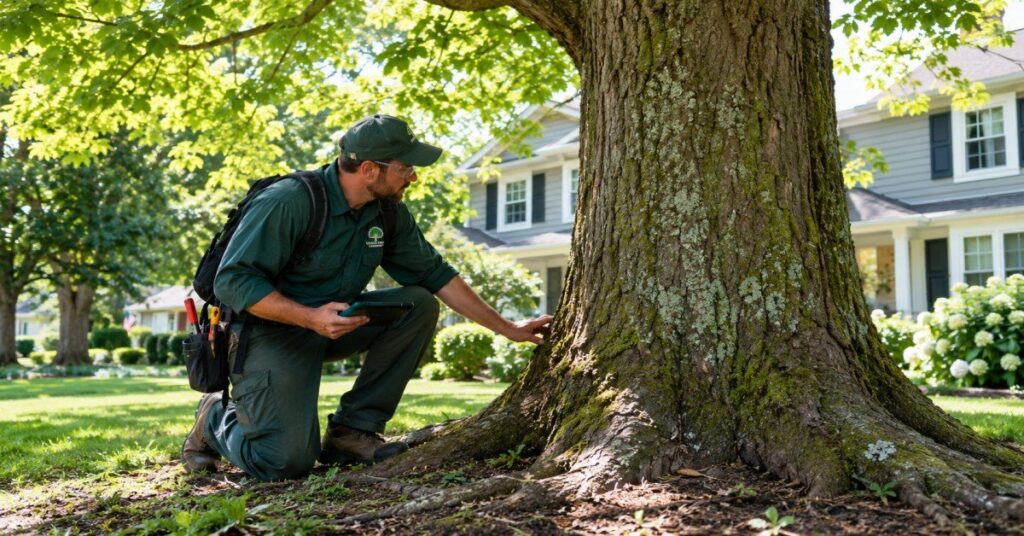
A systematic visual audit allows homeowners to identify physiological stress years before a tree reaches structural collapse. As outlined in the International Society of Arboriculture mature tree care standards, property owners should inspect trees annually across four distinct physiological indicators: leaf development, annual shoot growth, crown density, and bark stability.
| Tree Area | Normal Vigor Indicators | Critical Distress Warnings |
|---|---|---|
| Upper Canopy | Full, vibrant leaf coverage; robust terminal twig growth (4-8 inches yearly). | Stag-heading (dead top branches), early autumn leaf drop, crown thinning. |
| Foliage | Deep uniform color, natural leaf dimensions, absence of premature spotting. | Marginal leaf scorch, yellowing interveinal chlorosis, sticky honeydew. |
| Trunk & Bark | Intact bark, closed pruning wounds, balanced tapering toward the base. | Vertical frost cracks, peeling bark plates, weeping slime flux, sawdust frass. |
| Root Flare | Prominent, visible buttress flare entering the soil grade cleanly. | Girdling roots circling trunk, fungal shelf brackets (conks), soil heaving. |
When assessing overall tree health buffalo ny, examine the crown’s silhouette against bright daylight. Canopy thinning from the outside inward generally points to root restriction or vascular constriction, whereas sudden internal dieback may indicate insect boring activity. If you notice strange lesions, premature defoliation, or weeping bark, cross-reference our field guide on tree disease signs Buffalo NY to pinpoint the exact biological cause.
Monitoring these physiological cues enables homeowners to consistently protect tree health buffalo ny before internal decay spreads beyond recovery.
Early identification of cambium distress remains vital for maintaining resilient tree health buffalo ny year after year.
🌳 Noticing Signs of Tree Decline in Your Yard?
Treeman provides comprehensive plant health inspections, deep root soil conditioning, and structural hazard risk evaluations across Buffalo, Amherst, Clarence, and Getzville. Let our certified team diagnose and protect your landscape investments.
Major Tree Diseases and Insect Threats in Erie County
Urban and suburban canopies in Western New York face several severe biological threats. Understanding these local pathogens is essential to preserve long-term tree health buffalo ny.
According to research verified by the Cornell University Plant Disease Diagnostic Clinic, fungal and bacterial pathogens spread rapidly throughout New York State when seasonal moisture peaks. Below are the primary threats impacting local properties:
1. Oak Wilt (Bretziella fagacearum)
Perhaps the most aggressive fungal vascular wilt in the Northeast, Oak Wilt attacks red and pin oaks with fatal speed. Fungal spores clog the tree’s xylem vessels, cutting off water to the crown. Infected oaks drop bronze, water-soaked leaves from the top down within two to three weeks of initial symptoms. Because this pathogen spreads underground through root grafts, immediate intervention is mandatory. Property owners should review our regional protocol on oak wilt in Buffalo NY to learn about quarantine steps, macro-infusion treatments, and preventive pruning restrictions.
2. Cytospora Canker & Rhizosphaera Needle Cast
Suburban evergreens—especially mature Norway and Colorado Blue Spruces—suffer severely from needle cast fungi and fungal cankers. Rhizosphaera causes second-year needles to turn purplish-brown and drop, creating hollow, bare lower branches. Simultaneously, Cytospora canker infects drought-stressed spruces, causing white, crystalline sap to weep from branch collars. Addressing these fungal attacks early preserves screening conifers and sustains tree health buffalo ny across residential perimeters.
3. Verticillium Wilt and Anthracnose
Buffalo’s wet, cool spring seasons create prime environments for anthracnose on sycamores, white oaks, and maples. While anthracnose causes distorted leaves and dark vein lesions, it is rarely fatal on its own. However, soil-borne Verticillium wilt plugs water transport in maples, causing sudden branch-by-branch wilting in July and August. Professional soil diagnostics separate temporary foliar blights from systemic vascular decline to ensure correct management of tree health buffalo ny.
Safeguarding against these pervasive biological threats is essential to maintain tree health buffalo ny throughout mature neighborhoods.
Managing fungal sporulation and insect vectors prevents secondary infestations that quickly compromise tree health buffalo ny.
Four-Season Maintenance & Plant Health Care Schedule
Tree maintenance should not be a reactive response to falling branches; it requires a structured, year-round program. Implementing this seasonal timeline ensures uninterrupted tree health buffalo ny across changing weather extremes:
- Late Winter (January – March): Dormant Pruning & Structural Triage
Inspect bare canopies to spot crossing limbs, weak narrow V-crotches, and internal decay pockets. Perform ANSI A300 structural pruning while trees are fully dormant. For mature shade trees showing split forks or heavy lateral spread, installing tree cabling and bracing Buffalo NY provides supplemental physical support against storm loads, building a resilient foundation for tree health buffalo ny. - Early Spring (April – May): Deep-Root Fertilization & Mulch Correction
Inject liquid slow-release fertilizers and organic mycorrhizal fungi into the sub-surface feeder root zone (4 to 8 inches deep) to counteract clay compaction. Refresh mulch beds with natural aged bark mulch 2 to 4 inches deep, maintaining a strict 3-inch gap around the trunk flare to prevent collar rot. - Mid Summer (June – August): Hydration Auditing & Drought Protection
During prolonged dry spells, heavy clay soils shrink and crack, tearing delicate feeder roots. Deliver slow, deep watering sessions (10 gallons per inch of trunk diameter weekly) using soaker hoses beneath the outer drip line. Consistent deep hydration is crucial to sustain tree health buffalo ny during high heat. - Autumn (September – November): Soil Conditioning & Winterization
Apply gypsum to displace road salts and loosen tight clay particles. Clear fungal-spotted leaf debris away from spruce and maple root zones to interrupt overwintering fungal life cycles, protecting baseline tree health buffalo ny before ground freezes arrive.
Adhering to this structured seasonal calendar allows property managers and homeowners to preserve tree health buffalo ny throughout the year.
Executing scheduled cultural treatments at the proper seasonal milestones directly promotes flourishing tree health buffalo ny.
Structural Preservation vs. Necessary Tree Removal
A central objective of modern arboriculture is tree preservation. Trees with structural defects—such as multi-stem trunks, heavy over-extended horizontal limbs, or historical storm stress cracks—do not always require immediate removal. In many cases, installing dynamic synthetic cables and steel brace rods supports weak junctions, distributing severe wind and ice forces across the entire canopy so structural hardware safely extends tree longevity.
Similarly, understanding the subsurface root plate is paramount. Aggressive surface roots can threaten home foundations, driveways, and underground utility paths. Detecting structural root defects early helps homeowners protect their property while preserving vital tree stability.
However, preservation has biological and physical limits. When internal wood decay hollows out more than 40% of trunk diameter, when severe root decay creates extensive mushrooms at the soil line, or when fatal pathogens like advanced Oak Wilt cause full vascular collapse, preservation becomes unsafe. In these situations, scheduling professional tree removal Buffalo NY eliminates falling hazards before severe storms hit.
Knowing when to treat, support, or safely extract compromised trees is the final cornerstone of managing tree health buffalo ny on residential properties.
Prioritizing structural stability alongside root zone health is the most reliable way to maintain tree health buffalo ny year after year.
When property owners commit to ongoing evaluations, they successfully promote lasting tree health buffalo ny across their communities.
Frequently Asked Questions About Buffalo Tree Health
How does Buffalo’s clay soil impact tree health?
Heavy glacial clay soils across Western New York easily become compacted, suffocating feeder roots during wet spring periods and restricting moisture during dry summers. Deep root aeration, air-spading, and organic mulch additions loosen the soil structure to enhance tree health buffalo ny.
What are the earliest signs of a dying tree?
The earliest symptoms include canopy thinning, stag-headed dead branch tips in the upper crown, premature foliage color change in mid-summer, vertical trunk bark cracks, and fungal mushrooms (conks) emerging around the lower root collar.
When should I fertilize my mature landscape trees in Erie County?
The ideal window for deep root fertilization is early spring (April–May) before rapid shoot growth begins, or late autumn (October–November) after leaf drop. Sub-surface injections place slow-release nutrients and mycorrhizal fungi directly into the feeder root zone.
Can a tree with trunk decay or hollows be saved?
Yes, provided there is sufficient sound outer wood (at least 30-40% of the trunk radius intact) and the root flare is healthy. Certified arborists use crown reduction pruning, dynamic cabling, and root zone conditioning to stabilize hollow trees safely.
Schedule Your Professional Tree Health Evaluation Today
Don’t let hidden root rot, soil compaction, or aggressive fungal pathogens undermine your landscape. Treeman delivers certified diagnostic audits, plant health care, deep root feeding, structural cabling, and hazardous tree extraction across Getzville, Amherst, Clarence, Tonawanda, and the greater Buffalo area. Partner with certified local arborists to protect your property’s tree health buffalo ny for decades to come.
Treeman HQ: 2791 N Forest Rd, Getzville, NY 14068. Fully licensed and insured for residential and commercial tree preservation across Western New York.