
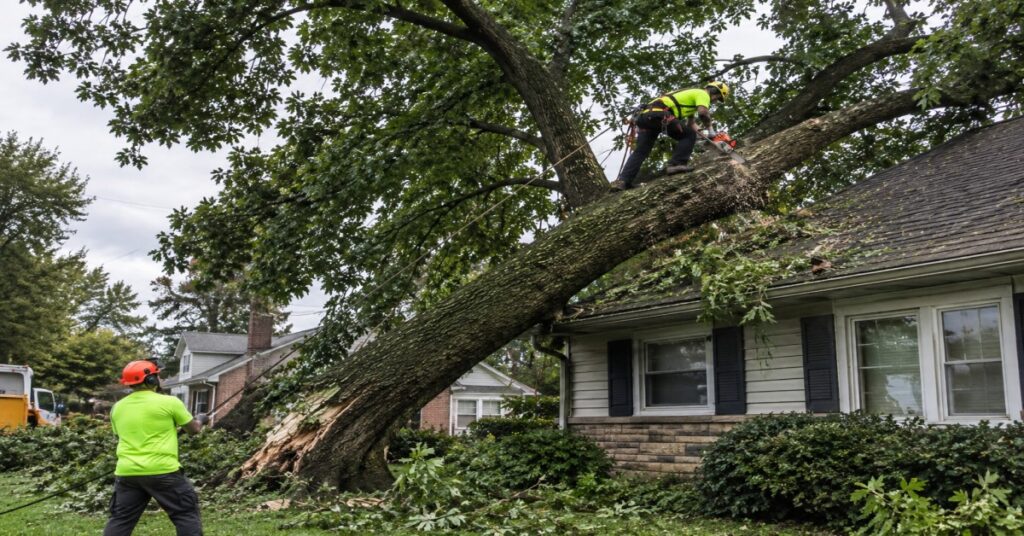
Waking up after a severe Lake Erie windstorm to discover a tree leaning toward house Buffalo NY homeowners cherish is terrifying. When tens of thousands of pounds of wood lean over bedrooms, living spaces, or utility lines, you need immediate, reliable answers. Saturated clay soil, freeze-thaw cycles, and heavy lake-effect snow make Western New York properties uniquely vulnerable to sudden subterranean root failure.
⚡ Quick Triage: Emergency vs. Safe Lean
- Immediate 911/Arborist Emergency: Soil mounding/heaving on the opposite side, visible snapped roots, fresh ground cracking, or sudden tilt after high winds.
- Non-Emergency (Monitor): A gradual, bowed trunk with undisturbed turf and no exposed roots that has looked the same for years (phototropism).
- First Action: Clear all occupants out of rooms facing the strike path and keep 30+ feet away from any compromised utility lines.
Table of Contents
- 1. Tree Leaning Toward House Buffalo NY: Is It an Immediate Emergency?
- 2. Natural Growth Angle vs. Acute Structural Failure
- 3. 5 Critical Warning Signs of Imminent Collapse
- 4. Why Western New York Weather Destabilizes Leaning Trees Faster
- 5. What to Do Immediately While Waiting for an Arborist
- 6. How Certified Arborists Stabilize or Remove Leaning Trees
- 7. Frequently Asked Questions
Tree Leaning Toward House Buffalo NY: Is It an Immediate Emergency?
A tree leaning toward house Buffalo NY is an immediate emergency if the root plate is actively lifting, fresh soil cracks appear opposite the tilt, or the trunk shifted suddenly after a storm. If the trunk displays a gradual, natural curve with intact soil, it requires monitoring rather than emergency removal.
In an acute crisis, an unstable tree leaning toward house Buffalo NY represents a dangerous structural threat that cannot wait. Before panicking, evaluate whether your tree has grown at an angle for decades or experienced sudden structural root loss. When an acute hazard arises, a severe tree leaning toward house Buffalo NY demands an immediate professional evaluation.
Immediate Safety Warning: If you see fresh soil heaving at the root collar, hear popping wood fibers, or notice limbs resting on your shingles, keep everyone away from that side of the house. Call our 24/7 emergency dispatch line at Tree Man NY (716) 466-5990 for rapid crane stabilization and inspection.
Natural Growth Angle vs. Acute Structural Failure
Not every tilted tree requires an emergency crew. Deciduous trees across Buffalo, Amherst, and Williamsville naturally bend toward sunlight—a biological process known as phototropism. Distinguishing safe natural growth from imminent failure comes down to two key patterns:
- Natural Phototropic Lean: The trunk curves smoothly upward, self-correcting as the canopy seeks sunlight. Over decades, the tree produces dense layers of reaction wood around its base, creating an anchor system balanced against its angle.
- Mechanical Root Shear: The trunk remains completely straight, but the tree tilts abruptly from beneath the soil line. This sudden movement indicates snapped lateral roots and taproot failure.
When an established oak or maple suddenly shifts following heavy weather, natural structural stability is gone. A sudden tree leaning toward house Buffalo NY becomes an unpredictable hazard requiring on-site evaluation by our experienced tree care professionals in Buffalo NY.
5 Critical Warning Signs of Imminent Collapse
If you notice a suspicious angle, inspect the base from a safe distance and check for these five critical warnings:
1. Soil Heaving Behind the Root Plate
Examine the lawn directly opposite the direction of the lean. If the soil is cracked, mounded, or lifting upward—exposing fine roots or fresh dirt—the subterranean root plate has torn loose. Soil heaving confirms the root system is actively failing.
2. Basal Decay and Fungal Conks
Bracket fungi or mushrooms sprouting around the root flare indicate rotted interior holding wood. As explained in our guide on 7 dangerous tree inspection signs Buffalo homeowners must know, hollow or decayed wood drastically reduces a tree’s wind-load tolerance.
3. Canopy Limbs Overhanging the Roofline
A tilted canopy exerts heavy leverage over your roof. Gusty winds cause unweighted branches to strike shingles, puncture decking, or crush gutters. If limbs already touch your roofing, review the safety precautions in our article on tree branches over roof removal to avoid major structural roof repairs.
4. Fresh Soil Sockets Around the Trunk
Check where the trunk enters the ground. A visible crescent gap between the trunk and dirt indicates that the tree is swaying loose within a dirt socket. Once water pools in this gap, soil friction disappears, accelerating the failure of any tree leaning toward house Buffalo NY.
5. Recent Windstorm and Ice Exposure
Severe Lake Erie gales create intense rotational forces. If a tree survives high winds but develops an unnatural tilt, critical support roots may have sheared below ground. Review our checklist on is your tree safe? 7 dangerous signs to spot after a Buffalo storm to inspect property boundaries safely.
Whenever you observe any of these warning signs in a tree leaning toward house Buffalo NY, treat the situation as an active risk and secure professional intervention immediately.
Spotting these warning signs on your lawn? Protect your home before the next storm—call Tree Man NY at (716) 466-5990 for immediate hazard assessment or request a free estimate online.
Why Western New York Weather Destabilizes Leaning Trees Faster
Western New York presents unique seasonal conditions that place severe physical stress on trees with compromised roots. Factors accelerating root failure include:
| WNY Climate Factor | Impact on Root Plate | Hazard Rating |
|---|---|---|
| Saturated Lake Plain Clay | Dense clay holds excess water during thaws, turning anchor points into soft mud. | Critical (High slip risk) |
| Wet Lake-Effect Snow | Heavy snow adds immense weight to canopies, increasing leverage against the root plate. | Severe (High fracture risk) |
| Freeze-Thaw Cycles | Rapid temperature swings expand and contract wet soil, severing fine anchor roots. | High (Soil looseness) |
These local weather elements mean that an unstable tree leaning toward house Buffalo NY poses a much higher collapse risk than in milder regions.
What to Do Immediately While Waiting for an Arborist
When dealing with an unstable tree threatening your residence, follow these safety steps:
- Evacuate the Strike Zone: Maintain a ground safety perimeter equal to 1.5 times the tree height. Keep family members out of rooms along the expected fall line.
- Never Use DIY Winches or Straps: Attempting to anchor a shifting trunk with consumer tow straps is hazardous. Under sudden strain, straps snap with lethal force.
- Stay Clear of Utility Wires: If branches are near power lines, keep at least 30 feet away and notify National Grid or NYSEG immediately.
- Document Details for Insurance: Take timestamped photos showing ground heave and structural proximity. The risk guidelines provided by the International Society of Arboriculture (ISA) confirm that documented root failure aids insurance claims.
- Plan for Low-Impact Extraction: High-risk trees close to structures require specialized equipment. See our guide on large tree removal near house Buffalo: 5 crucial steps to protect your home to learn how crane dismantling avoids property damage.
Staying clear of an unstable tree leaning toward house Buffalo NY during high winds is essential for your safety.
How Certified Arborists Stabilize or Remove Leaning Trees
When our specialists arrive on-site, we perform a thorough risk assessment to select the safest plan of action:
- Canopy Weight Reduction: If root structure remains sound, selective pruning removes weight from heavy limbs, easing pull toward your home.
- Dynamic Cabling and Guying: For sound trees with slight movement, high-strength cables help redistribute canopy stress.
- Crane-Assisted Sectional Removal: When root failure or internal trunk decay makes climbing unsafe, our crew uses cranes to lift trunk sections vertically without ground impact.
A professional arborist can determine whether a tree leaning toward house Buffalo NY can be stabilized or requires immediate crane-assisted removal.
Worried About a Leaning Tree on Your Property?
Avoid taking chances with heavy lake-effect winds and saturated ground. Tree Man NY provides 24/7 hazard assessments and emergency removals across Buffalo, Amherst, Cheektowaga, Williamsville, and Clarence.
Licensed & Insured • 24/7 Storm Response • Specialized Rigging Crews • Serving Buffalo, Amherst, Cheektowaga, Williamsville, Clarence, and surrounding WNY areas.
Frequently Asked Questions
Does homeowners insurance cover removing a tree leaning toward house Buffalo NY?
Most insurance policies cover removal only after a tree impacts a covered structure. However, when an arborist verifies that severe root failure threatens immediate collapse, some insurers authorize removal to avoid greater damage.
Can a tree leaning toward house Buffalo NY be stabilized with cables?
Cabling works only if the root plate and lower trunk wood are solid. If anchor roots have severed or ground heaving is present, cabling cannot prevent failure, and removal is required.
How close can a leaning tree stand before it poses a danger?
If the tree’s height falls within striking range of your home and shows dieback, decay, or root issues, have it inspected promptly before bad weather hits.
What should I do if a neighbor’s tree leaning toward house Buffalo NY looks dangerous?
New York law permits you to trim overhanging limbs to your boundary line. If the trunk itself is hazardous, obtain an arborist hazard inspection and send formal written notice to your neighbor.
When you spot a tree leaning toward house Buffalo NY, taking swift action ensures the safety of your family and property. Contact Tree Man NY to schedule an immediate assessment.