
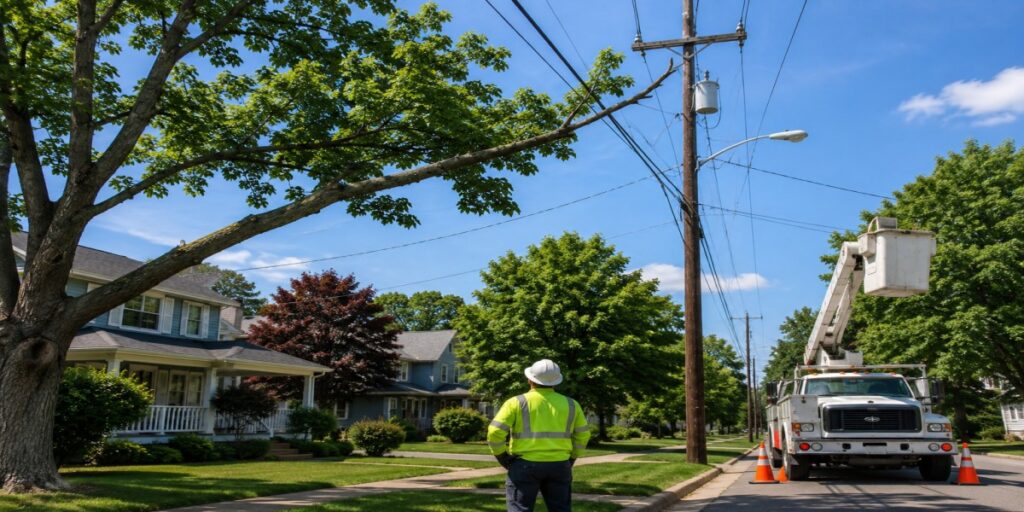
Spotting overgrown tree branches near power lines buffalo ny property owners face is an urgent hazard demanding immediate safety action. Across Western New York, turbulent weather—ranging from Lake Erie blizzards to severe summer squalls—places heavy mechanical strain on neighborhood trees. When an aging oak, maple, or locust limb bends near high-voltage lines, risks of fires, outages, and dangerous ground currents rise quickly. Recognizing these electrical hazards early is essential to protecting your home.
Erie County homeowners often ask: Who is legally responsible for clearing these limbs? Will National Grid trim branches touching my home line for free, or must I hire a private contractor?
Knowing where utility management ends and private liability begins is vital. This 2026 guide breaks down legal responsibilities, outlines proven emergency protocols, and details safe steps to eliminate the hazards of tree branches near power lines buffalo ny residents encounter each storm season.
⚡ Quick Answer: Who Clears Limbs Near Power Lines in Buffalo?
- Street Distribution Lines (Public Roads): Managed entirely by National Grid or NYSEG. They trim trees along public utility corridors for grid stability at zero direct cost to property owners.
- Private Service Drops (Pole to House): Maintaining limbs around this line is the homeowner’s legal and financial responsibility. National Grid will temporarily shut off power at the pole so a certified private tree service can trim safely.
- Emergency Protocol: Never attempt DIY trimming near wires. If active sparks, smoke, or downed wires occur, keep a 35-foot perimeter and dial 911 immediately.
Table of Contents
- 1. Who Is Legally Responsible for Tree Branches Near Power Lines in Buffalo?
- 2. Critical 2026 Safe Steps for Handling Overgrown Utility Limbs
- 3. The Extreme Dangers of DIY Trimming Around Electric Feeds
- 4. Western New York Weather Hazards: Why Buffalo Trees Threaten Power Lines
- 5. Professional Line Clearance: Equipment and Precision Lowering
- 6. Frequently Asked Questions
Who Is Legally Responsible for Tree Branches Near Power Lines in Buffalo?
When encountering tree branches near power lines buffalo ny utility corridors cross, legal duty depends on the specific wire involved. Overhead electrical infrastructure across Western New York features two distinct zones.
Utility Duty: National Grid / NYSEG
Homeowner Duty: Private Tree Service
1. High-Voltage Distribution Lines (The Utility’s Duty)
Heavy cables strung along public roadways carry high voltage (4,000 to 13,200+ volts). Under New York regulations, utilities like National Grid and NYSEG manage vegetation along these primary easements. If limbs threaten distribution circuits, the utility schedules line-clearance pruning solely to preserve grid reliability.
2. The Private Service Drop (The Homeowner’s Duty)
The lower-voltage cable running from the utility pole directly to your rooftop weatherhead is your service drop.
- The Erie County Standard: Property owners hold financial and legal responsibility for trees on their property encroaching upon this private line.
- The Utility Policy: If limbs push against your service drop, National Grid rarely cuts them down. Instead, they will temporarily disconnect household power at the pole so an authorized tree crew can work unhindered.
Before winter ice weighs down crowns, scheduling professional Buffalo tree trimming services keeps lines clear of encroaching tree branches near power lines buffalo ny trees produce. For properties with mature hardwoods, organizing routine crown health evaluations verifies stability before storms trigger structural failures.
Critical 2026 Safe Steps for Handling Overgrown Utility Limbs
Encountering dangerous tree branches near power lines buffalo ny yards contain requires immediate adherence to proven safety procedures:
1. Maintain a Strict 35-Foot Ground Perimeter
Under damp Western New York conditions, electric currents can arc through open space to find ground pathways. Keep children, family members, and pets at least 35 feet away from any tree or fence touching overhead wires.
2. Conduct a Ground-Level Hazard Evaluation
Observe the canopy safely with binoculars. Look for scorched bark, humming, arcing flashes, or visible smoke. Scheduling a formal structural tree hazard assessment uncovers hidden trunk decay and root instability before overhead limbs fail. Identifying weak points in tree branches near power lines buffalo ny neighborhoods feature helps prevent sudden catastrophic breaks.
3. Determine Triage: 911 vs. Utility Dispatch
If you observe active flames, sparking wires, downed lines, or a tree pulling the electrical mast away from your house, call 911 immediately. If branches touch a street distribution line without active sparking, call National Grid’s outage line at 1-800-867-5222.
4. Halt All Mechanical and DIY Cutting Efforts
Never approach tree branches near power lines buffalo ny properties harbor with pole pruners, ladders, or saws. Wet sapwood conducts electricity instantly, sending lethal current down tool shafts into the operator.
5. Protect Interior Electrical Systems
When wind rubs branches against your service drop, micro-shorts trigger power surges. Unplug computers and delicate appliances to protect sensitive circuitry from spikes.
6. Inspect Canopies for Storm-Induced Splitting
Following high gusts across Erie County, inspect crowns for vertical fractures. Spotting storm-damaged tree branches helps homeowners identify hanging boughs before they swing into energized lines carrying tree branches near power lines buffalo ny foliage.
7. Enlist a Qualified Line-Clearance Team
Because utility-adjacent work demands certified protocols, hiring a fully insured tree service in Buffalo provides liability protection. Specialized arborists possess the insulated gear needed to clear tree branches near power lines buffalo ny neighborhoods feature safely.
The Extreme Dangers of DIY Trimming Around Electric Feeds
Attempting to prune tree branches near power lines buffalo ny trees develop without professional training brings severe risks. According to the Occupational Safety and Health Administration (OSHA), line contact remains a leading cause of arboricultural fatalities:
- Arcing Current: High voltage discharges across air gaps, moist wood, and pole tools without direct contact.
- Violent Tension Release: Limbs resting against wires store mechanical energy; making a cut can cause lines or limbs to whip outward.
- Structural Wall Damage: Dropping limbs can rip the electric meter and siding straight off your house, requiring costly repairs.
Western New York Weather Hazards: Why Buffalo Trees Threaten Power Lines
The regional climate driven by Lake Erie makes managing tree branches near power lines buffalo ny residences encounter a year-round priority.
| Western New York Climate Force | Impact on Tree Canopies | Proactive Safety Response |
|---|---|---|
| Heavy Early-Winter Lake Snow | Dense snow forces heavy branches down into electrical lines. | Crown thinning and deadwood removal during early fall. |
| Freezing Rain & Ice Accumulation | Glaze ice loads branches beyond capacity, causing splits. | Pre-storm structural pruning and hazard inspections. |
| Lake Erie Wind Shear (50+ mph) | Strong gusts whip outer branches into energized conductors. | Maintaining dedicated 10-foot safety clearance corridors. |
When severe weather snaps limbs across lines, contact our team for 24/7 emergency tree removal in Buffalo to secure your property.
Professional Line Clearance: Equipment and Precision Lowering
Removing precarious tree branches near power lines buffalo ny homes sit beside requires specialized aerial gear and rigging:
- Dielectric Insulated Bucket Trucks: Aerial lifts tested and certified to isolate crews from dangerous electrical grounding.
- Non-Conductive Rigging Hardware: High-strength synthetic ropes and composite poles engineered specifically for high-voltage corridors.
- Controlled Sectional Lowering: Arborists rig and lower heavy boughs piece by piece using friction brakes, ensuring falling wood never swings toward utility wires or rooftops.
These specialized techniques ensure hazardous limbs are removed safely without property damage or power interruptions.
Need Dangerous Limbs Cleared Away From Wires?
Never risk clearing limbs off live electrical wires yourself. If overgrown oak, maple, or pine branches threaten the private service line to your home, contact our certified, fully insured crew at Treeman for a safe, precision line-clearance evaluation.
Treeman serves Getzville, Amherst, Williamsville, Clarence, Lockport, East Amherst, Cheektowaga, and surrounding Buffalo, NY communities. Fully licensed, insured, and equipped with dielectric aerial bucket equipment for your peace of mind.
Frequently Asked Questions
Does National Grid trim branches touching the electric wire to my home?
National Grid does not prune vegetation along private service drops (the line extending from the street pole to your home’s meter). Maintaining this individual line is the homeowner’s responsibility, though the utility will disconnect power temporarily upon request so your arborist can work safely.
How much clearance should exist between trees and power lines?
For high-voltage street lines, utility guidelines recommend at least 10 feet of clear space in all directions. For private residential drops, keep foliage trimmed back 3 to 5 feet to accommodate swaying tree branches near power lines buffalo ny winds push during storms.
What should I do if a tree branch is smoking or sparking against a wire?
Evacuate the immediate area and dial 911 immediately. Next, report the sparking limb to National Grid at 1-800-867-5222. Never spray water or use tools near energized trees.