
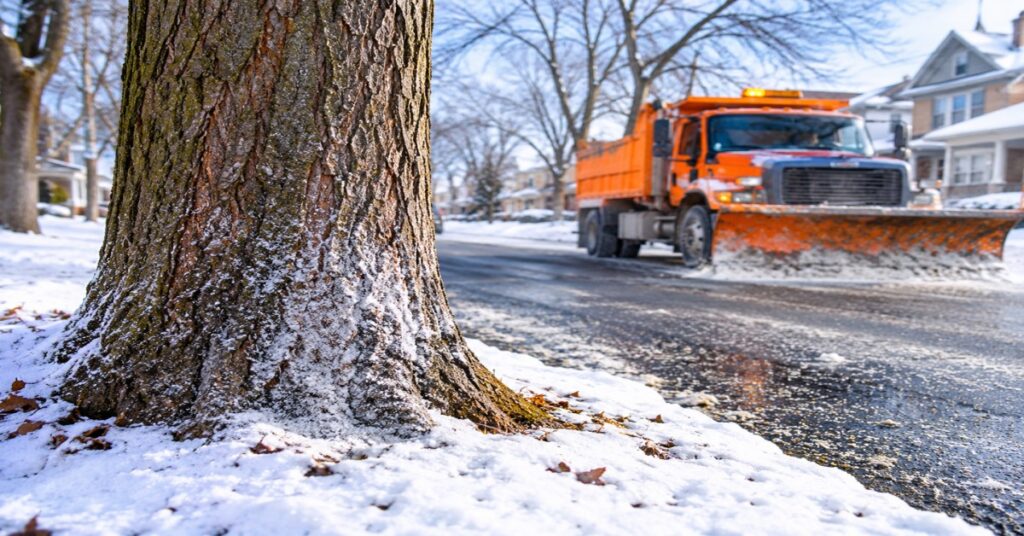
Western New York winters demand relentless municipal salting across Erie County. Every winter, heavy snowfalls bring massive plowing operations. Consequently, tons of rock salt accumulate along curbsides and driveways. Towns like Amherst, Clarence, Tonawanda, and Getzville experience severe roadside sodium runoff. Unfortunately, melted salt slush seeps directly into root zones. When property owners notice brown pine needles or stunted spring leaves, action is essential. Therefore, addressing road salt tree damage buffalo ny helps save valuable landscape trees before chronic decline occurs.
Surface rock salt harms trees through two distinct chemical pathways. First, airborne salt spray from passing vehicles coats dormant twigs. Second, dissolved sodium chloride saturates the subsoil. Thick Western New York clay holds these toxic ions for months. As a result, roots suffer from osmotic drought and nutrient starvation. However, understanding road salt tree damage buffalo ny allows homeowners to protect their yards. This guide covers visible salt symptoms, biological mechanisms, and proven remediation steps. Furthermore, it outlines how professional arborist care restores vitality.
📋 Table of Contents: Road Salt Protection Guide
How De-Icing Salt Destroys Tree Biology
Rock salt contains approximately 98.5% sodium chloride. When spread across icy roadways, it dissolves into sodium and chloride ions. Both ions attack tree biology in distinct, harmful ways. Specifically, chloride ions enter root tissues and move into leaves. They accumulate along leaf margins, causing severe tissue burn and browning. For this reason, road salt tree damage buffalo ny can quickly ruin curb appeal.
Meanwhile, sodium ions cause physical breakdown within the soil. Sodium displaces beneficial minerals like calcium, potassium, and magnesium. Without potassium, trees cannot produce chlorophyll effectively. Furthermore, sodium destroys soil structure. It breaks apart soil aggregates and compacts Western New York clay. As a result, water cannot drain properly.
In addition, salt in the soil triggers physiological drought. High salt concentrations pull moisture away from tree roots through reverse osmosis. Even when the ground is damp, roots cannot drink. Trees literally die of thirst in saturated soil. Therefore, tackling severe de-icing toxicity requires repairing subsurface soil chemistry.
Identifying Winter Salt Burn and Toxicity Signs
Homeowners often overlook early salt poisoning symptoms. However, arborist guidelines from the International Society of Arboriculture mature tree care standards emphasize routine inspections. Stressed roadside canopies show noticeable distress patterns. You should suspect road salt tree damage buffalo ny if you see these signs:
- One-Sided Needle Browning: Evergreens show scorched, yellowed, or broken needles facing salted pavement.
- Marginal Leaf Scorch: Deciduous leaves display dry, brown edges in late spring.
- Delayed Spring Leafing: Roadside trees fail to open flower and leaf buds on time.
- Witches’ Brooms: Dense clusters of small twigs sprout because salt spray killed terminal buds.
- Canopy Dieback: Entire branches near the curb turn brittle and die.
Furthermore, salt stress often encourages shallow root development. Shifting soils and compacted clay push roots to the surface. Property owners should also check for tree root damage signs around sidewalks and driveways. Catching structural root issues early protects overall property safety.
When left unchecked along busy street corridors, chronic chemical stress accelerates decline. Trees struggle to recover on their own. In severe cases, road salt tree damage buffalo ny leads to permanent branch failure. Early diagnostic evaluations prevent unnecessary tree loss.
🌲 Are Roadside Trees Browning Along Your Driveway or Curb?
Treeman NY provides professional soil flushing, gypsum treatments, and deep-root therapy across Buffalo, Amherst, and Clarence. Protect your landscape investment from severe winter de-icing toxicity today.
Practical Steps to Prevent Salt Damage This Season
Preventing chemical injury requires proactive seasonal care. First, set up protective barriers along sensitive roadside evergreens. Sturdy burlap snow fencing blocks airborne salt mist thrown by snowplows. Place barriers at least three feet from curbside branches for best results. Consequently, this simple step stops road salt tree damage buffalo ny on delicate pines and arborvitae.
Second, manage your own winter de-icing choices carefully. Standard rock salt works quickly but damages plants severely. Instead, use calcium magnesium acetate (CMA) or coarse traction sand. CMA melts ice without toxic sodium accumulations. Moreover, avoid piling salty snow around tree trunks. Shovel snow into open lawn areas away from drip lines instead.
Third, wash down exposed branches after winter storms. If temperatures rise above freezing, rinse foliage with clean water. This practice washes away dried salt crusts before buds awaken. Clearly, combining barrier fencing and careful snow handling significantly minimizes road salt tree damage buffalo ny across residential properties.
In addition, healthy soil biology gives root systems greater natural resistance. When soil pH is properly balanced, trees better withstand chemical runoff. Homeowners who monitor winter exposure can significantly reduce road salt tree damage buffalo ny before spring growth begins.
Road Salt Toxicity vs. Natural Winter Stress
Homeowners often confuse salt injury with cold winter desiccation. However, diagnostic research from the Cornell University Plant Disease Diagnostic Clinic reveals clear differences. Cold winds dry out entire canopies uniformly, while salt damage targets street-facing branches. The comparison table below highlights key diagnostic features:
| Factor | Winter Wind Desiccation | Road Salt Toxicity |
|---|---|---|
| Symptom Pattern | Uniform needle browning across entire exposed crown. | One-sided damage strictly facing roadways or driveways. |
| Soil Impact | Soil chemistry remains balanced and uncompromised. | High sodium levels displace calcium and potassium. |
| Bud Mortality | Buds usually survive and break normally in spring. | Chloride kills terminal buds, causing abnormal tufting. |
| Spring Recovery | Rapid recovery once spring rains return. | Worsens in summer heat without soil remediation. |
Correctly diagnosing road salt tree damage buffalo ny ensures you choose the proper treatment. It prevents wasted time and saves stressed shade trees.
Furthermore, early identification saves homeowners substantial tree care expenses. Rather than waiting for a tree to completely defoliate, timely intervention preserves structural health. Therefore, accurately confirming road salt tree damage buffalo ny is the first step toward long-term recovery.
Integrating Soil Remediation with Whole-Tree Health
Treating salt injury requires restoring both soil and canopy balance. First, homeowners must understand overall urban tree vitality. We encourage readers to explore our cornerstone manual on tree health buffalo ny. This guide outlines how seasonal soil conditioning protects mature shade trees year-round.
When sodium builds up in clay, professional soil remediation is necessary. Applying pelletized gypsum adds calcium that displaces harmful sodium ions. Following gypsum applications, arborists use high-pressure liquid injections. Specifically, scheduling specialized deep root fertilization buffalo ny aerates the soil. It delivers biostimulants, mycorrhizae, and potassium directly below compacted turf.
Ultimately, treating road salt tree damage buffalo ny through soil leaching restores normal root respiration. Healthy soil conditions allow trees to transport vital moisture throughout hot summers. By combining gypsum aeration with seasonal feeding, managing road salt tree damage buffalo ny becomes fully achievable for Western New York properties.
Frequently Asked Questions About Road Salt Tree Damage
Can a tree recover from severe road salt damage?
Yes, mild to moderate salt stress can be reversed with prompt spring care. Flushing the root zone with fresh water and applying soil amendments removes toxic sodium to reverse road salt tree damage buffalo ny.
How does gypsum help salt-damaged soil in Buffalo?
Gypsum provides calcium that replaces sodium on heavy clay particles. Once freed, sodium leaches out of the root zone, improving soil drainage and aeration.
Which tree species in Buffalo are most vulnerable to salt?
Eastern white pine, sugar maple, pin oak, and red maple are highly sensitive to road salt tree damage buffalo ny. In contrast, honey locust, white oak, and Austrian pine tolerate salt runoff much better.
What should I do if a roadside tree dies completely?
Dead roadside trees quickly become hazardous during high winds. Therefore, schedule professional tree removal Buffalo NY to eliminate safety hazards and protect property.
Protect Your Trees from Road Salt Toxicity Today
Do not let harsh winter de-icing chemicals ruin your landscape investment. Treeman NY provides arborist-grade soil testing, gypsum leaching, and deep-root therapy across Amherst, Clarence, Tonawanda, Getzville, and the Buffalo region. Contact our certified arborist team to reverse road salt tree damage buffalo ny before summer heat arrives.
Treeman NY: 2791 N Forest Rd, Getzville, NY 14068. Licensed, insured, and certified for urban plant health care and tree preservation across Western New York.