
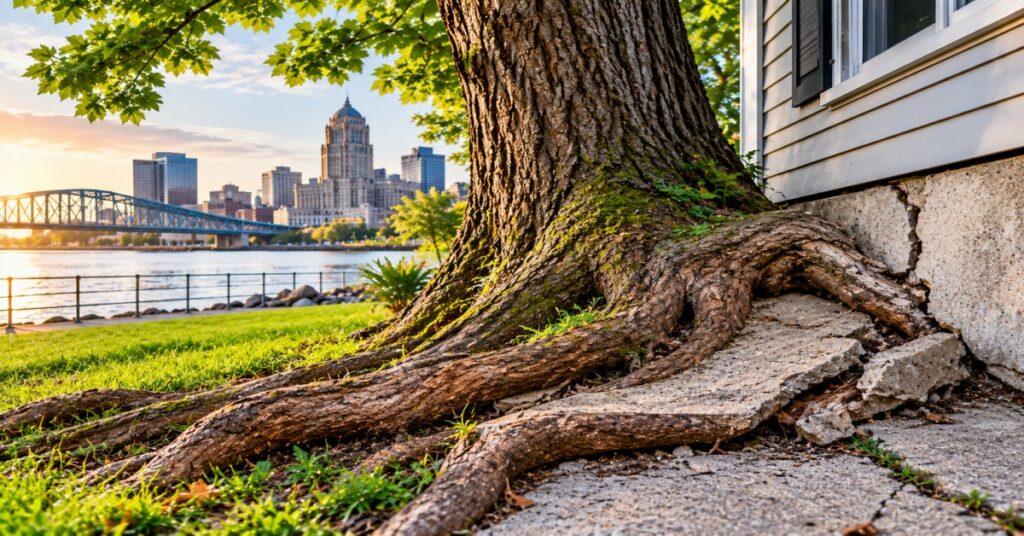
Spotting early tree root damage signs is essential to protect your home from sudden structural collapse. A mature tree adds beauty and shade to your yard, but its stability depends entirely on underground health. Most root systems remain hidden beneath the turf. Because of this, fungal decay and severed anchors often go unnoticed. Consequently, an unexpected storm can trigger catastrophic tree failure.
Western New York yards face severe weather conditions throughout the year. For example, heavy lake-effect snow and rapid freeze-thaw cycles stress tree root plates. Therefore, identifying these warning indicators early protects your home, driveway, and family. As a result, you can take action before a compromised tree falls.
- Ground Disruption: Lifting soil, mounding turf, or cracked ground on the side opposite a tree’s lean.
- Fungal Growth: Shelf mushrooms, conks, or brackets growing directly on the root flare.
- Canopy Stress: Sparse foliage, dead upper branches (stagheading), or premature leaf drop.
- Trunk Defects: Girdling roots choking the lower trunk collar or a sudden uncharacteristic lean.
Table of Contents
- 1. Why Root Plate Integrity Dictates Whole-Tree Stability
- 2. Primary Tree Root Damage Signs Homeowners Must Watch For
- 3. How Buffalo Soil and Weather Accelerate Root Decay
- 4. Can a Tree Recover from Significant Root System Trauma?
- 5. How Certified Arborists Assess Root Plate Integrity
- 6. Frequently Asked Questions
Why Root Plate Integrity Dictates Whole-Tree Stability
Many property owners believe roots grow deep into the earth. In contrast, over 90% of roots live in the top 18 to 24 inches of soil. Furthermore, these woody anchor roots spread wide. In fact, they frequently extend two to three times beyond the canopy drip line.
-
Zone 1Root Flare (Collar): Basal transition connecting the trunk to the subterranean root plate.
-
Zone 2Critical Root Zone: Houses major woody lateral and sinker roots for primary structural anchoring.
-
Zone 3Outer Drip Line: Microscopic feeder roots responsible for moisture uptake and canopy hydration.
Overall, root systems serve two vital mechanical and biological purposes:
- Mechanical Anchorage: Woody lateral roots lock into the soil matrix. Thus, they counterbalance heavy winds and canopy weight.
- Hydration and Nutrition: Microscopic feeder roots absorb soil moisture. In turn, they feed the upper branches through healthy sapwood.
When decay pathogens or construction sever anchor roots, holding capacity drops sharply. Therefore, homeowners must look for visible tree root damage signs across their property. In addition, for complete tree hazard management, explore our core guide to experienced tree care professionals in Buffalo, NY.
Primary Tree Root Damage Signs Homeowners Must Watch For
Root failures create noticeable physical symptoms. Specifically, these appear around the soil, on the trunk collar, and throughout the foliage.
1. Ground Heaving and Soil Cracking
First, look closely at the ground opposite a tree’s lean. If soil lifts or cracks, anchor roots are tearing loose. Consequently, this ranks among the most dangerous tree root damage signs. In fact, this condition creates an immediate tipping hazard that demands fast arborist intervention.
2. Fungal Conks and Mushrooms on the Root Flare
Next, inspect the base of the trunk for shelf mushrooms, conks, or brackets. For instance, species like Armillaria and Ganoderma signal active wood rot. Thus, they represent unmistakable tree root damage signs. Furthermore, their presence proves fungal mycelium is actively digesting internal woody tissue.
3. Stem Girdling Roots Choking the Collar
Additionally, watch for girdling roots that encircle the lower trunk rather than spreading outward. Over time, the expanding root acts like a tourniquet. As a result, it cuts off vascular flow and weakens the wood. Consequently, trees with girdling roots can snap cleanly at ground level in high winds.
4. Progressive Canopy Dieback and Stagheading
Similarly, compromised root structures cannot move sufficient water upward. Therefore, the highest and outermost branch tips die first. Sparse leaves, yellowing foliage, and dead branch tips serve as clear secondary tree root damage signs.
5. Construction Trenching and Compaction Damage
Finally, digging for utilities, driveways, or sidewalks inside the Critical Root Zone (CRZ) severs vital roots. In fact, cutting one large root can destroy up to 40% of root capacity. Furthermore, heavy equipment compacts soil and suffocates roots.
To identify other property hazards early, read our guide to dangerous tree inspection signs in Buffalo.
Suspect Your Tree Is Exhibiting Tree Root Damage Signs?
Never wait for the next severe storm to test root stability. Contact our certified arborists today to evaluate holding capacity and protect your property before high winds strike.
How Buffalo Soil and Weather Accelerate Root Decay
Properties in Buffalo, Amherst, Cheektowaga, and Clarence face difficult regional conditions. Unfortunately, these local factors accelerate subtle tree root damage signs:
- Dense Clay Soils: Heavy clay soils across Erie County drain very slowly. As a result, persistent standing water suffocates feeder roots. Thus, it creates ideal conditions for destructive root rot pathogens.
- Rapid Freeze-Thaw Shifts: Frequent temperature swings cause soil to expand and contract. Consequently, this movement tears micro-roots and destabilizes compromised root plates.
- Lake-Effect Snow and Wind: Saturated snow adds thousands of pounds of downward weight. Meanwhile, 50+ mph wind gusts blow off Lake Erie. For this reason, trees showing unaddressed tree root damage signs can fail without warning.
Can a Tree Recover from Significant Root Trauma?
A tree’s ability to recover depends on its species, age, soil quality, and total root loss.
| Damage Classification | Root Loss % | Structural Risk Level | Recommended Action Plan |
|---|---|---|---|
| Minor | Under 15% | Low | Deep root watering, soil aeration, organic mulching |
| Moderate | 15% – 30% | Moderate | Canopy pruning, root flare excavation, growth regulators |
| Severe | 30% – 50% | High | Cabling assessment, continuous load monitoring |
| Critical | Over 50% | Extreme Hazard | Immediate emergency tree removal for safety |
According to standards from the International Society of Arboriculture (ISA), severe root loss permanently impairs structural stability. Specifically, trees losing over 40% of their root system rarely recover safe anchoring strength. Therefore, when advanced tree root damage signs threaten safety, removal is often the safest path forward.
How Certified Arborists Assess Root Plate Integrity
Most root systems remain subterranean. Because of this, certified arborists use specialized tools to evaluate structural integrity:
- Air-Spade Excavation: First, supersonic compressed air clears soil safely. Thus, arborists inspect hidden girdling roots and basal decay without damaging sensitive bark.
- Resistograph Testing: Next, micro-drill tools measure internal mechanical resistance. Hence, arborists detect hidden hollows and soft rot within the root collar.
- Soil Compaction Profiling: Finally, soil penetrometers test ground density. As a result, arborists locate compacted zones that prevent healthy root growth.
When diagnostic testing shows anchor roots cannot support canopy weight, prompt action is required. Homeowners should arrange professional tree removal in Buffalo, NY before winter storms arrive.
Frequently Asked Questions
Can severed tree roots heal themselves?
No. Trees do not heal damaged tissue like humans. Instead, they wall off decay through the CODIT (Compartmentalization of Decay in Trees) process. While a tree may grow new fine feeder roots in loose, decompressed soil, severed woody structural roots will never reconnect or regain their original anchoring strength.
What is the Critical Root Zone (CRZ)?
The Critical Root Zone is the minimum soil area surrounding the trunk required to keep the tree alive and mechanically stable. You can calculate the CRZ radius by measuring 1 to 1.5 feet outward for every 1 inch of trunk diameter at breast height (DBH). Digging or trenching inside this perimeter causes severe root loss.
How do I know if visible tree root damage signs mean my tree will fall?
A sudden, uncharacteristic lean accompanied by lifting soil, ground cracks, or fungal conks encircling the root flare indicates an active failure. When heavy wind or snow loads hit, a tree with these severe tree root damage signs is at imminent risk of uprooting and demands an immediate emergency inspection.
Can you save a tree after construction machinery damaged its roots?
It depends on how close the damage occurred to the trunk and the percentage of roots lost. If less than 25% to 30% of the root zone was disturbed, techniques like vertical mulching, radial trench aeration, deep watering, and growth regulators can stabilize the tree. However, if major buttress anchor roots were cut, removal is often the only safe option.
Does homeowners insurance cover damage caused by decayed tree roots?
Insurance policies generally cover sudden and accidental damage to your home if a storm topples a tree. However, if the tree had obvious, longstanding tree root damage signs or fungal decay that was neglected, insurers may cite a lack of maintenance and contest the claim. Regular arborist hazard assessments protect both your property and your liability.
Protect Your Home with a Professional Tree Inspection
Underground root rot and physical severance will not resolve on their own. If you have spotted visible tree root damage signs around your yard, don’t wait for the next storm to test your tree’s stability. Schedule a comprehensive on-site hazard evaluation with Western New York’s trusted arborists today.
Treeman serves Buffalo, Amherst, Williamsville, Clarence, Cheektowaga, Getzville, East Amherst, and surrounding Western New York communities. Fully licensed and insured for complete residential and commercial tree safety.