
Western New York landscapes present tough underground challenges for trees. Standard suburban lawn care routines fail to resolve these issues. Consequently, mature shade trees across Erie County face constant environmental stress. Towns like Amherst, Clarence, and Getzville feature dense clay soils. In addition, road de-icing salts and summer droughts weaken root systems. When homeowners notice thinning canopies or pale leaves, fast action is needed. Therefore, scheduling deep root fertilization buffalo ny delivers vital subsurface care to reverse decline.
Surface-applied fertilizers rarely reach tree roots. Instead, thick turf grass quickly consumes the nutrients first. As a result, mature shade trees remain starved of essential minerals. However, targeted deep root fertilization buffalo ny solves this problem. It injects liquid nutrients and beneficial mycorrhizae deep underground. Specifically, this care reaches the active root zone directly. This homeowner guide explains why pressurized soil feeding protects your canopy. Furthermore, it outlines how to schedule treatments effectively throughout the year.
📋 Table of Contents: Deep Root Feeding Guide
The Western NY Heavy Clay Soil Problem
Beneath Buffalo lawns lies dense glacial clay. This heavy soil contains flat, tightly packed mineral particles. Lawn mowers and foot traffic compress these particles further. Consequently, macroscopic pore space disappears. As a result, root systems suffer from chronic oxygen starvation. Roots cannot breathe or absorb moisture efficiently. For this reason, professional deep root fertilization buffalo ny is critical. The pressurized injection fractures this dense clay layer effectively.
In addition, Erie County subsoils exhibit high alkalinity. Local soil pH frequently rises above 7.2. Under these alkaline conditions, essential minerals become chemically locked. Therefore, trees cannot access iron or manganese. Pin oaks and red maples develop severe chlorosis as a result. Leaves turn pale yellow while the veins stay dark green. Fortunately, certified arborists use deep root fertilization buffalo ny to solve this. They inject chelated iron directly into the root zone.
Moreover, winter snow clearing washes road salt into soils. Sodium ions displace helpful calcium and magnesium. Consequently, roots suffer severe osmotic drought stress. Trees struggle to take up hydration during spring bud break. Thus, regular deep root fertilization buffalo ny restores essential balance. It flushes excess sodium and rebuilds beneficial soil microbial networks.
Furthermore, because subsurface soil compaction and shifting clay frequently force root systems toward the surface, property owners must also monitor nearby hardscapes. Learning to recognize common tree root damage signs around sidewalks, driveways, and foundations ensures you catch root-plate instability before subsoil stress compromises overall tree vitality.
How Subsurface Pressure Injection Works
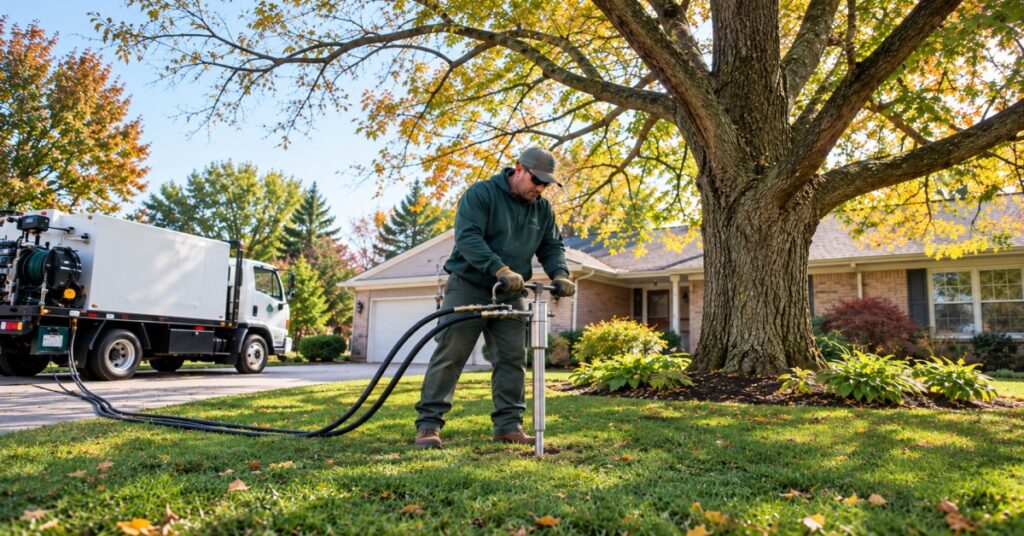
Professional soil feeding is a specialized mechanical service. It is completely different from broadcast lawn spreading. First, technicians insert a hydraulic probe into the turf. The probe penetrates 6 to 8 inches deep. Notably, over 85% of active tree roots live in this zone.
Next, the arborist injects liquid fertilizer under controlled pressure. Specifically, equipment operates at 150 to 200 PSI. This hydraulic pulse produces three clear physiological advantages:
- Physical Soil Decompaction: The pressurized liquid fractures dense clay. Consequently, it creates vital oxygen channels without harming turf.
- Precision Nutrient Placement: Technicians deliver slow-release nutrients into root zones. Therefore, roots absorb food efficiently without chemical burning.
- Mycorrhizal Inoculation: Injections introduce beneficial fungal spores. Thus, root surface area expands up to 300% for better moisture uptake.
Clearly, this direct method avoids competing grass roots entirely. In this way, deep root fertilization buffalo ny ensures maximum nutrient absorption for your shade trees.
🌱 Are Your Trees Showing Signs of Yellowing or Thin Canopies?
Treeman NY provides specialized subsurface soil aeration and deep root nutrient injections across Buffalo, Amherst, Clarence, and Getzville. Let our certified arborist team restore your trees’ biological vigor.
Distress Signs & The Ideal Seasonal Application Window
Homeowners must watch for subtle visual signs of stress. For example, the International Society of Arboriculture mature tree care standards emphasize regular crown evaluations. Canopy decline reveals underground root fatigue. Therefore, schedule deep root fertilization buffalo ny if you notice these warning signs:
- Stag-Heading in the Canopy: Dead branch tips emerge in the upper crown.
- Early Autumn Foliage: Leaves turn orange or brown prematurely in August.
- Yellowing Foliage: Pale leaves display dark green veins from nutrient deficiencies.
- Stunted Twig Growth: New spring shoots extend less than two inches.
- Recent Ground Disturbance: Nearby patio, sidewalk, or driveway construction compressed the soil.
Furthermore, timing matters when treating root systems. There are two primary application windows for deep root fertilization buffalo ny:
1. Early Spring Window (April to May): First, early spring injections provide energy reserves before bud break. As a result, trees produce lush foliage and resist summer insects.
2. Late Autumn Window (October to November): Next, autumn injections take place after leaves drop. Trees store these vital nutrients in root cells before winter freezes arrive.
Surface Lawn Spreading vs. Professional Deep Root Injection
Many homeowners believe standard lawn fertilizer feeds trees. However, research from the Cornell University Plant Disease Diagnostic Clinic reveals a major drawback. Dense turf grass absorbs nearly all surface-applied nutrients. Consequently, very little food penetrates down to tree roots. The table below details these critical performance differences:
| Feature | Surface Granular Application | Deep Root Liquid Injection |
|---|---|---|
| Delivery Depth | 0 to 1 inch (Trapped in turf & thatch). | 6 to 8 inches (Directly in root zone). |
| Soil Compaction Relief | Zero aeration; mower traffic worsens compaction. | Hydraulic fractures introduce oxygen into clay. |
| Nutrient Efficiency | Low; risk of chemical runoff into storm drains. | High; 100% contained within tree root radius. |
| Micronutrient Delivery | Rarely contains mycorrhizae or chelated iron. | Custom blended with humates and mycorrhizae. |
Ultimately, choosing deep root fertilization buffalo ny delivers proven value. Your investment directly benefits your valuable trees rather than excess lawn growth.
Integrating Soil Care with Whole-Tree Health
Root zone feeding is one part of tree care. In addition, canopies require regular diagnostic reviews. Property owners should consult our pillar guide on tree health buffalo ny. This resource explains how soil care pairs with pest management and pruning.
Moreover, severe soil compaction often forces roots upward. Consequently, roots can damage nearby concrete footings. Homeowners should inspect sidewalks for early root heave before fertilizing. Early detection prevents foundation hazards while preserving tree anchors.
However, fertilization cannot save structurally failed trees. Extensive heartwood rot or severed root plates create safety hazards. In those severe cases, scheduling professional removal is necessary. This prevents hazardous tree falls during winter storms.
Nevertheless, for most struggling landscape trees, deep root fertilization buffalo ny is highly effective. It restores biological strength and extends tree life for decades.
Frequently Asked Questions About Deep Root Feeding
How often should deep root fertilization be performed in Buffalo?
Most mature trees thrive on an annual application. However, trees suffering from compacted clay or chlorosis benefit from bi-annual treatments.
Will deep root fertilization damage my lawn or grass?
No. The probe leaves tiny half-inch holes that close quickly. Furthermore, subsurface injections prevent surface lawn fertilizer burn completely.
How soon will I see visible results in my tree’s canopy?
Root development begins immediately below ground. Consequently, visible canopy improvements appear during the next spring vegetative flush.
Can root fertilization revive a completely dead tree?
No. Trees require living vascular cambium to transport minerals. Therefore, dead trees cannot recover and require safe, professional tree removal Buffalo NY to eliminate property hazards.
Schedule Your Deep Root Soil Injections in Buffalo NY
Do not let compacted clay starve your mature shade trees. Treeman NY brings specialized injection equipment and organic mycorrhizae to your yard. We proudly serve Getzville, Amherst, Clarence, Tonawanda, and the greater Buffalo area. Contact our arborist dispatch team to schedule your seasonal deep root fertilization buffalo ny assessment today.
Treeman NY: 2791 N Forest Rd, Getzville, NY 14068. Fully licensed and insured for plant health care and tree preservation across Western New York.