
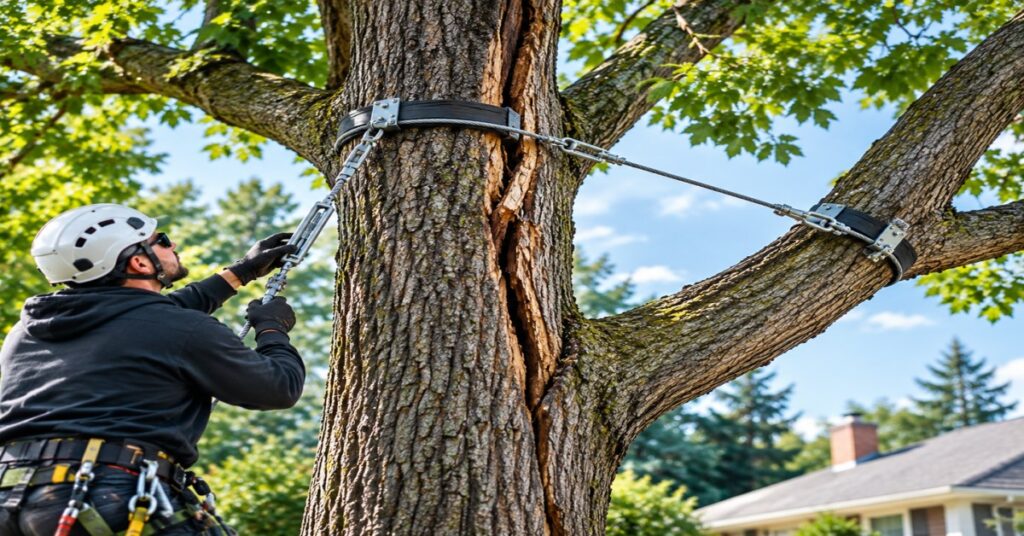
Investing in certified tree cabling and bracing in Buffalo NY is the premier preservation method for saving structurally compromised trees. Western New York weather places extreme mechanical strain on large hardwoods. Heavy lake-effect slush, wet snowfalls, and severe wind shear regularly target weak branch unions. Instead of removing an irreplaceable landmark tree, certified arborists install specialized supplemental support systems. These systems stabilize the canopy and significantly lower failure risks.
During late-autumn assessments, property owners often pair structural stabilization with scheduled dormant pruning in Buffalo NY. Removing interior deadweight while reinforcing fragile crotches ensures the canopy moves harmoniously in heavy gusts. At Treeman NY, we evaluate mature trees throughout Buffalo, Amherst, Williamsville, Clarence, and Getzville. We provide custom tree cabling and bracing in Buffalo NY engineered to protect valuable landscape assets safely.
📋 Tree Cabling and Bracing in Buffalo NY: Fast Facts
- Tree Preservation Over Removal: High-strength support systems save mature, historical trees that would otherwise require costly removal.
- Dynamic vs. Static Systems: Synthetic dynamic lines allow natural trunk sway, whereas rigid steel cables secure actively split unions.
- Critical Crotch Stabilization: Tight V-crotches with included bark are prime candidates for supplemental arborist hardware.
- Ongoing Inspection Required: Certified arborists must re-inspect cabling systems periodically to accommodate active tree growth.
Why Buffalo Homeowners Choose Tree Cabling and Bracing in Buffalo NY
Historic neighborhoods across Western New York boast magnificent red oaks, sugar maples, and weeping willows. However, these older giants frequently develop competing leaders known as codominant stems. As these heavy trunks expand, their bark presses together inside the union. Consequently, high-wind storms can easily pry the stems apart.
Professional tree cabling and bracing in Buffalo NY bridges this structural gap. Our arborists connect heavy limbs with flexible or rigid cables high in the canopy. This setup redistributes mechanical strain across multiple stems. Thus, when powerful gales strike Erie County, interconnected branches support one another instead of splitting outward.
- How Tree Cabling and Bracing Works: Mechanics & Hardware
- Signs Your Tree Needs Tree Cabling and Bracing in Buffalo NY
- Preventing Catastrophic Winter Storm Splitting in Buffalo NY
- Cabling vs. Complete Removal: Evaluating Safety & Long-Term Costs
- Frequently Asked Questions About Tree Cabling in Buffalo NY
- Book Your Structural Tree Assessment with Treeman NY
Notice a visible crack in your tree crotch or leaning codominant trunks? Don’t wait for heavy snow loads to split the tree in half. Schedule an assessment for tree cabling and bracing in Buffalo NY to secure your canopy today.
Call Treeman NY: (716) 466-5990How Tree Cabling and Bracing Works: Mechanics & Hardware
Arboricultural support systems rely on distinct structural engineering techniques. While people often group the terms together, cabling and bracing perform complementary roles. Certified arborists determine the proper combination based on branch diameter, defect severity, and species flexibility when designing a plan for tree cabling and bracing in Buffalo NY.
Cabling systems utilize high-strength steel or synthetic lines installed in the upper two-thirds of the canopy. In contrast, bracing rods use heavy threaded steel bolts drilled directly through lower trunk unions. These rods pin split wood together securely. Our crews adhere strictly to ISA ANSI A300 structural support standards. This practice ensures tension lines allow the tree to adapt without strangling the vascular cambium.
Moreover, dynamic cabling lines allow natural sway during light breezes. This gentle movement encourages the tree to produce reaction wood over time. In turn, reaction wood reinforces the structural base. When intense gales hit, the cables reach maximum extension. They absorb the shock load and prevent sudden trunk detachment.
Signs Your Tree Needs Tree Cabling and Bracing in Buffalo NY
Identifying structural flaws early saves trees before irreversible breaks occur. Homeowners in Amherst, Clarence, and Buffalo should watch for key warning signs. These five telltale symptoms indicate a need for professional tree cabling and bracing in Buffalo NY:
- Codominant Stems with Deep V-Crotches: Two or more main trunks growing closely together in a sharp “V” shape lack connective wood fibers. This defect makes them prone to peeling apart under wind load.
- Visible Included Bark Formations: Bark can curl inward between joining trunks instead of pushing outward. This pattern creates a wedge that weakens the entire structural joint.
- Fresh Seam Cracks or Sap Bleeding: A visible vertical fissure extending downward from a branch union signals an active structural tear. This issue requires immediate stabilization.
- Heavy Asymmetrical Limbs Over Structures: Huge horizontal scaffold branches over roofs, garages, or driveways create intense rotational leverage during storms.
- Previous Storm Damage Tears: If one half of a multi-stem tree failed in a past storm, the remaining upright stems often require supplemental support.
For a detailed breakdown of hazard symptoms, consult our companion homeowner guide on dangerous tree inspection signs before severe weather rolls in.
Preventing Catastrophic Winter Storm Splitting in Buffalo NY
Erie County’s lake-effect weather cycle presents extreme structural hazards for vulnerable canopies. Early winter storms frequently dump wet, adhesive snow onto canopies that haven’t fully shed their leaves. Consequently, thousands of extra pounds gather on broad lateral branches within hours.
Installing proactive tree cabling and bracing in Buffalo NY provides vital reinforcement against these winter loads. The support network tethers weaker leaders to sturdier central trunks. This arrangement spreads the deadweight across multiple root anchors. Thus, you drastically reduce the risk of structural limb collapse.
In fact, properties that invest in preventive support systems suffer significantly less winter tree damage in Buffalo NY during major blizzards. Rather than paying for emergency crane extractions after a tree lands on your home, cabling stabilizes the tree safely through the winter season.
Cabling vs. Complete Removal: Evaluating Safety & Long-Term Costs
Homeowners often assume that a cracked or leaning tree must be cut down immediately. However, whole tree removal is permanent and significantly more expensive than strategic preservation. Deciding between structural cabling and removal comes down to root plate stability, trunk soundness, and target hazards.
If the root plate is lifting or the main trunk is hollowed by fungal decay, removal is generally unavoidable. But if the trunk base is healthy, structural support is the ideal, budget-friendly choice. This approach works exceptionally well when problems stem from poor crown architecture or codominant stems. Review our detailed resource on tree removal vs tree trimming to evaluate your options.
Ultimately, opting for certified tree cabling and bracing in Buffalo NY protects your home’s curb appeal. It provides crucial cooling shade and preserves mature landscape equity at a fraction of the cost of full tree removal.
Frequently Asked Questions About Tree Cabling and Bracing in Buffalo NY
Does installing hardware into a tree trunk hurt it?
No. Certified arborists use surgical installation practices following ANSI A300 standards. Trees compartmentalize small, clean bolt holes rapidly through CODIT. This response prevents decay from entering the wood, as documented in Cornell Cooperative Extension woody plant research.
How long does a tree cabling and bracing system last?
Steel cable systems typically last 20 to 25 years or more. In contrast, synthetic dynamic systems generally have a functional lifespan of 7 to 10 years. However, our team recommends a visual arborist inspection every 2 to 3 years. This check ensures cables maintain proper tension as branches grow thicker.
Can cabling save a tree that has already split down the center?
Yes, provided the split is fresh and caught early. Arborists use heavy-duty winches to pull split halves together. Next, they install threaded bracing rods across the crack to pin the wood. Finally, they place overhead cables in the canopy to relieve pressure.
Is tree cabling and bracing visible from the ground?
Barely. Professional support cables sit high in the upper two-thirds of the canopy. Once installed, the hardware blends with the natural branch scaffold. This placement makes it virtually unnoticeable to passersby from the street or lawn.
Protect Your Landscape with Tree Cabling and Bracing in Buffalo NY
Don’t wait for the next winter gale to split your prized shade tree. Protect your property, restore canopy balance, and extend the lifespan of mature hardwoods with certified tree cabling and bracing in Buffalo NY from Treeman NY. Our fully insured arborists utilize ANSI A300-rated hardware to safeguard homes across Buffalo, Amherst, Williamsville, Clarence, and Getzville.
Treeman NY provides professional tree preservation, cabling, bracing, pruning, and emergency tree removal across Buffalo, Amherst, Williamsville, Clarence, Getzville, and Western New York. Fully insured, certified arborists equipped to protect your valuable trees.