
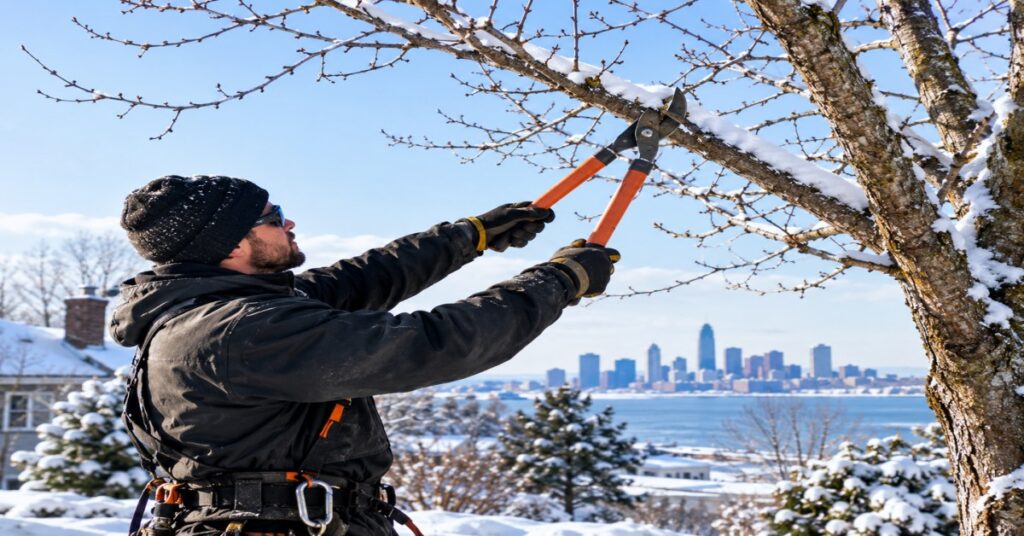
Executing professional dormant pruning in Buffalo NY is the single most effective way to shield your yard against intense lake-effect freezes and gale-force winter winds. Without proper canopy preparation, heavy snow loads frequently result in severe winter tree damage in Buffalo NY that puts homes, garages, and power drops at serious risk.
At Treeman NY, our ISA-guided team works across North Buffalo, Amherst, Williamsville, Clarence, and Getzville to reinforce regional trees before deep freezes settle in. Understanding the proven benefits of dormant pruning in Buffalo NY ensures your hardwoods, fruit trees, and ornamentals remain structurally resilient all winter and burst with vigorous growth come spring.
📋 Dormant Pruning in Buffalo NY: Fast Facts at a Glance
- Reduced Tree Stress: Professional dormant pruning in Buffalo NY halts sap loss completely. In addition, it preserves vital carbohydrate stores inside the root zone.
- Strict Oak Wilt Defense: Winter is the only legal, safe pruning window for local oak species. Therefore, it keeps fresh wounds clear of beetle-borne fungal spores.
- Unmatched Canopy Visibility: Bare branches let arborists inspect tight crotches and decay pockets easily. Thus, hidden structural cracks become simple to diagnose.
- Lake-Effect Storm Protection: Thinning dense interior branches lowers wind resistance substantially. Consequently, heavy snow cannot easily accumulate on limbs.
- Why Winter Is the Safest Time for Dormant Pruning in Buffalo NY
- Key Western New York Tree Species That Mandate Winter Pruning
- How Dormant Pruning Protects Canopies from Severe Lake Storms
- Common Winter Tree Trimming Mistakes Buffalo Homeowners Must Avoid
- Frequently Asked Questions About Dormant Pruning in Buffalo NY
- Protect Your Landscape with Treeman NY’s Certified Winter Tree Care
Don’t leave your roofline and mature hardwood canopies vulnerable to sudden Erie County ice storms. Take advantage of bare-branch visibility this winter by scheduling expert dormant pruning in Buffalo NY to reinforce tree health before spring sap begins to rise.
Call Treeman NY: (716) 466-5990Why Winter Is the Safest Time for Dormant Pruning in Buffalo NY
When deciduous trees shed their leaves, their metabolic energy drops to baseline levels. Throughout late autumn, root systems draw carbohydrates and moisture downward from the crown. Then, they store these reserves deep below the ground frost line. Therefore, scheduling dormant pruning in Buffalo NY prevents damaging sap bleeding. In addition, it protects the vital energy trees require to push out healthy leaves next spring.
Equally important, cold-weather pruning eliminates the threat of insect-borne infections. Warm-season pruning cuts emit aromatic chemical compounds that attract sap beetles and bark borers almost immediately. In contrast, Western New York’s sub-freezing winter weather keeps these pests completely dormant. Hence, making cuts during winter complies with strict NYS DEC oak wilt quarantine protocols. Consequently, your trees seal their wounds cleanly without pathogen interference.
Bare winter canopies also provide unmatched structural clarity for arborists. Thick summer foliage often hides dangerous crossing limbs, tight V-crotches, and trunk cracks. However, regular dormant pruning in Buffalo NY strips away this visual clutter completely. Because the full branch scaffold is visible, our arborists can make balanced cuts that reinforce long-term stability.
Key Western New York Tree Species That Mandate Winter Pruning
Most local shade trees benefit from cold-weather care. However, certain regional varieties require winter attention to prevent disease outbreaks and limb failure. Prioritizing these target species for dormant pruning in Buffalo NY keeps your yard safe and healthy:
- Red, Pin, and White Oaks: Oaks should never be pruned between April and October in Western New York. Cutting oaks during warm months invites beetles that spread oak wilt in Buffalo NY. Therefore, relying on professional dormant pruning in Buffalo NY is the only safe, state-recommended option for mature oak trees.
- Silver, Sugar, and Red Maples: Maples produce large volumes of vascular sap. Pruning them in early spring causes excessive bleeding, which stresses the tree. Fortunately, winter trimming allows cuts to begin compartmentalizing well before late-winter sap surges occur.
- Domestic Fruit Trees (Apples, Pears, Cherries): Backyard orchards in Clarence, Amherst, and Lockport require thorough pruning every winter. Trimming fruit trees while dormant stimulates fruit spurs, improves sun exposure, and curbs fire blight infections effectively.
- Crabapples, Hawthorns, and Dogwoods: These ornamental varieties are prone to cedar-apple rust and powdery mildew. However, selective winter canopy thinning improves airflow through the crown. As a result, fungal spores struggle to establish themselves in spring.
How Dormant Pruning Protects Canopies from Severe Lake Storms
Buffalo sits directly downwind of Lake Erie. Because of this location, our neighborhoods face moisture-heavy blizzards and fierce seasonal winds. Overgrown canopies packed with deadwood act like huge sails during winter gales. When 50 mph wind gusts strike Erie County, this extra resistance twists branches and splits mature tree crotches easily.
Carrying out scheduled dormant pruning in Buffalo NY lowers storm risk through precise crown thinning. By removing redundant lateral limbs, arborists create open paths for wind to pass through the crown. Consequently, rotational strain on primary scaffold limbs drops significantly. Furthermore, thinning eliminates horizontal shelves where heavy, wet snow settles. Therefore, limbs stay intact when severe ice storms arrive.
Winter pruning visits also serve as thorough hazard inspections. Before severe snowstorms arrive, check out our guide on dangerous tree inspection signs. This guide helps you identify trunk decay, weak unions, and shifting root plates that require dynamic cabling or immediate removal.
Common Winter Tree Trimming Mistakes Buffalo Homeowners Must Avoid
Winter provides optimal conditions for tree maintenance. Even so, improper pruning cuts can permanently injure valuable shade trees. Amateur cuts made during freezing spells often fail to heal correctly, leading to heartwood decay. When scheduling dormant pruning in Buffalo NY, be sure to avoid these four common pitfalls:
- Cutting Flush to the Trunk: Slicing limbs flush against the trunk removes the branch collar entirely. This area contains specialized cells necessary for compartmentalizing decay. Therefore, always make cuts just outside the branch bark ridge.
- Leaving Long Branch Stubs: Leaving long branch stubs prevents wound wood from closing over the cut surface. Eventually, these stubs rot backward into the main trunk. This defect gives wood-boring insects and fungi direct access to the tree’s interior.
- Canopy Topping and Shearing: Cutting off central leaders ruins the natural architecture of the tree. Moreover, it triggers a flush of weakly attached sprouts that break easily under heavy snow. Review our guide on how often trees should be trimmed around a home to maintain proper canopy health safely.
- Pruning During Severe Sub-Zero Spells: Avoid heavy cutting when temperatures drop below 0°F (-18°C). Extreme cold makes frozen wood fibers brittle, causing cuts to fracture. For this reason, certified arborist crews performing dormant pruning in Buffalo NY choose mild winter days to ensure clean cuts.
Frequently Asked Questions About Dormant Pruning in Buffalo NY
Does pruning trees in freezing temperatures cause internal damage?
No. Trees are physiologically resting in winter, meaning active water movement and cell division are suspended. Clean cuts made outside the branch collar will not injure the tree. Backed by Cornell Cooperative Extension arboriculture research, wounds created during winter dormancy begin sealing naturally as soon as temperatures warm up in early spring.
Which local tree species must never be pruned in spring or summer?
All oak species—including red, pin, black, and white oaks—must receive strictly timed dormant pruning in Buffalo NY to prevent sap beetles from spreading destructive oak wilt spores. Elm trees also need cold-weather trimming to protect against bark beetles that transmit Dutch elm disease.
When is the best time to prune backyard fruit trees in Buffalo?
Late winter (from mid-February through late March) is the ideal window for pruning fruit trees such as apples, pears, and plums. Trimming just before spring bud swell stimulates vigorous fruiting wood, increases light penetration, and clears away overwintering insect larvae.
How does winter pruning help prevent power line outages?
Conducting proactive dormant pruning in Buffalo NY eliminates overhanging, structurally unsound, and dead branches positioned above utility service lines, removing the heavy deadweight that leads to outages during lake-effect storms.
Protect Your Landscape with Expert Dormant Pruning in Buffalo NY
Don’t wait for the next severe lake-effect storm to uncover hidden branch weaknesses. Protect your landscape and reinforce tree health this winter with professional dormant pruning in Buffalo NY from Treeman NY. Our fully insured, certified arborists use advanced rigging gear and precise ANSI A300 pruning methods to protect homes and yards across Buffalo, Amherst, Williamsville, Clarence, and Getzville.
Treeman NY provides complete tree care and emergency storm response throughout Buffalo, Amherst, Williamsville, Clarence, Getzville, and Western New York. Fully insured, certified, and equipped with cranes and bucket trucks to keep your property safe in any weather.