
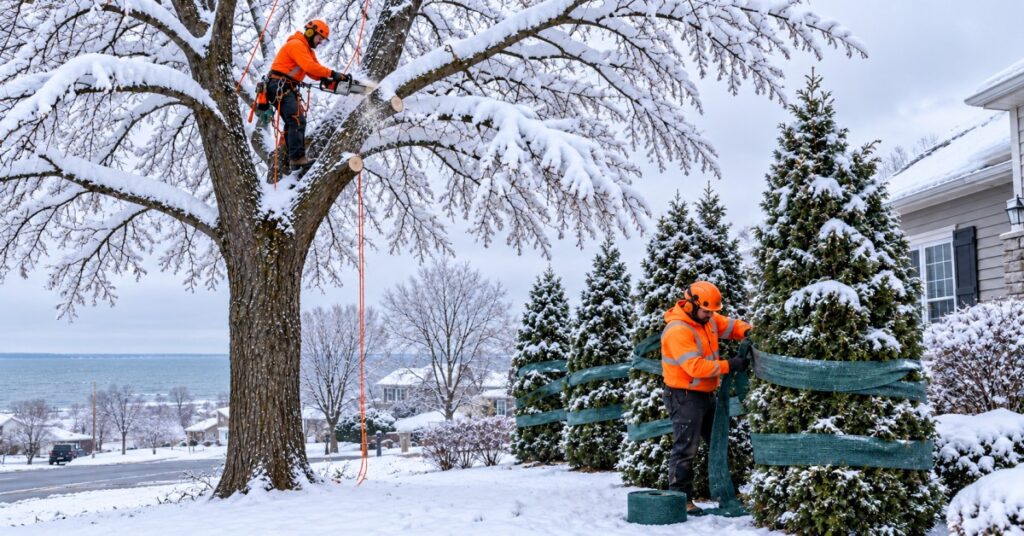
When lake-effect snow squalls sweep off Lake Erie, residential properties across Western New York experience some of the heaviest winter precipitation in North America. For homeowners across Erie County, knowing how to protect trees from ice damage buffalo ny before winter freezes set in is essential to prevent crushed vehicles, pierced rooflines, and downed power drops. Wet “concrete” snow and freezing rain encase mature tree crowns in thousands of pounds of added deadweight, turning healthy shade trees into high-risk structural liabilities.
Preventing winter tree collapse is not a matter of reacting after branches snap; it requires understanding branch leverage mechanics, dormant weight-reduction pruning, and proper evergreen protection. Follow our field-tested arborist guide to protect trees from ice damage buffalo ny and keep your landscape resilient this winter.
🎧 Listen to Our Podcast: Protecting Trees from Heavy Snow and Ice in Buffalo, NY
Want to learn how to protect your trees during Buffalo’s harsh winter weather? Listen to our latest Treeman podcast episode!
Discover how heavy snow and freezing rain affect tree branches, why professional winter weight-reduction pruning matters, and how to protect arborvitae and evergreen trees from snow damage.
Get practical tree-care tips from Treeman to help protect your landscape and property before the next winter storm.
Press play below to listen to the full episode!
Prefer reading? Continue below for our complete guide to protecting trees from Buffalo’s heavy snow and ice storms.
📋 Table of Contents
The Physics of Heavy Snow and Radial Ice Loading
Winter storms in Buffalo produce unique mechanical stress on urban trees. In late autumn and mid-winter, moisture-laden air passing over warmer lake waters dumps dense, saturated lake-effect snow. When temperatures hover between 30°F and 32°F, freezing drizzle creates radial ice accretion around twigs and branches. To effectively protect trees from ice damage buffalo ny, homeowners must understand how small increases in ice thickness multiply branch strain exponentially.
A mere 1/4-inch coating of radial ice adds roughly 30 times the branch’s normal weight. When that glaze reaches 1/2 inch to 1 inch, a mature silver maple or pin oak canopy can support over 10 tons of extra static deadweight. As detailed in our parent guide to winter tree damage Buffalo NY, sub-freezing temperatures cause tree cell walls to contract, making wood fibers brittle and unable to handle downward torque.
When combined with lake gales, heavily weighted limbs snap with little warning. While property owners can also learn how to prevent tree wind damage in Buffalo NY, preventing ice overload requires managing static branch load before precipitation begins. Proactive planning helps you reliably protect trees from ice damage buffalo ny throughout severe freezing cycles.
Investing in pre-season inspections ensures that you effectively protect trees from ice damage buffalo ny before the first polar vortex reaches Western New York.
Safe Snow Clearing vs. Dangerous DIY Mistakes
During heavy snowfall, many well-meaning homeowners rush outside with brooms, shovels, or rakes to clear sagging branches. Unfortunately, improper clearing methods often cause more damage than the snow itself. Understanding safe handling techniques is crucial to protect trees from ice damage buffalo ny without breaking living tissue.
Never shake or violently whack frozen branches. When wood fibers are cold, sudden movement causes internal shear stress, snapping limbs at the collar. Furthermore, when snow is knocked off too quickly, the elastic rebound can shatter the branch or whip adjoining iced limbs together. Taking the right safety precautions allows you to carefully protect trees from ice damage buffalo ny without creating secondary fractures.
According to the mature tree care guidelines maintained by the International Society of Arboriculture pruning guidelines, any intervention on stressed trees must respect internal wood vascular integrity.
If you can safely reach low branches from the ground, gently sweep accumulating powder upward using a soft-bristled push broom. If branches are encased in solid ice, leave them untouched until temperatures rise naturally. Attempting to chip ice off bark destroys buds and strips cambium layers needed for spring foliage.
❄️ Ice-Laden Limbs Bending Toward Your Home?
Treeman provides professional weight-reduction pruning, multi-stem evergreen tying, and emergency hazard mitigation across Buffalo, Getzville, Amherst, and Clarence. Protect your structures before the next ice storm.
Structural Weight-Reduction Pruning for Hardwoods
The most permanent way to protect trees from ice damage buffalo ny is pre-winter structural pruning. Deciduous trees with wide, spreading crowns—such as silver maples, green ashes, and honey locusts—naturally hold excessive horizontal snow weight on over-extended branches.
| Tree Species Group | Vulnerability to Ice & Snow | Recommended Protection Method |
|---|---|---|
| Silver Maple / Boxelder | Brittle wood structure with narrow V-crotches prone to sudden splitting under ice. | End-weight reduction pruning and dynamic synthetic cabling. |
| Arborvitae / Eastern Cedar | Multi-stem columnar habits splay outward and collapse permanently under heavy snow. | Pre-season spiral tying with broad woven arbor-tie webbing. |
| White Pine / Hemlock | Dense evergreen needles hold snow loads, shearing horizontal branch attachments. | Selective crown clearance pruning away from rooflines. |
| Oaks / Hickories | Strong hardwood fibers, but old deadwood over 2 inches snaps easily when frozen. | Dormant deadwooding and clearance trimming. |
Certified arborists apply reduction cuts back to healthy lateral branches, significantly shortening the lever arm. By decreasing the limb’s overall reach, you reduce the physical leverage exerted at the trunk attachment during freezing rain.
However, when structural defects like internal hollows or deep trunk splits exist, pruning may not guarantee safety. In these severe scenarios, professional tree removal Buffalo NY before winter storms prevents structural damage to homes and garages.
Applying dormant structural cuts remains one of the safest strategies to protect trees from ice damage buffalo ny across residential properties.
Professional canopy balancing works in tandem with cabling systems to sustainably protect trees from ice damage buffalo ny through long-term load control.
Protecting Multi-Stem Evergreens, Arborvitae, and Shrubs
Columnar evergreens like emerald green arborvitae, pyramidal yews, and upright junipers are prized across Western New York subdivisions for privacy screens. Unfortunately, their upright multi-stem structure acts as a natural snow trap. Once wet snow lodges between vertical leaders, the stems splay outward in all directions. If ice freezes inside the open canopy, the branches may never return to an upright position.
To safely protect trees from ice damage buffalo ny on multi-stem ornamentals:
- Use Flexible Woven Webbing: Secure the base of the stems and spiral upward to the top leader using broad, breathable polypropylene arbor-tie webbing. Avoid narrow wires or twine, which cut into bark under tension.
- Install Wooden A-Frame Shelters: For prized specimen shrubs beneath roof drip lines, erect sturdy wooden A-frames. These deflect heavy snow avalanches sliding off metal roofs.
- Construct Burlap Wind and Ice Screens: Wrap exterior windward exposures in breathable burlap secured to wooden stakes to keep glaze from sticking directly to needles.
Taking an afternoon in late autumn to tie up evergreens will effectively protect trees from ice damage buffalo ny, preserving privacy screens for years to come. When planning your full winter defense strategy, pair these techniques with measures to prevent tree wind damage in Buffalo NY to secure both dense conifers and sprawling hardwood canopies against Lake Erie storms.
Equipping fragile shrubs with proper mechanical barriers ensures that homeowners reliably protect trees from ice damage buffalo ny throughout seasonal blizzards.
Post-Ice Storm Property Inspection Checklist
Once a storm passes and ice begins to thaw, a structured yard evaluation helps identify hidden hazards before branches fall. Follow this practical checklist:
- Scan Overhead for “Widowmakers”: Look for broken limbs lodged high in the crown. These hung-up branches often break loose days later as ice melts.
- Examine Main Crotch Unions: Check for fresh bark tears or hairline fractures where major co-dominant stems meet.
- Identify Downed Utility Conflicts: If a limb touches an electrical service feed, maintain a minimum 30-foot perimeter and notify your utility provider immediately.
- Address Critical Structural Failures: If severe ice loading causes a tree to split in half or topple across a structure, consult our protocol for tree removal after ice damage Buffalo to organize safe emergency crane extraction.
Conducting these routine post-storm evaluations helps homeowners proactively protect trees from ice damage buffalo ny and catch compromised limbs before they fail completely.
Documenting stress fractures early remains an essential step to protect trees from ice damage buffalo ny and maintain overall property safety.
Frequently Asked Questions
Should I shake snow off my tree branches after a Buffalo storm?
No. Shaking frozen branches can snap brittle wood fibers or cause an elastic rebound that shatters limbs. If snow is soft and within reach, gently sweep it upward with a soft broom. If limbs are encased in solid ice, let them thaw naturally.
How do arborists protect trees from ice damage buffalo ny before winter?
Arborists perform ANSI A300 dormant weight-reduction pruning to shorten over-extended lateral limbs, remove weak deadwood, and install dynamic synthetic cabling across co-dominant trunks to support excessive ice loads.
Can bent arborvitae recover after heavy snow load?
Yes, provided the stems have not fractured. Once snow melts, gently guide the leaders upright and bind them together using broad, soft arbor webbing. Keep the webbing in place for a full growing season to reset the plant’s structural memory.
Is it safe to use de-icing salt around trees during winter?
No. Rock salt (sodium chloride) runoff seeps into root zones, causing osmotic root burn and severe dehydration. Use sand or calcium magnesium acetate (CMA) on walkways near trees to prevent winter chemical damage.
Protect Your Trees from Heavy Snow and Ice Today
Don’t wait for winter storms to overload your canopy. Treeman provides certified dormant pruning, weight-reduction trimming, dynamic cabling, and hazard evaluations across Getzville, Amherst, Tonawanda, Clarence, and the greater Buffalo area. Learn how to protect trees from ice damage buffalo ny and safeguard your home before the next winter freeze.
Treeman HQ: 2791 N Forest Rd, Getzville, NY 14068. Licensed, insured, and equipped for residential and commercial tree care throughout Erie County.