
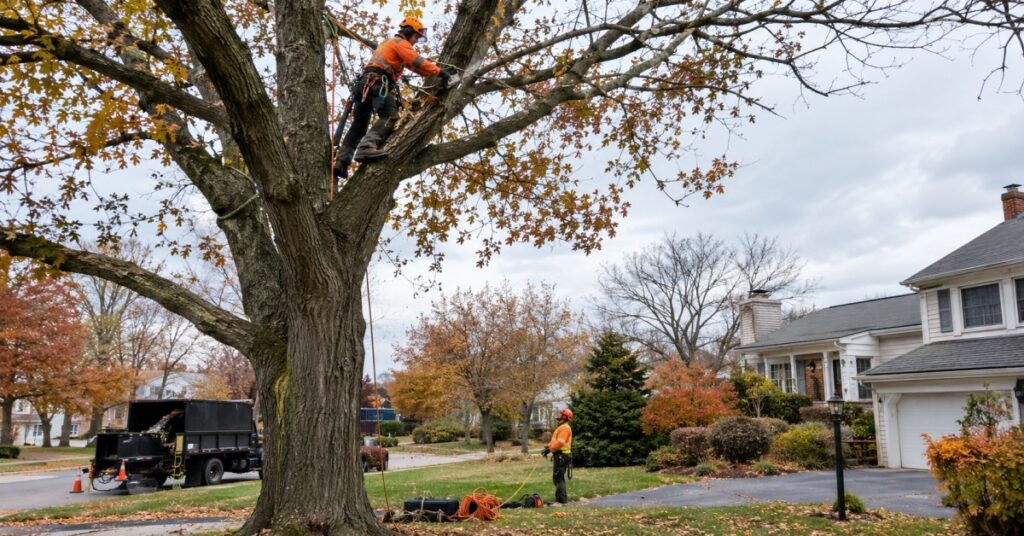
When powerful lake-effect squalls and gale-force seiche winds roar off Lake Erie, residential shade trees face immense structural stress. For property owners across Erie County, knowing how to prevent tree wind damage buffalo ny before winter wind advisories hit is the difference between an intact landscape and thousands of dollars in roof repairs. Dense canopies, co-dominant stems, and hidden root decay turn mature oaks and maples into high-risk hazards under sustained 50+ mph gusts.
Proactive storm preparation is not about aggressive topping or cutting back random limbs. Modern arboriculture relies on aerodynamic wind-sail reduction, strategic deadwood removal, and dynamic support cabling to help trees flex with winter gales rather than snap. Follow our proven guide to prevent tree wind damage buffalo ny and protect your home this storm season.
📋 Table of Contents
Understanding Lake Erie Wind Dynamics in Western NY
Buffalo experiences some of the most concentrated overland wind patterns in the Northeast. Funneled along the open waters of Lake Erie, low-pressure systems accelerate as they cross the shoreline, hitting neighborhoods from South Buffalo and Lackawanna north to Amherst, Getzville, and Tonawanda with intense gusts. To effectively prevent tree wind damage buffalo ny, homeowners must understand how cold, dense winter air multiplies the destructive force exerted on canopies.
Unlike warm summer breezes, freezing winter air is denser and pushes with significantly higher kinetic mass. When combined with freezing rain or heavy lake-effect snow, branches carry thousands of pounds of added weight. As detailed in our comprehensive guide to winter tree damage Buffalo NY, cold temperatures make hardwood fibers brittle, dramatically increasing the risk of sudden trunk fracture under violent wind oscillations.
Taking proactive steps before early winter storms arrive ensures your trees withstand these recurring seasonal gales without threatening nearby homes or overhead utility feeds.
Investing in timely canopy management helps property owners safely prevent tree wind damage buffalo ny before the severe freeze cycles of January and February take hold.
The “Wind Sail” Effect and Crown Aerodynamics
A mature hardwood canopy functions exactly like a canvas sail on a boat. When unbroken winds strike an overgrown, unpruned tree canopy, the force does not simply pass through; instead, the canopy traps the air, transferring massive rotational torque down the trunk and into the root plate. A core objective to prevent tree wind damage buffalo ny is reducing this wind resistance without stripping the tree of its natural vigor.
Unfortunately, many uncertified tree trimmers attempt to solve this with “lion-tailing”—removing all interior branches and leaving foliage only at limb tips. This amateur practice actually magnifies the pendulum swing of the limb, concentrating extreme mechanical stress at the branch collar and causing catastrophic failure in moderate wind.
According to the pruning standards outlined by the International Society of Arboriculture pruning guidelines, selective structural thinning preserves interior foliage while opening air channels that allow winter storm winds to blow harmlessly through the canopy.
When arborists apply proper crown thinning, you effectively prevent tree wind damage buffalo ny by transforming an unyielding wooden wall into a flexible, wind-permeable structure.
🌬️ Concerned About High Winds Hitting Your Trees?
Treeman provides professional wind-sail reduction, structural cabling, and pre-storm tree hazard assessments across Buffalo, Getzville, Amherst, and Clarence. Don’t wait for the next gale advisory.
Crown Thinning vs. Structural Dynamic Cabling
Not every storm hazard requires cutting down the tree. In fact, many prized mature trees can be preserved through a combination of precision pruning and supplementary support systems. Choosing the right mechanical intervention helps homeowners prevent tree wind damage buffalo ny while preserving property value and curb appeal.
| Mitigation Method | How It Works | Ideal Tree Condition |
|---|---|---|
| Crown Thinning (ANSI A300) | Removes 10%–20% of selective secondary branches across the outer crown to reduce wind drag without removing top growth. | Overgrown maples, oaks, and dense spruce barriers. |
| Deadwood Removal | Extracts dry, decaying, or hollow branches over 2 inches in diameter before high winds tear them loose. | Older hardwoods hanging above roofs or driveways. |
| Dynamic Synthetic Cabling | Installs shock-absorbing synthetic rope high in the canopy to link co-dominant stems, allowing controlled flex while arresting tears. | Trees with tight “V-crotch” split trunks. |
| Crown Reduction Pruning | Reduces overall tree height and lateral spread back to healthy lateral junctions, lowering the wind fulcrum point. | Fast-growing willows, silver maples, and ash trees. |
When trees show signs of uncorrectable structural instability—such as major trunk cavities, split crotches with bark inclusions, or rapid tipping—proactive pruning may no longer suffice. In these situations, scheduling professional tree removal Buffalo NY before severe weather strikes eliminates the risk of an emergency roof strike.
Implementing targeted structural pruning is the most reliable way to prevent tree wind damage buffalo ny before winter storms cause irreversible loss.
Choosing proper structural cable dampening allows large trees to withstand microbursts, helping you sustainably prevent tree wind damage buffalo ny without altering their natural growth architecture.
Protecting Root Plate Anchorage in Saturated Winter Soils
High winds alone rarely uproot healthy, well-anchored trees. Whole-tree windthrow typically occurs when intense wind gusts coincide with water-saturated, un-frozen soil. In Western New York, late-autumn rainstorms and mid-winter thaws soften the clay soils common to Amherst and Clarence, significantly weakening root grip.
To prevent tree wind damage buffalo ny through root plate preservation:
- Maintain a 3- to 4-Inch Organic Mulch Ring: Mulch insulates the soil against rapid freeze-thaw cycles, stabilizing moisture levels and preventing frost heave around structural anchoring roots.
- Keep Mulch Off the Trunk: Avoid “mulch volcanoes.” Piling mulch against the root flare traps moisture, inviting fungal root rot (like *Armillaria*) that undermines structural stability.
- Inspect for Soil Mounding: Look around the base of your tree on the upwind side. If you see cracked turf, lifted soil plates, or exposed lateral roots after a storm, the root system is failing.
When soil softens and roots shift under heavy gusts, the trunk often starts pitching off-balance. If you notice fresh soil upheavals or an uneven canopy angle, consult our diagnostic guide on spotting a tree leaning toward house buffalo ny before sudden ground failure causes a collapse.
Protecting the root plate ensures that when heavy gusts sweep through, your trees maintain the anchor strength needed to prevent tree wind damage buffalo ny throughout the winter season.
Monitoring sub-surface drainage around foundation footings is equally critical to prevent tree wind damage buffalo ny when wet winter storms batter regional properties.
Pre-Storm Homeowner Defense Checklist
Before the National Weather Service issues high wind warnings for Erie County, follow this step-by-step checklist to evaluate your property:
- Check Canopy Clearances: Ensure all limbs maintain at least 10 feet of clearance from roof shingles, chimney caps, and siding. Rubbing branches quickly wear through roofing materials during storms.
- Identify Deadwood Clusters: Look up into the crown on a bright afternoon. Limbs lacking bark, shedding twigs, or showing bracket fungi must be cut down immediately.
- Review Co-Dominant Trunks: If your tree splits into two main stems resembling a “V” rather than a “U,” wind will attempt to wedge those halves apart. Dynamic cabling can stabilize this fault line.
- Compare Prevention vs. Emergency Costs: Scheduled structural pruning is a fraction of the cost of emergency crane work. Review our local budgeting analysis on storm tree removal cost buffalo ny to understand the financial advantages of preventive care.
Taking early action allows homeowners to safely prevent tree wind damage buffalo ny, keeping landscapes beautiful and structures secure year-round.
Frequently Asked Questions
How much pruning is needed to prevent tree wind damage in Buffalo NY?
ANSI A300 standards recommend removing no more than 15% to 20% of live foliage through selective crown thinning. This opens sufficient air corridors through the canopy to reduce wind drag while preserving the tree’s health and natural counterbalance.
Does tree topping help prevent tree wind damage buffalo ny?
No. Topping severely damages a tree’s structure and stimulates rapid growth of weakly attached epicormic shoots. These “water sprouts” snap easily in moderate winds, creating an even greater storm hazard within two to three seasons.
What is dynamic cabling and how does it prevent storm damage?
Dynamic cabling uses synthetic, shock-absorbing rope installed in the upper third of the canopy. It allows stems to flex naturally under gentle breezes but catches and dampens extreme movement during heavy wind gusts, preventing co-dominant trunks from splitting apart.
When is the best time of year to prepare trees for wind storms in Western NY?
Late autumn and early winter (October through December) is the optimal window. Once leaves have dropped, arborists have a clear, unobstructed view of structural defects, co-dominant splits, and deadwood, allowing precise pruning before major winter storms strike.
Protect Your Trees Before the Next Buffalo Windstorm
Don’t wait for gale-force gusts to test your tree canopy. Treeman provides certified crown thinning, dynamic cabling, deadwood pruning, and hazard removals across Getzville, Amherst, Tonawanda, Clarence, and the greater Buffalo area. Learn how to prevent tree wind damage buffalo ny and protect your family and property today.
Treeman HQ: 2791 N Forest Rd, Getzville, NY 14068. Licensed, insured, and equipped for residential and commercial tree care throughout Erie County.