
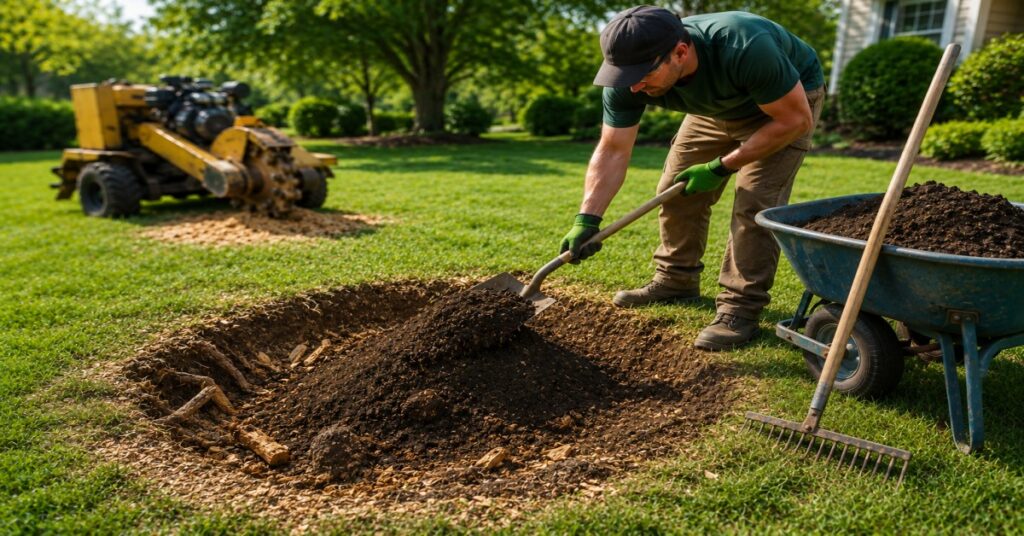
Knowing how to fill a hole after stump grinding properly is essential for restoring a flat, hazard-free lawn after tree removal. Having a tree stump ground down is a major win for any homeowner—the bulky wood mass is gone, mower blades are safe, and your yard looks noticeably larger. However, once the tree service crew leaves, you are left with a messy problem: a deep, uneven crater filled with loose dirt, trapped air pockets, and piles of wood mulch.
Whether you recently read our guide on stump grinding vs stump removal or are dealing with an old leftover cavity, mastering the right backfill and compaction techniques keeps your property level and prevents future sinkholes.
In this comprehensive guide, we will walk you through the exact 5-step process our team at Treeman uses across Western New York. Ultimately, our goal is to help you clear, fill, compact, and re-grass your stump hole so your lawn returns to a smooth, healthy grade.
Table of Contents
- 1. Why Properly Filling a Stump Hole Matters
- 2. Tools and Materials You Will Need
- 3. Step 1: Remove Excess Wood Chips and Debris
- 4. Step 2: Choose the Right Fill Dirt Blend
- 5. Step 3: Fill and Tamp in 3-Inch Layers (The Secret to No Sinkholes)
- 6. Step 4: Re-Seed or Lay Fresh Sod
- 7. Step 5: Long-Term Maintenance & Monitoring
- 8. Frequently Asked Questions (FAQs)
Why Properly Filling a Stump Hole Matters
It is tempting to kick the surrounding dirt back into the depression, stomp on it a couple of times, and consider the job done. Unfortunately, taking shortcuts when you fill a hole after stump grinding leads to several ongoing lawn issues:
- First, as buried root bits and organic debris decompose underground, the soil slumps inward, creating tripping hazards and mower obstacles.
- Second, decomposing wood chips consume high levels of nitrogen. Therefore, leaving a dense mass of sawdust beneath your lawn will rob new grass roots of critical nutrients.
- Finally, rotting subterranean wood creates an inviting environment for termites, carpenter ants, and unwanted lawn fungi or mushrooms.
Shoveling topsoil, tamping dirt in 3-inch layers, and hauling heavy material takes time and effort. Because of this, if you’d rather leave the cleanup, soil compaction, and turf installation to experienced arborists, explore our expert tree stump removal in Buffalo, NY or contact Treeman directly for a quote.
Tools and Materials You Will Need
Before starting the restoration work to fill a hole after stump grinding, gather these basic tools and supplies:
| Required Tools | Recommended Materials |
|---|---|
| • Flat shovel & bow rake | • Quality screened topsoil |
| • Heavy hand tamper or water roller | • Organic compost or soil conditioner |
| • Wheelbarrow & garden hose | • Coarse fill dirt or sandy loam |
| • Garden hose with spray nozzle | • Matching grass seed or sod patch |
| • Pitchfork (optional) | • Starter fertilizer & straw cover |
Step 1: Remove Excess Wood Chips and Debris
When a tree stump is ground down, it creates a large mound of mixed wood shavings and dirt—often three to four times the volume of the original stump.
- First, use your shovel or pitchfork to extract loose, thick root fragments and heavy bark chunks remaining in the cavity. Because residual roots beneath the surface naturally break down over 6 to 12 months, understanding what happens to underground roots after grinding will help you anticipate how much subsoil settling to expect before adding your top layer of fill dirt.
- Next, save clean wood shavings in your wheelbarrow to use as mulch around garden borders, flower beds, or shrubs.
- Finally, use your shovel or pitchfork to extract loose, thick root fragments and heavy bark chunks remaining in the cavity.
Although a small percentage of wood fragments mixed with soil is fine, the cavity itself must be largely clear before backfilling. In order to properly fill a hole after stump grinding, the new dirt must be allowed to set firmly.
Step 2: Choose the Right Fill Dirt Blend
To keep your yard level for years to come, you cannot rely on lightweight garden topsoil alone. This is because bagged topsoil contains high organic matter that compresses significantly when wet.
In order to properly fill a hole after stump grinding, use a balanced two-part blend:
- Base Layer (Fill Dirt / Sandy Loam): Provides dense structural weight, packs down tightly, and prevents future soil slumping.
- Top Layer (Screened Topsoil + Organic Compost): Supplies the essential nutrients and moisture retention required for new grass seed or sod roots to establish.
Step 3: Fill and Tamp in 3-Inch Layers (The Secret to No Sinkholes)
Dumping all your soil into the hole at once is the single biggest mistake homeowners make. For example, pouring 12 inches of loose soil into a cavity and raking it flat guarantees that the first heavy rainstorm will drop the surface level by 3 to 4 inches.
How to Compact Correctly:
- First, shovel 3 inches of fill dirt into the base of the cavity.
- Next, use a hand tamper or flat shovel back to pack the dirt firmly into all edges.
- Then, lightly spray the layer with a garden hose to settle fine dust and eliminate air pockets.
- Finally, repeat this process—adding 3 inches at a time, tamping, and lightly watering—until you fill a hole after stump grinding to sit 1 to 2 inches higher than the surrounding lawn grade.
If your stump hole is larger than 2 feet across or deeper than 10 inches, tamping manual soil lifts takes considerable physical labor. Depending on the proper stump grinding depth used during removal, deep cavities require multiple 3-inch tamped lifts to prevent major lawn depressions after heavy Western New York rainstorms.
Need Help with Heavy Soil Tamping & Lawn Leveling?
Skip the heavy lifting and dirt hauling. Let Treeman handle your soil compaction, grading, and lawn restoration.
Step 4: Re-Seed or Lay Fresh Sod
Once your base soil layer is firmly packed and level with the lawn, it is time to restore grass growth across the patch.
Option A: Planting Grass Seed
- First, spread a 1-inch layer of fine, screened topsoil over the tamped surface.
- Next, rake the soil gently to create fine grooves.
- Then, broadcast a high-quality cool-season grass seed mix (such as Kentucky Bluegrass or Tall Fescue). According to turfgrass management research from the Cornell Cooperative Extension, cool-season grasses establish best when seeded into a finely prepared, firm seedbed with good soil-to-seed contact.
- After that, gently rake the seed into the top $1/4$ inch of soil.
- In addition, apply a starter fertilizer high in phosphorus to encourage rapid root growth.
- Finally, water lightly twice daily to keep the seed damp until germination (10–14 days).
Option B: Laying Turf Sod
- First, adjust your topsoil layer so it sits approximately 1 inch below the level of existing grass blades.
- Next, cut a section of matching sod to fit the exact shape of the hole.
- Then, press the sod patch firmly into place so its roots make solid contact with the soil underneath.
- Finally, water deeply every day for the first two weeks until roots anchor firmly.
Step 5: Long-Term Maintenance & Monitoring
Even with careful tamping when you fill a hole after stump grinding, organic matter beneath the surface breaks down over the first year.
- Watch for Minor Settling: Specifically, if a slight dip forms after a few months, top-dress the depression with a 1/2-inch layer of fine topsoil directly over the grass and rake it gently.
- Avoid Overwatering: In order to support new seedling growth, keep soil damp, but avoid flooding the patch, which can wash out uncompacted subsoil.
Frequently Asked Questions (FAQs)
Can I plant a new tree in the exact same spot?
It is best not to plant a new tree directly in the same hole immediately. Because residual subterranean roots deplete soil nitrogen, it becomes hard for a young sapling to establish. Instead, plant new trees at least 3 to 5 feet away from the original location.
How long does it take for a stump hole to settle completely?
Depending on how thoroughly you fill a hole after stump grinding and tamp the dirt, a stump hole undergoes most natural settling within 6 to 12 months as rain and weather pack the subsoil.
Why are mushrooms growing where my old stump used to be?
Mushrooms are a natural sign that harmless fungal spores are breaking down remaining wood fibers below the surface. Consequently, they will disappear naturally once organic wood matter fully decomposes.
What is the best soil ratio to fill a stump hole?
For long-term lawn stability, use a blend of 60% topsoil, 30% organic compost, and 10% coarse sand. This mix provides necessary weight to prevent sinking, delivers rich organic nitrogen for grass growth, and improves water drainage in heavy soils.
Why is the grass turning yellow over my filled stump hole?
Yellowing grass usually indicates a nitrogen deficiency caused by buried wood chips breaking down beneath the surface. To fix this, apply a nitrogen-rich starter fertilizer or top-dress the area with a thin layer of screened compost.
Ready for a Pristine, Perfectly Level Yard?
Knowing how to fill a hole after stump grinding properly takes time, heavy lifting, and the right soil materials. If you’d rather save your weekend and leave the soil compaction, lawn leveling, and turf restoration to experienced arborists, Treeman is here to help.
Treeman serves Getzville, Amherst, Williamsville, Clarence, Lockport, East Amherst, and surrounding Buffalo, NY communities. Licensed, insured, and committed to leaving your property cleaner than we found it — on every job, every time.