
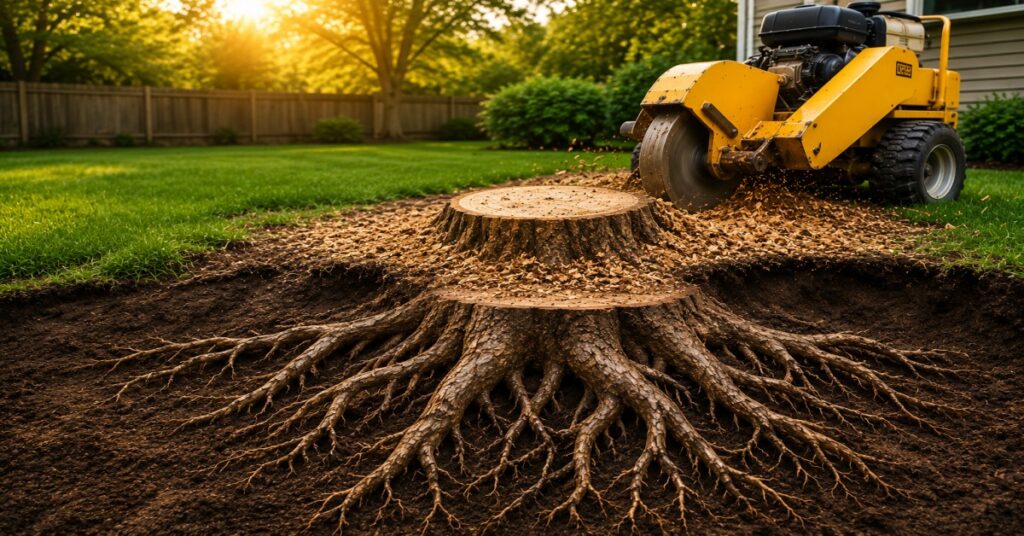
You just had a massive tree removed from your Buffalo property. The crew has finished the grinding, the wood chips are piled high, and for the first time in years, your horizon is clear. But as you look at the fresh mulch where the trunk once stood, a nagging question remains: what happens to roots after stump grinding when they are left deep underground?
It is one of the most frequent questions we receive at Treemanny. Because the root system is invisible, many homeowners worry that the “ghost” of the tree will continue to grow, damage underground pipes, or cause the ground to suddenly collapse.
Here is the authoritative, straight-talk guide on exactly what happens to roots after stump grinding, the biology of wood decomposition, and how to properly manage your Western New York landscape to generate a beautiful, pristine lawn.
Understanding the “Invisible” Half of Your Tree
To understand what happens to roots after stump grinding, you first have to understand the massive scale of what is left behind. A mature Oak, Ash, or Maple tree doesn’t just grow down; it grows out. The root system often extends two to three times the width of the tree’s canopy.
When we perform professional tree stump removal in Buffalo, NY, we use heavy-duty, high-speed carbide-tipped teeth to completely pulverize the stump and the “root collar”—the heavy, woody junction where the trunk meets the soil. This process usually grinds to a critical depth of 6 to 12 inches below the surface.
The Reality: The vast network of lateral roots remains deep in the soil. However, they are no longer a connected, living “system.” They are now simply disconnected pieces of organic matter.
Do Tree Roots Keep Growing After Stump Grinding?
This is the number one concern for homeowners in Erie County: Will the tree come back to life?
The short answer is no. For a tree to survive, it requires a biological loop. The leaves collect sunlight (photosynthesis) to create sugars, which are sent down to feed the roots. The roots collect water and minerals, which are pumped back up to the leaves. When we grind the stump, we break that vital loop permanently.
However, when investigating what happens to roots after stump grinding, you might notice small sprouts or “suckers” popping up in your lawn a few weeks later. This is common in specific invasive or aggressive species found around Buffalo, such as:
- Black Locust
- Tree of Heaven (Ailanthus altissima)
- Certain Fruit Trees (Cherry and Apple)
- Willows
These sprouts are not “new growth” from a recovering tree. They are the result of stored starch remaining in the underground roots. The roots are essentially “panicking” and using their final reservoir of energy to try and find a light source. If you simply mow over these sprouts or treat them immediately, the roots will quickly exhaust their energy reserves and die. Knowing what happens to roots after stump grinding means understanding that these sprouts are a sign of the root system’s final expiration, not a revival.
🛑 Got stubborn sprouts or an ugly stump ruining your curb appeal?
Don’t let it damage your lawnmower. Click here to visit our Google Business Profile or Contact us to schedule your quick, free on-site estimate today!
The Decomposition Timeline: How Long Does It Take?
If the roots aren’t growing, they are actively decaying. But wood doesn’t disappear overnight. If you want to know what happens to roots after stump grinding over a multi-year period, you have to look at the “Decomposition Clock.”
1. The First Year: The Starvation Phase
During the first 12 months, the buried roots lose all their internal moisture. The fine “hair roots” that absorb water die almost immediately. The larger, woody lateral roots begin to undergo a rapid chemical change as their internal sugars ferment and break down.
2. Years 2 to 5: The Fungal Takeover
This is the most active stage of underground decay. Beneficial soil fungi, such as white-rot and brown-rot fungi, begin to colonize the buried wood. You may see mushrooms popping up in a circle where the root span used to be (sometimes called a “fairy ring”). Do not be alarmed—this is simply nature’s cleaning crew at work.
3. Years 5 to 10+: The Humus Stage
Depending on the size of the original tree, the wood eventually softens into a “spongy” state and completely merges with the surrounding soil. In the clay-heavy soils of Tonawanda or West Seneca, this process can be significantly slower due to restricted oxygen. In the sandier soils of Clarence, it might happen much faster.
| Tree Type | Est. Decomposition Time |
| Softwoods (Pine, Spruce, Fir) | 3–5 Years |
| Medium Hardwoods (Ash, Birch) | 5–8 Years |
| Dense Hardwoods (Oak, Hickory, Beech) | 10+ Years |
Will Decomposing Roots Damage My Property?
Many homeowners worry about the structural implications of what happens to roots after stump grinding. Let’s address the three biggest myths we hear in Western New York:
- Myth 1: “The roots will rot and create a sudden sinkhole.”While the ground will settle as the wood disappears, it rarely creates a dangerous hole. Instead, you will notice a gradual, shallow depression in the lawn over several years. This is easily managed by adding a few shovels of topsoil and grass seed once a year.
- Myth 2: “The rotting roots will attract termites directly to my house.”Subterranean termites do eat decaying wood, but they are already present in almost every yard in WNY. Decaying roots deep underground are far less attractive to termites than a damp wood pile or a mulch bed touching your foundation. The natural deep-earth breakdown rarely increases the risk to your home’s structure.
- Myth 3: “The roots will continue to lift my concrete sidewalk.”Once you invest in professional tree stump removal in Buffalo, NY, the “lifting” force stops instantly. Roots lift concrete because they are actively growing in diameter. Since the roots are dead, that pressure is permanently gone.
Post-Grinding Management: The Treemanny Way
Knowing what happens to roots after stump grinding is only half the battle. You also need to know how to treat the site to ensure a beautiful, flat lawn.
The “Chip” Dilemma & Lawn Restoration
Stump grinding produces a massive mountain of wood chips. If you leave these chips packed tightly in the hole, they will rob the surrounding soil of essential nitrogen as they decompose. If you want to grow grass immediately, you must remove the majority of the chips and replace them with nutrient-rich topsoil.
- The Treemanny Advantage: Don’t break your back hauling wheelbarrows of heavy mulch. When you book your service, ask about our full-service cleanup and topsoil restoration add-on so your lawn looks pristine the very same day!
Planting a New Tree
We generally recommend not planting a brand-new tree directly in the exact spot where the old stump was ground. The soil there is often temporarily depleted of nutrients, and the mass of decaying wood can interfere with the new tree’s root development. Instead, check out our guide on the Tree Services or plant your new tree at least 3 to 5 feet away from the old site.
Monitoring Utilities & Pipes
If you previously had tree roots encroaching near an old clay sewer line, the decay process is actually a massive benefit. As the roots rot, they become incredibly brittle. If you previously had a plumber “snake” the lines to cut out roots, the dead roots will no longer grow back into the pipes, eventually solving your underground intrusion problem permanently.
Why Buffalo Soil & Climate Matter
In Western New York, our unique climate plays a massive role in the overall decomposition timeline. Our long, frozen winters act as a literal “pause button” for wood breakdown. Biological activity completely stops when the ground freezes, which is why a stump ground in Buffalo might take a year or two longer to fully decompose than one in the southern states.
At Treemanny, we’ve served clients from the Elmwood Village to the suburbs of Lancaster. We know the exact difference between handling the deep-seated roots of a century-old City of Buffalo Silver Maple and managing the shallower, widespread root systems of a suburban Spruce. If you are dealing with storm damage or clearing land, you can also read our expert tips on Emergency Tree services.
Why Choosing a Cheap “Shallow Grind” Costs More in the Long Run
When homeowners ask what happens to roots after stump grinding, they often assume all grinding services are equal. They aren’t. Choosing an uninsured “guy with a rental machine” usually results in a shallow 2-inch grind.
Shallow grinds leave the massive, heavy root collar completely intact just beneath the surface. This means:
- You will instantly break your lawnmower blades the next time you mow.
- Surface roots will continue to trip your family and guests.
- You will never be able to grow smooth grass over the area.
Investing in a thorough, professional tree stump removal in Buffalo, NY ensures the wood is pulverized deeply enough to allow complete, healthy lawn restoration.
Frequently Asked Questions
Can I build a deck over the area?
If you are building a heavy structure with permanent concrete footings, you need to plan carefully. We highly recommend full structural excavation rather than standard grinding, as decaying underground roots can cause the footings to subtly shift over time.
Should I use chemicals to speed up root rot?
Generally, no. While nitrogen-rich fertilizers can slightly accelerate soil fungi, nature is usually the best medicine. Chemical “stump out” products are designed to penetrate solid wood left above ground, making them largely ineffective for a vast, buried lateral root system.
Is it okay to leave the roots alone?
Yes, provided the stump was ground deep enough by a professional arborist. Once the main root collar is destroyed, letting nature take its course deep underground is the safest, most cost-effective path for 95% of residential properties.
Ready to Reclaim Your Yard?
Don’t let an ugly, hazardous stump ruin your property’s value through another harsh Western New York winter. Whether you are in Williamsville, Amherst, Clarence, Orchard Park, or right in the heart of the City of Buffalo, Treemanny is ready to help you restore your landscape.