
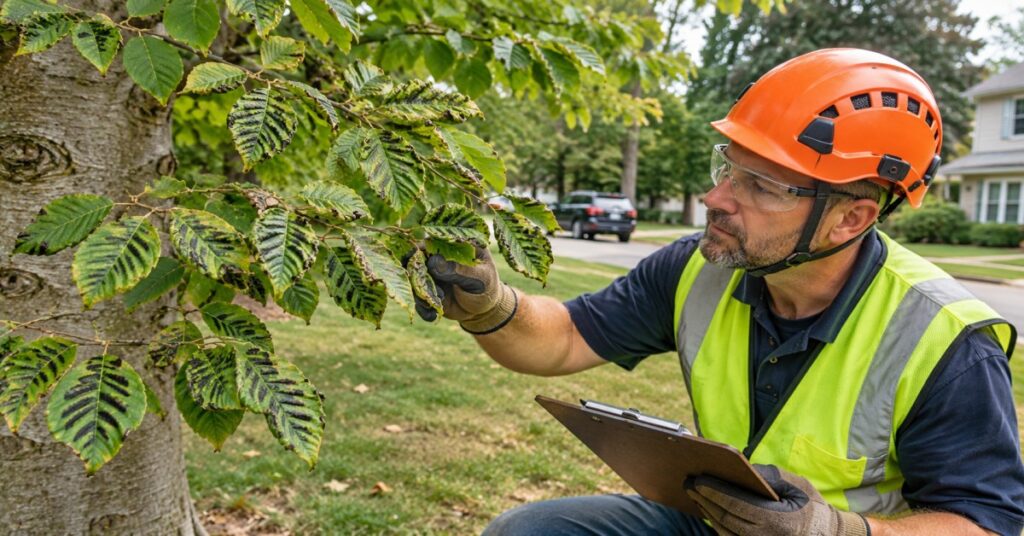
Western New York landscapes feature grand native hardwood canopies, but an invasive parasite is rapidly changing regional ecosystems. Across Erie County communities in Amherst, Clarence, Tonawanda, and Getzville, mature American and European beeches face an aggressive biological crisis. Consequently, recognizing beech leaf disease symptoms buffalo ny early is essential for preserving high-value landscape shade trees. When foliar nematodes penetrate tender leaf buds, they disrupt cellular development before spring leaves unfurl.
Beech Leaf Disease is caused by an invasive nematode known scientifically as Litylenchus crenatae mccannii. Unlike root-feeding nematodes, this worm overwinters inside dormant buds and feeds within mesophyll leaf tissue. By the time property owners notice darkened foliage or cupping leaf margins, internal tissue damage is already severe. Therefore, identifying beech leaf disease symptoms buffalo ny allows homeowners to implement timely treatments. This guide details key visual signs, canopy mortality thresholds, and practical arborist solutions.
📋 Table of Contents: Beech Leaf Disease Management Guide
How Nematodes Destroy Beech Trees in Erie County
Beech Leaf Disease was first identified in 2012 and has spread rapidly across Western New York. The causal pathogen is a microscopic roundworm that selectively targets beech species. Female nematodes lay eggs inside buds during autumn, remaining protected against freezing Buffalo winter weather. When spring temperatures trigger bud break, larvae emerge and consume leaf cells from within.
As infested buds open into summer foliage, damage appears as dark green or black bands between leaf veins. These feeding zones disrupt photosynthesis, starving branches of stored carbohydrates. In heavy Western New York clay soils, stressed root systems struggle to recover from persistent foliage loss. Tracking beech leaf disease symptoms buffalo ny is essential to prevent premature vascular decline and limb failure.
To understand broader canopy resilience and seasonal vulnerability, review our comprehensive guide on tree health buffalo ny. According to regional alerts from the New York State Department of Environmental Conservation BLD guidance, untreated saplings often die in two to three years, while mature beeches decline within six to ten seasons. Secondary fungal cankers frequently attack weakened trees. Therefore, professional Plant Health Care management remains the only reliable defense for local yards.
Primary Diagnostic Signs of Active Infestation
Accurate identification requires inspecting the canopy carefully because damage begins in the lower branches before spreading upward. Professional evaluations following International Society of Arboriculture mature tree care standards look for specific structural clues. Homeowners should watch for these clear beech leaf disease symptoms buffalo ny:
- Interveinal Dark Banding: Holding leaves up to the light reveals dark green or black bands between lateral veins.
- Leathery Texture: Diseased foliage thickens, developing a crinkled, puckered surface distinct from smooth healthy leaves.
- Early Leaf Drop: Damaged leaves wither, curl, and fall prematurely during July and August.
- Bud Abortion: Infested buds fail to open in spring, causing noticeable canopy thinning.
- Clustered Regrowth: Weakened limbs push out undersized, yellowed leaves that struggle to survive winter freezes.
- Bark Cracking: Stressed branches develop vertical fissures as secondary fungi invade vulnerable cambium tissue.
Catching these warning signs early protects your property from severe landscape loss. Identifying beech leaf disease symptoms buffalo ny promptly gives arborists the opportunity to stabilize canopy health.
🍂 Noticing Dark Bands or Leathery Leaves on Your Beech Trees?
Treeman NY provides certified arborist evaluations, trunk micro-injections, and crane removals across Buffalo, Amherst, Clarence, and Getzville. Protect your mature trees before defoliation becomes fatal.
The 30% Canopy Threshold: Treatment vs. Removal
Homeowners often wonder whether an infested beech tree can be saved. Arborists rely on the 30% canopy dieback threshold to determine practical treatment viability. Because systemic injections depend on water movement through healthy vascular tissue, heavily defoliated trees cannot absorb therapeutic products. This diagnostic table outlines recommended actions:
| Canopy Condition | Observable Symptoms | Recommended Action |
|---|---|---|
| 0% to 15% Thinning | Faint dark leaf banding on lower branches, minimal curling, normal twig growth. | Early systemic trunk micro-injection paired with preventative root care. |
| 16% to 30% Thinning | Canopy gaps, heavy leathery leaf cupping, premature summer leaf drop. | Therapeutic micro-injection combined with root zone aeration and feeding. |
| 31% to 50% Dieback | Extensive branch dieback, yellowing leaves, sparse clustered foliage. | Low recovery probability. Plan arborist monitoring or phased removal. |
| Over 50% Mortality | Complete crown death, brittle snapping limbs, internal wood rot. | Immediate crane-assisted tree removal before limbs drop on structures. |
Evaluating your yard against these criteria prevents dangerous structural failures. Waiting until beech leaf disease symptoms buffalo ny cause severe dieback eliminates treatment options and raises safety hazards.
Targeted Micro-Injections and Soil Rehabilitation
When an arborist detects symptoms before canopy loss reaches 30%, targeted treatments help arrest nematode reproduction. Certified arborists insert injection ports into the root flare to deliver systemic phosphite formulations. These treatments circulate upward through the vascular system, reducing pest activity within expanding buds.
Alleviating soil compaction improves root respiration and water movement in heavy local clay. Scheduling specialized deep root fertilization buffalo ny injects organic biostimulants, beneficial mycorrhizae, and balanced micronutrients directly to feeder roots. As a result, treated root systems deliver the essential nutrition required to rebuild canopy vigor.
Addressing early beech leaf disease symptoms buffalo ny through trunk injections preserves mature shade and curb appeal. Preventative maintenance is far more economical than emergency crane removals.
Structural Hardwood Failure and Hazardous Crane Extraction
When canopy mortality exceeds 50%, saving the beech tree is no longer realistic. Defoliated limbs dry out quickly, becoming brittle and prone to sudden collapse. Unlike flexible conifers, beech timber decays rapidly once sap flow stops, making branches hazardous during storms.
Consequently, managing a compromised tree—much like taking down a dead ash tree in Buffalo NY—demands experienced crews. Arborists cannot safely tie into brittle beech limbs because wood fibers snap without warning. Instead, crane-assisted dismantling provides controlled extraction without impacting roofs or lawns.
Ignoring severe beech leaf disease symptoms buffalo ny creates urgent property liabilities during Western New York winter gales and lake-effect snowstorms. Therefore, scheduling prompt tree removal Buffalo NY eliminates falling hazards before heavy snow loads trigger structural failure.
Frequently Asked Questions About Beech Leaf Disease
Can a mature beech tree recover from Beech Leaf Disease?
Yes, if caught before crown dieback exceeds 30%. Systemic trunk micro-injections and root biostimulants help suppress nematode populations and protect developing buds.
How do I tell Beech Leaf Disease apart from leaf anthracnose?
Beech Leaf Disease causes distinct dark bands between veins visible when held to light. Anthracnose produces irregular brown spots across veins rather than neat bands.
When should I treat beech leaf disease symptoms buffalo ny?
Trunk micro-injections are most effective from late spring into mid-summer while trees actively transport fluids and nematodes migrate toward buds.
Why are dead beech trees hazardous to remove?
Dead beech wood loses moisture quickly and rots rapidly. Brittle branch joints can snap under tension, requiring crane-assisted extraction for safety.
Protect Your Beech Trees Before Damage Becomes Irreversible
Mature American and European beech trees provide lasting shade and curb appeal for Western New York properties. Treeman NY offers certified arborist inspections, trunk micro-injections, deep root feeding, and crane removals across Amherst, Clarence, Tonawanda, Getzville, and the Buffalo area. Contact our arborist team today to evaluate beech leaf disease symptoms buffalo ny and protect your landscape investment.
Treeman NY: 2791 N Forest Rd, Getzville, NY 14068. Fully licensed and insured arborist team specializing in plant health care, crane extractions, and emergency tree removal across Western New York.