
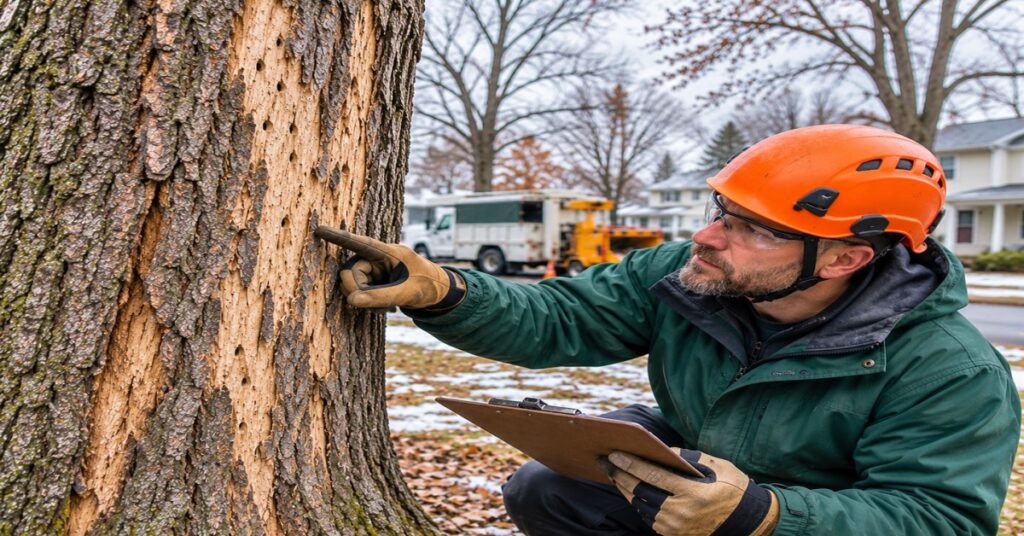
Western New York ash canopies face a quiet, persistent biological threat. Across Erie County communities like Amherst, Clarence, Tonawanda, and Getzville, mature green and white ash trees continue to suffer from invasive beetle activity. Consequently, identifying emerald ash borer symptoms buffalo ny early can mean the difference between saving a prized yard tree and paying for a complex crane removal. When invasive larvae burrow beneath tree bark, they cut off the sap flow that carries moisture and essential nutrients to the upper crown.
The emerald ash borer (Agrilus planipennis) has established strong populations throughout suburban Buffalo neighborhoods. Unfortunately, early infestations often remain hidden high in the upper branches for several years. By the time property owners notice thinning foliage or dead upper limbs, internal damage is already severe. Therefore, understanding emerald ash borer symptoms buffalo ny allows homeowners to make smart, cost-effective decisions. This guide explains key visual indicators, critical canopy dieback thresholds, and whether your tree needs trunk micro-injections or immediate removal.
📋 Table of Contents: Emerald Ash Borer Action Guide
How Emerald Ash Borer Destroys Ash Trees
The emerald ash borer is an exotic, metallic-green beetle native to Asia. Adult beetles feed on ash leaves with minimal consequence, but their larvae cause devastating damage. Female beetles lay hundreds of eggs in bark crevices between late spring and mid-summer. Once these eggs hatch, the larvae chew through the outer bark to reach the phloem and cambium layers. In these vital zones, feeding larvae create extensive, winding galleries that disrupt the tree’s natural fluid flow.
As these feeding channels expand, they effectively girdle the trunk from the inside out. Healthy roots can no longer receive sugars manufactured by the leaves, and the upper canopy starves for water. In heavy Western New York clay soils, an infested tree can deteriorate quickly. As a result, recognizing emerald ash borer symptoms buffalo ny early gives homeowners a chance to act before structural instability sets in.
According to regional invasive pest data from the New York State Department of Environmental Conservation EAB resources, untreated ash trees succumb to infestation within two to four years. Furthermore, winter temperature drops in Buffalo do not kill larvae overwintering safely under thick trunk bark. Therefore, active arborist intervention remains the only proven defense.
Key Physical Signs of an Active Infestation
Spotting early infestation signs takes careful inspection because symptoms appear high in the tree before showing on the lower trunk. Professional arborist assessments aligned with the International Society of Arboriculture mature tree care standards focus on specific diagnostic clues. Property owners should look for these clear emerald ash borer symptoms buffalo ny:
- Woodpecker Flecking (Bark Blonding): Native woodpeckers chip away dark outer bark to feed on larvae, revealing light-colored patches across the upper trunk.
- D-Shaped Exit Holes: Emerging adult beetles chew distinct, flat-topped exit holes roughly one-eighth of an inch wide in the bark.
- S-Shaped Larval Galleries: Peeling loose bark reveals winding, serpentine paths packed with fine, sawdust-like frass.
- Canopy Thinning and Dieback: Leaves in the upper third of the crown look sparse, turn yellow prematurely, and fail to leaf out in spring.
- Epicormic Water Sprouts: Stressed trees push out dense clusters of suckers and small branches from the lower trunk and root flare as a survival response.
- Vertical Bark Splitting: The trunk bark cracks open vertically over old larval feeding galleries as internal tissues dry out.
If you see two or more of these signs on your property, your ash tree is actively under attack. Recognizing these emerald ash borer symptoms buffalo ny helps you schedule timely arborist evaluations before the canopy becomes unsafe.
🪲 Notice Thinning Branches or Woodpecker Holes on Your Ash Trees?
Treeman NY provides certified arborist evaluations, systemic trunk injections, and crane-assisted tree removals across Buffalo, Amherst, and Clarence. Protect your home and landscape before brittle limbs snap.
The 30% Dieback Rule: Treatment vs. Removal
Homeowners often wonder whether an infested ash tree can still be saved. Arborists rely on the widely recognized 30% dieback rule to guide this decision. Because systemic insecticide treatments travel upward through the tree’s natural vascular system, sufficient healthy tissue must remain to carry the product. The table below outlines how arborists evaluate these damage levels:
| Canopy Condition | Observable Symptoms | Recommended Action |
|---|---|---|
| 0% to 15% Dieback | Minor upper crown thinning, occasional woodpecker flecking, healthy trunk tissue. | Immediate systemic trunk injection. High probability of complete recovery. |
| 16% to 30% Dieback | Distinct crown gaps, epicormic sprouting along lower trunk, visible D-shaped holes. | Therapeutic trunk injection paired with root zone health support. |
| 31% to 50% Dieback | Extensive branch death, heavy bark splitting, large clusters of epicormic sprouts. | Treatment rarely succeeds. Schedule controlled arborist dismantling. |
| Over 50% Dieback | Entire crown dead, brittle structural limbs, extensive bark separation. | Immediate hazardous tree removal via crane before structural collapse. |
Evaluating your tree against this triage framework is important. Waiting too long once emerald ash borer symptoms buffalo ny appear often turns a treatable tree into an urgent safety hazard.
Trunk Injections and Soil Rehabilitation
For trees with less than 30% crown loss, direct trunk micro-injection remains the industry standard. Certified arborists drill small, precision ports into the root flare and inject emamectin benzoate directly into the vascular tissue. This systemic insecticide spreads through the tree, killing feeding larvae under the bark and providing two full years of protection.
In addition to insecticide therapy, recovering trees need balanced soil nutrition. To build long-term resistance, explore our core guide on tree health buffalo ny. This resource explains how proper soil pH and canopy care help urban shade trees recover from pest stress.
Furthermore, feeding stressed root systems accelerates the healing of damaged cambium. Scheduling specialized deep root fertilization buffalo ny aerates heavy clay soil. It injects liquid biostimulants, mycorrhizae, and balanced micronutrients directly to the feeder roots. As a result, treated trees quickly regain the strength needed to heal old larval wounds.
When caught early, treating emerald ash borer symptoms buffalo ny with trunk injections is significantly more affordable than tree removal. It preserves your shade canopy, property value, and curb appeal.
Brittle Wood Physics and Hazardous Tree Removal
When canopy dieback surpasses 30% to 50%, saving the tree is rarely possible. At this stage, chemical treatments cannot move through the severed vascular pathways. Even worse, dead ash timber dries out and becomes exceptionally brittle within months. Unlike healthy oak or maple, dead ash wood loses its structural elasticity rapidly, making limbs prone to sudden failure.
Consequently, managing a standing dead ash tree in Buffalo NY requires experienced professionals. Arborists cannot safely climb dead ash trees because upper branch unions snap without warning under load. Instead, safe removal requires specialized bucket trucks and crane rigging to dismantle the tree piece by piece.
Ignoring late-stage emerald ash borer symptoms buffalo ny increases the risk of property damage during severe winter windstorms. Therefore, scheduling prompt tree removal Buffalo NY protects your home, driveway, and utility lines from falling limbs.
Frequently Asked Questions About Emerald Ash Borer
Can an ash tree recover once emerald ash borer symptoms appear?
Yes, provided the canopy has lost less than 30% of its leaves. Professional emamectin benzoate trunk micro-injections stop active larvae and allow the tree to rebuild healthy tissue.
How do I tell woodpecker damage apart from emerald ash borer?
Woodpecker feeding flecks off dark outer bark, creating light patches known as blonding. On ash trees in Western New York, this activity is almost always a direct response to beetle larvae feeding just beneath the bark.
How often do ash trees need emerald ash borer treatments?
Professional trunk micro-injections provide two full years of protection against emerald ash borer symptoms buffalo ny. Treatments are typically applied every other spring while adult beetles are emerging.
Why are dead ash trees so dangerous to remove?
Larval feeding destroys the vascular cambium, causing wood fibers to dry out and rot rapidly. The wood becomes brittle, and limbs can snap without warning, making crane-assisted removal essential for safety.
Protect Your Property from Ash Tree Hazards Today
Do not wait until brittle branches threaten your home or family. Treeman NY provides certified arborist evaluations, preventative trunk injections, and specialized crane removals across Amherst, Clarence, Tonawanda, Getzville, and the greater Buffalo area. Contact our team today to evaluate emerald ash borer symptoms buffalo ny and protect your landscape investment.
Treeman NY: 2791 N Forest Rd, Getzville, NY 14068. Fully licensed and insured arborist team specializing in plant health care, crane extractions, and emergency tree removal across Western New York.