
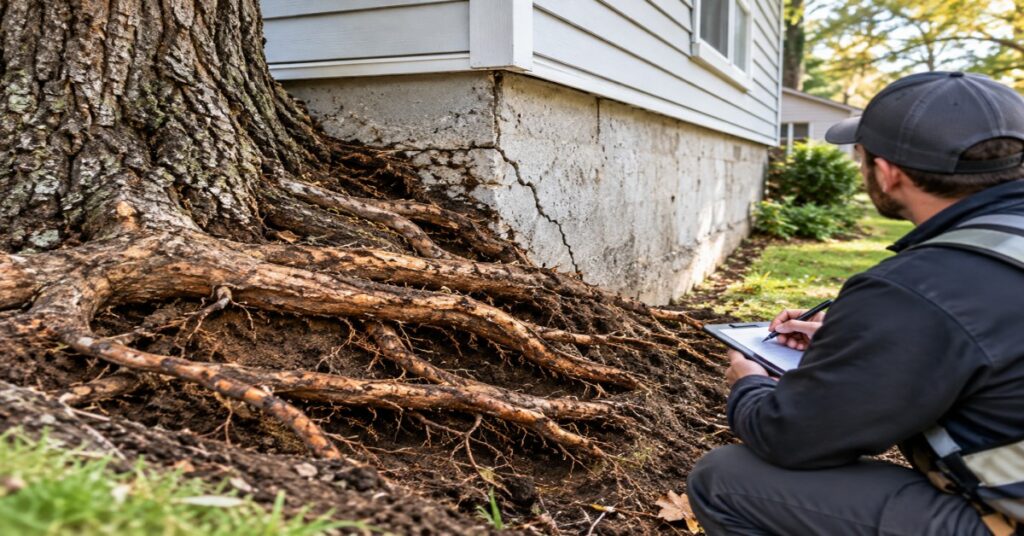
Dealing with tree roots damaging foundation buffalo ny properties can turn any homeowner’s day upside down. When you notice cracked basement walls or an uneven slab near an expansive shade tree, it is easy to assume the worst. Many owners believe aggressive roots are destroying the structure and that the tree must come down immediately, but removal is rarely your best first move.
Western New York neighborhoods are famous for their mature trees. North Buffalo, Elmwood Village, Amherst, and Williamsville showcase century-old silver maples, northern red oaks, and weeping willows. These magnificent trees bring substantial shade and curb appeal. However, their underground systems naturally expand in search of moisture and soil nutrients.
Before bringing in heavy cutting machinery, you must identify the true underlying cause. Can the structural roots be redirected? How can you protect both your basement footers and your yard? Having an accurate diagnostic plan protects both your property value and your wallet. Here is your step-by-step arborist guide on what to do before scheduling tree removal.
- Roots rarely drill through solid concrete: They exploit existing settling cracks or shrink clay soil beneath footers.
- Removal isn’t always mandatory: Surgical root pruning and HDPE bio-barriers often save both the tree and the wall.
- Never cut roots blindly: Severing more than 25% of anchor roots can turn a healthy tree into a dangerous windthrow hazard.
- Call an arborist first: A professional air-spade diagnostic determines true root depth before you pay for masonry or removal.
- Step 1: Determine How Tree Roots Damaging Foundation Buffalo NY Issues Actually Happen
- Step 2: Check for Secondary Warning Signs Around Your Property
- Step 3: Consult an ISA-Certified Arborist Before a Mason
- Step 4: Explore 4 Non-Invasive Solutions for Tree Roots Damaging Foundation Buffalo NY
- Step 5: Identify When Removal Is Truly Non-Negotiable
- Buffalo Permits, Underground Utilities & Next Steps
- Protect Your Home and Trees with Treeman NY
- Frequently Asked Questions
Step 1: Determine How Tree Roots Damaging Foundation Buffalo NY Issues Actually Happen
A common myth is that tree roots act like drills. Homeowners picture them punching directly through solid poured concrete walls. In reality, sound concrete footers are virtually impenetrable to fibrous roots. Poured basement slabs resist them just as well.
When evaluating cases of tree roots damaging foundation buffalo ny structures, arborists see two common patterns. Real structural damage almost always happens in one of two ways:
- Opportunistic Crevice Growth: Buffalo faces severe winter freeze-thaw cycles. These cycles create microscopic stress cracks in mortar joints, stone foundations, and older cinder block parging. Tree roots sense moisture escaping through these gaps. They send fine hair roots inside. As roots mature, radial expansion forces the cracks wider.
- Soil Desiccation and Subsidence: Large mature trees pull heavy moisture from the earth. During summer heat, they can absorb over 100 gallons daily. Western New York features dense clay-heavy soils. When a large root system drains moisture beneath a footer, the clay contracts. This uneven shrinkage causes settlement cracks that look identical to direct root intrusion.
Before assuming you have tree roots damaging foundation buffalo ny masonry, inspect your exterior drainage. Clogged gutters, broken downspouts, and poor yard grading cause foundation settling. These issues often cause damage long before root tips reach the wall.
According to research highlighted by the Cornell University Urban Horticulture Institute, cutting roots indiscriminately creates serious risks. It often fails to fix concrete defects while creating severe windthrow hazards.
Not Sure If Your Tree Is Actually Damaging the Wall?
Before paying for unnecessary tree removal or foundation repairs, have an ISA-certified arborist inspect the root zone. Call our Buffalo team for a fast diagnostic check.
Step 2: Check for Secondary Warning Signs Around Your Property
Underground root movement rarely stays hidden in the basement. Before making drastic decisions about tree roots damaging foundation buffalo ny neighborhoods face, inspect your hardscaping and plumbing:
- Heaving Sidewalks and Driveway Slabs: Look for cracked or tented concrete pads within the tree’s drip line. Rippled asphalt is another common warning sign.
- Plumbing and Sewer Slowdowns: Mature roots seek condensation around older clay or cast-iron lateral pipes. This causes recurring basement floor-drain backups.
- Surface Girdling Roots: Check the soil within 6 to 10 feet of the trunk. Roots encircling the flare or pressing against the sill plate indicate severe spatial limits.
Review our diagnostic guide on tree root damage signs that threaten Buffalo, NY homes. This helps rule out standard settling versus active root pressure. Catching these signs early makes managing complex root intrusion far simpler and less expensive.
Step 3: Consult an ISA-Certified Arborist Before a Mason
When homeowners notice basement walls bowing, they often call a foundation repair company first. Some contact a general contractor. Structural engineers evaluate masonry integrity well. However, they are rarely trained in tree biology.
A contractor might suggest digging a trench and cutting every root within four feet of the house. Severing roots indiscriminately to stop tree roots damaging foundation buffalo ny residences can trigger catastrophic failure:
- Windthrow Hazard: Cutting major anchor roots destroys the tree’s counterbalance system. It turns a healthy oak or maple into a severe fall hazard during high-wind Lake Erie squalls.
- Rapid Crown Dieback: Stripping away more than 25% of a root zone abruptly cuts water to the canopy. This causes massive limb die-off.
- Pathogen Entry: Blunt, jagged trenching tears underground bark collars. This allows destructive fungi like armillaria root rot to infect the stump flare.
An ISA-certified arborist will use supersonic air tools (air spades) to blow away soil safely. This non-invasive excavation reveals root diameter, depth, and structural function before cuts are made. This provides a clear diagnostic picture before making irreversible cuts.
Step 4: Explore 4 Non-Invasive Solutions for Tree Roots Damaging Foundation Buffalo NY
An arborist inspection may show that your tree can be preserved safely. If your footers remain sound, consider these proven preservation methods to safeguard your foundation and canopy:
1. Surgical Root Pruning
An arborist can cleanly prune back non-structural feeder roots encroaching on the foundation. Unlike backhoe tears, surgical cuts allow the root to compartmentalize cleanly. This prevents fungal spread while safeguarding primary anchor roots.
2. High-Density Polyethylene (HDPE) Root Barriers
After pruning offending roots, technicians install a durable, vertical HDPE sheet. They bury it 24 to 36 inches deep into the trench. These commercial-grade barriers redirect future root growth downward and away from your home’s perimeter. This provides permanent protection for basement masonry.
3. Crown Reduction & Structural Bracing
When minor root trimming is necessary near a foundation, arborists often pair the work with canopy management. Thinning the upper crown reduces wind resistance against the trunk. Adding tree cabling and bracing in Buffalo, NY gives physical support to split or weak branch unions above.
4. Direct Moisture Management
Roots track moisture. Installing clean gravel French drains keeps water away from foundation walls. Redirecting sump pump discharges helps as well. Using deep-root soaking bags in the outer yard naturally trains expanding roots away from your concrete.
Step 5: Identify When Removal Is Truly Non-Negotiable
Preservation is always the top priority. However, keeping the tree can sometimes pose an immediate safety hazard. Complete extraction to eliminate tree roots damaging foundation buffalo ny buildings is necessary when:
- Trunk Flare Contact: The base of the trunk flare grows directly against the exterior brick, stone, or concrete wall.
- Over 30% Anchor Severance Required: Foundation repairs require cutting major tap or buttress roots needed to hold the tree upright.
- Incompatible Species in Tight Quarters: Aggressive surface-rooting trees planted fewer than 10 feet from a foundation outpace repair efforts. Common culprits include Weeping Willow, Silver Maple, and Poplar.
When structural risks make extraction unavoidable, work with an experienced crew using specialized rigging gear. Review our full safe tree removal Buffalo NY service to see how tight-quarter residential removals are completed safely.
Buffalo Permits, Underground Utilities & Next Steps
Before performing deep trenching or root excavation:
- Call 811 Before You Dig: Erie County has extensive underground infrastructure. Gas, water, electric, and fiber lines frequently run parallel to residential foundations. Always verify utility lines before any mechanical or air-spade digging.
- Verify Property and Municipal Boundaries: In the City of Buffalo and nearby towns, street trees are municipal property. This includes Amherst, Tonawanda, and Cheektowaga. Homeowners cannot prune or remove municipal trees without municipal arborist permits.
- Complete the Job with Stump Grinding: Never leave a subterranean stump to rot near your basement after removal. Decaying wood attracts subterranean termites and carpenter ants toward your sill plate. Schedule professional stump grinding in Buffalo NY immediately following removal.
Protect Your Home and Trees with Treeman NY
Dealing with tree roots damaging foundation buffalo ny residences doesn’t have to be a guessing game. At Treeman NY, our skilled tree care professionals evaluate underground root concerns across Buffalo, Amherst, Williamsville, Clarence, and Getzville.
We evaluate whether your tree can safely coexist with your foundation, install protective root barrier solutions, and perform precision hazardous removals when structural safety demands it.
Need an On-Site Structural Root Assessment?
Don’t let foundation cracks get out of hand. Get a professional, non-invasive evaluation from ISA-certified arborists who understand Western New York soil conditions and tree biology.
Frequently Asked Questions
Can tree roots crack a poured concrete foundation?
Healthy, uncracked poured concrete foundations rarely get pierced directly by tree roots. However, roots readily penetrate hairline settling cracks or mortar joints, expanding over time and worsening the damage. When tree roots damaging foundation buffalo ny soils absorb excessive moisture from surrounding clay, it causes soil subsidence that cracks footers.
What happens if I cut a large tree root near my house?
Cutting a large structural root (greater than 2 inches in diameter) close to the trunk can severely destabilize the tree, making it prone to tipping over during high winds or heavy snowstorms. It also creates a large wound that can introduce wood-rotting pathogens. Always have an arborist evaluate the root before cutting.
How far away from a foundation should a tree be planted in Buffalo?
Large shade trees like Oaks and Sugar Maples should be planted at least 20 to 30 feet away from foundations and driveways. Medium-sized trees should sit 15 feet away, while small ornamentals like Dogwoods or Crabapples can safely be planted 8 to 10 feet out.