
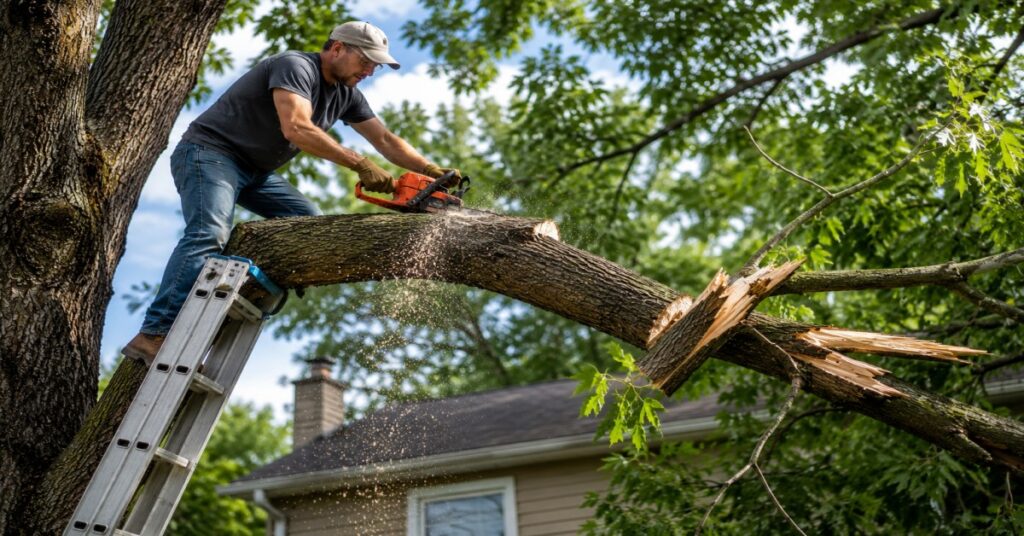
Improper tree pruning can permanently stunt tree growth, introduce internal fungal rot, and create severe storm hazards across Western New York. While overgrown limbs and roof-hanging branches often prompt DIY trimming, proper tree care requires strict timing and precise cuts outside the branch bark collar. Furthermore, making critical tree trimming mistakes can compromise your property’s safety and value. Below are six dangerous tree trimming mistakes Buffalo homeowners make, how to fix them, and when hiring a licensed arborist is safest for your yard.
Table of Contents
- 1. Mistake 1: “Topping” the Tree Canopy
- 2. Mistake 2: Making Bad Flush Cuts Near the Trunk
- 3. Mistake 3: Leaving Stub Cuts After Trimming
- 4. Mistake 4: Trimming During the Wrong Season in WNY
- 5. Mistake 5: Removing Too Much Foliage at Once (Over-Pruning)
- 6. Mistake 6: Trimming Near Active Utility & Power Lines
- 7. How Proper Pruning Prevents Storm Hazard Risks
- 8. Frequently Asked Questions About Tree Trimming Mistakes
“Topping” the Tree Canopy
Specifically, tree topping means cutting off top leader branches to reduce height. Indeed, this is one of the most destructive tree trimming mistakes homeowners commit.
When you top mature oaks, maples, or pines, you trigger a panic survival response. As a result, the tree rapidly sprouts thin, weakly attached shoots called water sprouts. Over time, these sprouts grow into heavy limbs with weak attachments. Consequently, they snap easily during severe winter lake-effect storms. Thus, topping creates severe long-term storm hazards rather than safety.
Making Bad Flush Cuts Near the Trunk
In addition, cutting branches flat against the trunk destroys natural defense mechanisms. This critical junction, the branch bark collar, contains cells that seal wounds naturally.
When a flush cut removes the collar:
- First, the tree cannot form natural callus tissue to close wounds.
- Next, exposed sapwood invites wood-boring insects and fungal decay.
- Eventually, internal rot spreads downward into the main trunk stem.
Therefore, avoiding flush cuts prevents severe tree trimming mistakes that cause wood rot.
Leaving Stub Cuts After Trimming
Similarly, leaving a long branch stub is as harmful as a flush cut. Stubs 6 to 12 inches long prevent bark from sealing over dead wood properly.
Over time, the remaining stub slowly decays and dies. Ultimately, it acts as an open pipeline for carpenter ants, pests, and rot. Because of this, always cut cleanly just outside the branch bark collar. Overall, avoiding stub cuts is one of the easiest tree trimming mistakes to prevent.
Trimming During the Wrong Season in WNY
In fact, timing is essential when pruning hardwoods and softwoods. For example, pruning during late spring or summer attracts pests. Furthermore, high sap flow spreads diseases like Oak Wilt or Dutch Elm Disease.
For Buffalo and Erie County homeowners, winter and late dormancy are best. Specifically, dormant pruning minimizes sap loss and lowers disease risks. Additionally, it lets arborists evaluate branch structure without leaf cover. To prevent seasonal tree trimming mistakes, read our guide on tree trimming and maintenance plans Buffalo NY.
Spotted a bad cut or a hazardous limb near your home?
Protect your property from injury and storm damage. Call Treeman NY today at (716) 466-5990 for a free hazard assessment. You can also locate our service team on Google Maps.
Removing Too Much Foliage at Once (Over-Pruning)
Additionally, over-pruning or “lion-tailing” removes over 20% to 25% of living canopy. Since leaves act as energy factories, stripping canopy starves root systems and causes severe stress.
Consequently, over-pruned trees suffer bark sunscald, interior cracking, and root decline. Furthermore, removing internal branches shifts weight outward. As a result, long tips act like levers that snap under ice loads. For this reason, review our guide on critical signs for tree trimming before storm season for storm safety advice.
Trimming Near Active Utility & Power Lines
Above all, pruning branches near power lines, service drops, or roofs is extremely hazardous. Ladders, metal poles, and saws conduct electricity, thereby posing severe electrocution risks.
Because of these dangers, utility line work requires certified line-clearance training and safety gear. In short, DIY work near high-voltage wires ranks among the most hazardous tree trimming mistakes. As a result, professional arborist intervention is non-negotiable.
How Proper Pruning Prevents Storm Hazard Risks
Ultimately, avoiding tree trimming mistakes preserves healthy growth and boosts curb appeal. Moreover, it protects properties from catastrophic storm damage. For instance, drop-crotch pruning and crown thinning allow wind to pass safely through canopies.
For further technical tree care standards, consult the official International Society of Arboriculture (ISA) Pruning Guidelines.
Frequently Asked Questions About Tree Trimming Mistakes
What is the single biggest tree trimming mistake homeowners make?
In general, the worst tree trimming mistakes involve tree topping or flush cutting. This is because both destroy natural healing mechanisms and cause severe structural decay.
How do I know if my tree was over-trimmed?
For example, over-pruned trees look bare inside, drop leaves early, or sprout thin water shoots. Clearly, these signs mean the tree suffers from tree trimming mistakes and severe stress.
When should I hire a professional arborist in Buffalo, NY?
Always hire professionals when branches hover near power lines or roofs. Likewise, you should hire experts for limbs over 3 inches thick to avoid critical tree trimming mistakes.
Can a tree recover after making improper pruning cuts?
Yes, but recovery takes years and proper arborist intervention. While severed branch collars cannot regrow, certified arborists can perform corrective crown restoration to prevent further rot and structural failure.
Is it cheaper to fix tree trimming mistakes or hire a pro initially?
Hiring a licensed professional initially is much cheaper. Fixing damage caused by DIY tree trimming mistakes often requires emergency cabling, pest treatments, or full tree removal after storm damage.
Request Your Free Local Tree Inspection
In conclusion, avoid costly tree trimming mistakes and protect your home. Contact Treeman NY today at (717) 836-8733 or visit our contact page for a professional estimate in Buffalo, NY.
Treeman serves Getzville, Amherst, Williamsville, Clarence, Lockport, East Amherst, and surrounding Buffalo, NY communities. Licensed, insured, and committed to leaving your property cleaner than we found it — on every job, every time.