
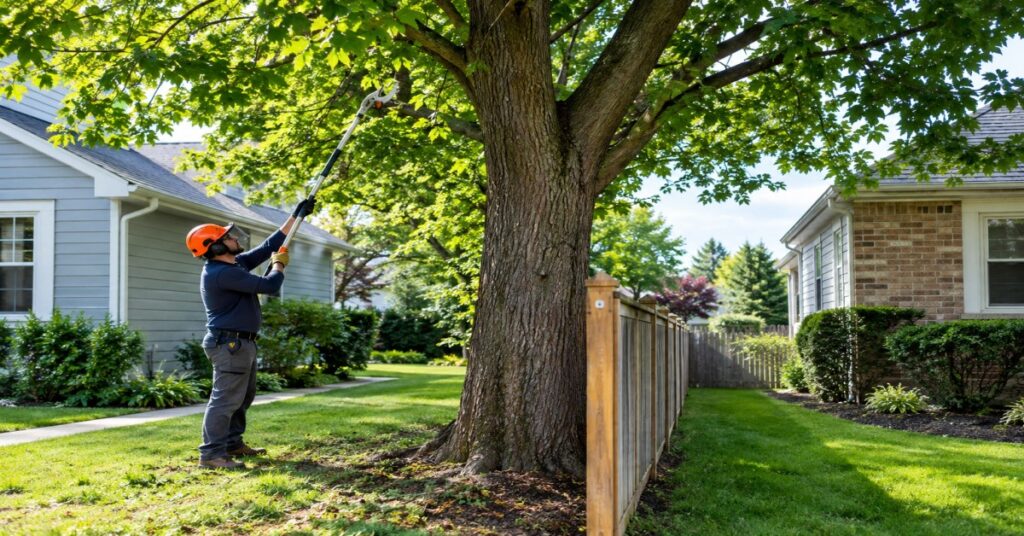
Severe lake-effect snowstorms and high winds strike Western New York often. When limbs overhang or trunks lean, resolving a tree on property line who pays ny question quickly becomes an urgent priority. Large silver maples, oaks, and ash trees frequently straddle narrow property boundaries in Buffalo, Amherst, Cheektowaga, and Tonawanda. An encroaching branch may threaten a garage roof, or a shared trunk might begin to rot. Knowing who legally pays for trimming or removal prevents ugly neighborhood disputes and denied insurance claims.
Table of Contents
- 1. Tree on Property Line: Who Pays in NY? Quick Legal Answer
- 2. Determining Boundary Tree Ownership: The Trunk Base Rule
- 3. Routine Trimming & The New York Self-Help Doctrine
- 4. Storm Damage: Who Pays When a Boundary Tree Falls?
- 5. Resolving Tree on Property Line Disputes in Buffalo
- 6. Why Choose Treeman for Boundary Line Tree Care?
- 7. Frequently Asked Questions (FAQs)
Tree on Property Line: Who Pays in NY? Quick Legal Answer
Under New York State law, financial and maintenance responsibilities depend directly on trunk location and who commissions the work:
- Overhanging Branches (Routine Maintenance): The affected homeowner has the legal right to trim up to the boundary line. You pay 100% of the cost under the New York “Self-Help” Rule.
- Boundary Trees (Trunk Straddling the Line): Both neighbors share ownership as tenants in common. Removal needs mutual agreement. Costs are usually split 50/50.
- Storm Damage (Act of God): A healthy tree may fall across a property line during a storm. Each owner’s insurance pays for cleanup and repairs on their own property.
- Negligence (Known Dead or Dying Tree): An owner may get formal written notice about a hazardous dead tree. If they fail to act, their insurer is liable for damage.
| Scenario | Legal Authority | Who Pays the Bill? |
|---|---|---|
| Branches cross your fence | Trim back to the line (Self-Help) | You pay 100% for work on your side |
| Trunk rests on boundary line | Joint ownership; mutual consent needed | 50/50 split between both neighbors |
| Healthy tree snaps in storm | Classified as an Act of God | Your own homeowners insurance |
| Documented dead tree falls | Property owner negligence | Neighbor’s insurance policy |
When boundary trees grow near overhead utility cables, sorting out maintenance duties is crucial. While property owners must keep the private service line running to their home clear, regional utility providers handle pole-to-pole transmission lines. Reviewing official National Grid tree trimming guidelines helps you determine whether the utility company or the adjacent homeowners bear the obligation to prune encroaching branches.
Determining Boundary Tree Ownership: The Trunk Base Rule
Evaluating a tree on property line who pays ny dispute starts at ground level. Under New York law, canopy spread and roots do not decide ownership. Ownership depends entirely on where the trunk emerges from the soil:
- Sole Property: The trunk base may sit fully on your neighbor’s land. In that case, it belongs to your neighbor. This applies even if 70% of the canopy hangs over your lawn.
- Boundary Tree: The trunk cylinder may touch or cross the boundary line at ground level. If so, it is legally a boundary tree.
Both neighbors share a joint tree on property line who pays ny scenario for total removal. Neither neighbor can cut the tree down without consent. You cannot girdle the bark or use root-killing chemicals alone. Checking an official land survey prevents irreversible mistakes.
Routine Trimming & The New York Self-Help Doctrine
A neighbor’s tree may extend branches over your roof, driveway, or power drop line. You do not have to wait for them to act. Left unchecked, heavy limbs scraping shingles cause structural wear and invite roof leaks. Learning the warning signs of hazardous overhanging roof branches helps you intervene early. When asking about a tree on property line who pays ny for routine upkeep, New York common law offers the Self-Help Doctrine. This rule lets you trim encroaching branches and roots up to your boundary line.
However, the self-help rule has strict legal limits:
- No Entering the Property: You cannot cross the fence line. Never enter your neighbor’s yard to cut limbs without consent.
- No Crossing the Airspace Boundary: Trimming must stop cleanly at your property line.
- No Tree Damage: Pruning must never harm the health, balance, or life of the tree.
Warning under NY RPAPL § 861: Cutting down or critically injuring another person’s tree without permission creates liability. You can face statutory treble damages (three times the tree’s replacement value) plus legal fees.
Improper pruning can easily kill a mature oak or maple. Sorting out a tree on property line who pays ny scenario requires real expertise. Hiring an experienced crew for tree trimming services in Buffalo NY ensures cuts follow ANSI A300 standards. This keeps your trimming legal while protecting canopy health.
Need safe boundary trimming? Avoid neighbor disputes and tree damage—call Treeman at (716) 466-5990 or request an on-site property line assessment.
Storm Damage: Who Pays When a Boundary Tree Falls?
Western New York blizzards and severe wind shears snap heavy limbs under snow loads. Deciding a tree on property line who pays ny case after a storm depends on tree health before the event:
The Act of God Defense
A healthy tree can snap during severe storms. New York law considers that collapse an “Act of God.” Your neighbor is not legally responsible for branches crushing your roof, car, or fence. When facing a tree on property line who pays ny issue here, your own policy pays. Your insurance handles structural repairs and debris removal on your parcel, minus your deductible.
The Legal Negligence Exception
The tree may be hollow, dead, or diseased before the storm hits. In that case, the owner’s legal defense fails. Proactively identifying dangerous tree warning signs such as fungal conks, trunk cavities, or deep bark splits—is essential. You may have sent written notice warning them about the structural hazard. The tree owner is then negligent for ignoring a known danger. For this tree on property line who pays ny issue, their insurer pays for repairs, debris removal, and yard restoration.
Severe storms can create urgent structural hazards on your lot. Booking emergency tree removal stabilizes damaged roofs and clears fallen trees safely before further collapse occurs.
Resolving Tree on Property Line Disputes in Buffalo
You can keep costs low and protect neighbor relationships. When solving a tree on property line who pays ny issue, follow this simple checklist:
- Find Property Boundary Markers: Check boundary pins with a land survey before arguing over trunk location.
- Order an Arborist Assessment: Hire an ISA-certified arborist to inspect rot, hollow trunks, or root damage. A written third-party report removes personal tension.
- Draft a Shared Cost Agreement: Boundary trees often need canopy thinning or deadwood pruning. Splitting the invoice in writing is cheaper than paying insurance deductibles or legal fees.
- Send Notice via Certified Mail: A neighbor may ignore a dead, brittle ash tree. Mail an arborist safety report via certified mail with a return receipt. This establishes clear legal notice under New York law.
A decaying or leaning boundary tree can threaten homes or cars. When both neighbors agree that a shared boundary trunk must come down, understanding the professional tree removal process ensures everyone knows what to expect regarding rigging, crew access, and site cleanup. Booking certified tree care removes hazards before winter winds cause a collapse.
Why Choose Treeman for Boundary Line Tree Care?
Managing boundary line tree care requires precision rigging, certified arborist documentation, and full compliance with Western New York municipal codes. Partnering with Treeman on your boundary property project provides clear advantages:
- ISA-Certified Arborists: We deliver unbiased, written structural assessments that satisfy code enforcement officers and insurance adjusters.
- Comprehensive Insurance Protection: Full liability and workers’ compensation coverage safeguards both adjoining properties during the job.
- Low-Impact Specialized Rigging: Compact machinery and track lifts navigate narrow side yards and gates without damaging shared fences, turf, or gardens.
- Dual-Party Billing: Itemized estimates allow neighbors sharing tree care costs to divide and pay invoices separately without dispute.
Resolving a tree on property line who pays ny question does not have to cause neighborhood friction or unexpected costs. Treeman provides safe, compliant, and experienced solutions across Buffalo and Erie County.
Frequently Asked Questions (FAQs)
Can my neighbor force me to pay for trimming branches in their yard?
No. Under New York law, a neighbor cannot compel you to pay for trimming healthy branches that cross the property line. Under the legal standard for a tree on property line who pays ny, the neighbor who wants encroaching limbs pruned must cover those costs under the Self-Help Doctrine.
What if a tree sits directly on the boundary line and my neighbor refuses removal?
A trunk straddling the line creates joint ownership as tenants in common. You cannot legally cut down a boundary tree without mutual consent. However, if the tree is dead, rotting, or dangerous, an ISA-certified arborist can issue an official hazard report to compel removal through municipal code enforcement or court mediation.
Who pays if a neighbor’s healthy tree falls on my fence during a Buffalo storm?
Sudden storm failures of healthy trees are legally classified as an “Act of God” in New York. Your neighbor is not liable for storm cleanup or repair on your side of the boundary line. In this tree on property line who pays ny scenario, your own homeowners insurance policy handles the claim, subject to your deductible.
Can I trim branches back to the boundary line myself?
Yes, but with strict legal limits under the New York Self-Help Doctrine. You cannot cross your neighbor’s fence line, and your cuts must never harm or destabilize the tree. Indiscriminate cutting that causes tree death exposes you to statutory treble damages under New York Real Property Actions and Proceedings Law (RPAPL § 861). Hiring certified professionals ensures trimming stays safe and compliant.
Protect Your Property and Clear Boundary Hazards
Stop property damage and avoid legal battles over overhanging limbs or hazardous boundary trees. When facing a tree on property line who pays ny decision, the safest first step is an objective on-site evaluation by certified local arborists.
Treeman serves Getzville, Amherst, Williamsville, Clarence, Lockport, East Amherst, and surrounding Buffalo, NY communities. Fully licensed and insured with specialized compact rigging equipment for tight property line boundaries.