
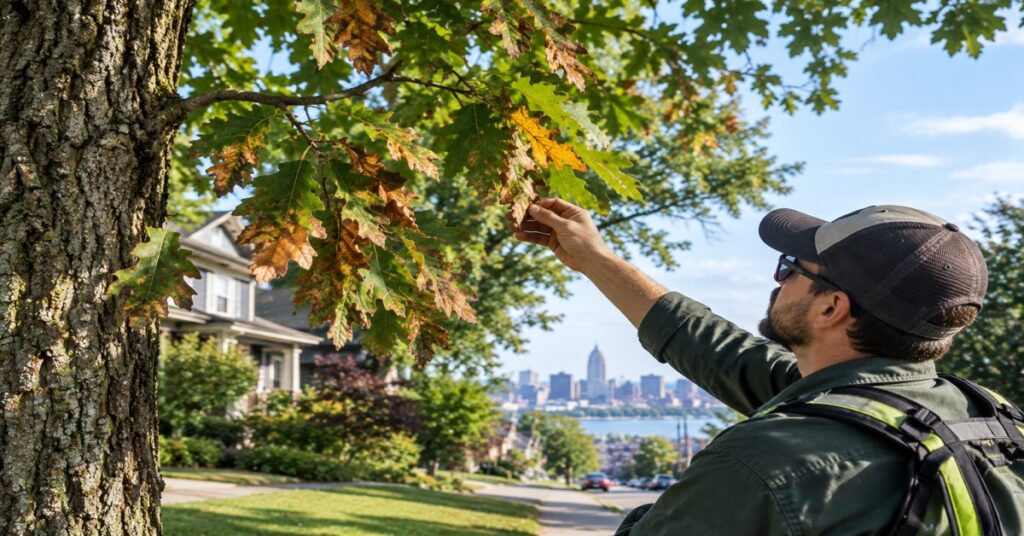
Are the oaks on your property suddenly wilting, turning bronze, or shedding green leaves in summer? If so, your yard may face an aggressive outbreak of oak wilt in Buffalo NY. Oak wilt (Bretziella fagacearum) is a lethal vascular fungus. It blocks water conduction in oak trees, causing rapid dieback and crown collapse.
In established Western New York neighborhoods, mature oaks form our urban shade canopy. This is true across North Buffalo, Elmwood Village, Amherst, Williamsville, and Getzville. However, a healthy northern red oak can succumb to this vascular pathogen in under two months.
Recognizing early symptoms is an essential step to save neighboring trees. In addition, you must comply strictly with state pruning restrictions. Partnering with an experienced arborist is equally vital. As a result, the team at Treeman NY provides diagnostic evaluations, plant healthcare management, and precision removals to help property owners identify oak wilt in Buffalo NY and safeguard their landscapes.
- The Threat: Oak wilt kills mature red oaks in 3 to 6 weeks by cutting off internal water flow.
- NYS DEC Rule: Never prune or trim oak trees between April 1 and July 31 to prevent sap beetles from carrying spores into open cuts.
- Top Warning Signs: Sudden leaf drop in July/August, outer leaf browning, and dark vascular sapwood staining.
- Immediate Action: Nearby healthy oaks can be protected with preventative trunk macro-injections if treated before root transmission begins.
Quick Navigation (Table of Contents)
- 1. What Is Oak Wilt and How Does It Spread in Western New York?
- 2. Are Your Trees at Risk? Key Symptoms of Oak Wilt in Buffalo NY Residents Should Spot
- 3. NYS DEC Oak Pruning Restrictions: What Homeowners Must Know
- 4. Red Oak Group vs. White Oak Group: Understanding Tree Vulnerability
- 5. How to Act: Treatment Options, Root Trenching, and Safe Tree Removal
- 6. Preventing Disease Spread Across Buffalo Landscapes
- 7. Frequently Asked Questions (FAQ)
What Is Oak Wilt and How Does It Spread in Western New York?
Oak wilt is a destructive tree disease caused by the fungal pathogen Bretziella fagacearum. Specifically, the fungus invades the xylem tissue of the tree. These internal vascular tubes carry water and minerals from roots to the crown. To protect itself from colonization, the tree produces defensive resinous plugs called tyloses. Unfortunately, these natural barriers seal off water transport. Consequently, the canopy dries out and dies from the crown downward.
In Erie County and the broader Niagara Frontier, the pathogen spreads through two distinct pathways:
- Overland Transmission (Insect Vectors): During spring and early summer, the fungus develops spore mats beneath dying bark. These fungal mats emit a fruity odor that attracts nitidulid sap-feeding beetles. Afterward, the beetles land on fresh pruning cuts or storm-broken limbs of healthy oaks. They introduce viable fungal spores directly into the exposed sapwood.
- Subsurface Transmission (Root Grafts): Oaks within 40 to 60 feet of each other naturally fuse their root systems underground. Once a single tree contracts oak wilt in Buffalo NY, the infection travels through these connections. Thus, it systematically kills neighboring oaks sharing the underground network.
To stop subterranean spread before entire tree rows die, review our local options for fast stump and tree removal service in Amherst and surrounding areas.
Are Your Trees at Risk? Key Symptoms of Oak Wilt in Buffalo NY Residents Should Spot
Early detection is critical to stopping the spread of infection to adjacent properties. Therefore, you should inspect your yard from June through September. Watch for these five common warning signs of oak wilt in Buffalo NY:
- Sudden Summer Leaf Shedding: Unlike typical autumn foliage changes, diseased trees drop heavy foliage in July and August. These fallen leaves are often green, bronze, or pale yellow.
- Marginal Leaf Scorching: The hallmark pattern of oak wilt in Buffalo NY begins at the outer leaf margins. The browning then moves inward toward the midrib and stem.
- Rapid Crown Dieback: Foliage wilting usually begins at the top of the tree crown. It also starts at outer branch tips before spreading through the remaining canopy.
- Vascular Sapwood Staining: When an arborist prunes a symptomatic branch, dark discoloration is visible. Specifically, brown or black streaks appear in the outer sapwood ring.
- Fungal Pressure Mats: In late summer or the following spring, raised fungal mats develop under cracked bark. Consequently, they emit a sweet, fermenting scent.
If you observe these symptoms, act quickly. Identifying these issues alongside other dangerous tree inspection signs ensures prompt protection for your surrounding landscape.
NYS DEC Oak Pruning Restrictions: What Homeowners Must Know
The New York State Department of Environmental Conservation (NYS DEC) Oak Wilt Regulations mandate specific timing rules to stop beetle transmission.
Crucial Rule: Do not prune, trim, or mechanically wound oak trees between April 1 and July 31. For optimal protection against oak wilt in Buffalo NY, Treeman NY recommends avoiding structural trimming on oaks through October.
During spring and early summer, nitidulid beetles actively search for sap. An exposed cut made during these months attracts beetles carrying fungal spores within hours. Therefore, pruning at this time creates severe risk across Western New York properties.
| Time of Year | Risk Level | Arborist Recommendations |
|---|---|---|
| Nov 1 – March 15 (Dormant Season) | Safe Window | Ideal period for crown cleaning, structural pruning, and deadwooding. |
| Aug 1 – Oct 31 (Late Summer/Fall) | Moderate Risk | Limit pruning strictly to urgent clearance or storm-damaged branches. |
| April 1 – July 31 (Peak Beetle Flight) | High Risk | Pruning prohibited. If a branch breaks in a storm, seal the cut immediately with wound sealant. |
Red Oak Group vs. White Oak Group: Understanding Tree Vulnerability
Oak species respond differently to fungal infection. For this reason, knowing your oak varieties helps determine the level of urgency:
The Red Oak Family (Northern Red, Pin, Scarlet, and Black Oaks)
Red oaks possess large vascular vessels that allow fungal spores to circulate rapidly. Once exposed to oak wilt in Buffalo NY, red oaks suffer severe canopy loss. In fact, they frequently die within 3 to 6 weeks. Curative treatments rarely work on red oaks. As a result, the tree must be dismantled to prevent spore mats from forming and spreading.
The White Oak Family (White, Bur, Swamp White, and English Oaks)
White oaks feature tighter vascular pores. Furthermore, they produce tyloses more effectively to isolate the fungus in individual limbs. Because of this defense, an infected white oak can survive for several seasons with gradual dieback. With prompt identification of oak wilt in Buffalo NY, systemic fungicide trunk injections can often protect white oaks and halt further vascular damage.
To maintain tree vitality and minimize seasonal stress, review our complete homeowner guide on how often trees should be trimmed around a home.
How to Act: Treatment Options, Root Trenching, and Safe Tree Removal
If you suspect an oak tree in your yard is showing symptoms of oak wilt in Buffalo NY, taking immediate, structured steps is critical:
1. Professional Diagnostic Assessment
Never guess when assessing valuable shade trees. Instead, hire a certified arborist to inspect the canopy and check for sapwood staining. When necessary, we submit wood tissue samples to the Cornell Plant Disease Diagnostic Clinic for laboratory verification.
2. Preventative Micro-Injections for Surrounding Oaks
Healthy oaks within 50 feet of a diagnosed tree should receive preventative systemic injections. Specifically, arborists inject propiconazole directly into root flares. Consequently, this treatment shields healthy vascular vessels against fungal spores.
3. Root Severing (Vibratory Trenching)
Because the disease readily travels underground, mechanical isolation is vital. Cutting a trench 4 to 5 feet deep between trees severs interconnected roots. In turn, this barrier isolates the root zone and halts fungal spread.
4. Sanitary Removal and Deep Stump Grinding
Infected red oaks with heavy canopy dieback require complete removal. This critical step eliminates spore-producing material. Tree crews must dismantle the trunk with specialized rigging. In addition, they must sterilize all cutting equipment between cuts.
After dismantling a tree damaged by oak wilt in Buffalo NY, grinding the remaining stump is essential to eliminate root flares where the fungus persists. For more details on this process, explore our analysis of how deep stump grinding should go on local properties.
Preventing Disease Spread Across Buffalo Landscapes
Homeowners can protect urban and suburban tree canopies across Erie County by adopting key landscape maintenance practices:
- Schedule Pruning During Winter Dormancy: Book non-emergency oak trimming from December through February. During these cold months, insect vectors and fungi are completely inactive.
- Seal Storm Wounds Immediately: Most pruning cuts heal naturally without paint. However, you must seal emergency storm breaks between April and August within 30 minutes to deter sap beetles.
- Keep Firewood Local: Never transport unseasoned oak firewood across county lines. Burning local, seasoned wood prevents moving vascular pathogens into Western New York.
- Monitor Soil and Root Zones: Construction trenching and heavy lawn equipment cause root damage. Consequently, root injuries stress trees and invite disease.
Taking these proactive measures helps protect your yard against oak wilt in Buffalo NY outbreaks while preserving your home’s mature shade trees.
Frequently Asked Questions (FAQ)
Can an infected red oak tree recover from oak wilt?
No. Once a red oak shows widespread wilting, the vascular system is plugged and the tree cannot recover. Therefore, it should be removed promptly to protect nearby oaks from root graft transmission and spore mat exposure.
Is oak wilt the same as oak anthracnose?
No. Oak anthracnose is a common, mild foliar fungus caused by cool, wet spring weather. It causes spotted or deformed leaves, but trees typically push a second flush of healthy growth by midsummer. In contrast, oak wilt is a systemic vascular disease that kills entire limbs and causes complete canopy mortality.
What does oak wilt removal cost in Buffalo, NY?
Removal costs depend on tree height, location, proximity to power lines or home structures, and yard accessibility. Addressing trees affected by oak wilt in Buffalo NY typically ranges from $600 to $1,800+, with stump grinding adding $150 to $450 depending on trunk diameter.
Protect Your Property With Buffalo’s Trusted Tree Specialists
Do not wait for canopy dieback to spread across your property lines. Whether you need an early-season disease assessment, preventative winter pruning, or hazardous tree removal, Treeman NY brings over 20 years of hands-on arborist experience to every job across Western New York.
Office Address: 2791 N Forest Rd, Getzville, NY 14068 | Official Website: treemanny.com | Serving Buffalo, Amherst, Williamsville, Getzville, and Western New York.