
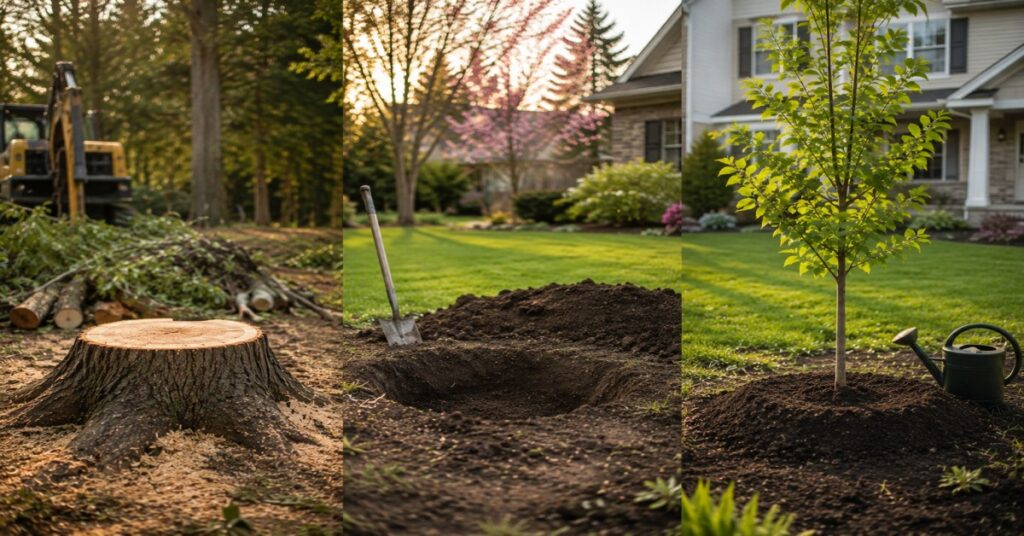
Taking down a dead, diseased, or hazardous tree brings immediate peace of mind, but it leaves an empty void across your landscape. After completing the professional tree removal process, property owners quickly ask: when is the best time to replace tree after removal?
You can replace a tree immediately (in spring or fall) if you plant 3 to 5 feet away from the old site. However, if you plan to plant in the exact same spot, you should wait 1 to 3 years for old root mass and sawdust to decompose, or complete deep stump grinding (12–18 inches) and soil replacement first.
While planting a new sapling feels like the obvious next step, rushing without proper ground preparation can lead to rapid sapling decline. Whether dealing with nitrogen-depleting sawdust, underground root networks, or heavy clay in Western New York, understanding site preparation is essential.
Table of Contents
- 1. When to Replace Tree After Removal
- 2. 4 Key Factors That Dictate Replanting Timelines
- 3. How to Prepare Soil to Replace Tree After Removal
- 4. Step-by-Step Planting Checklist for Buffalo Yards
- 5. Hardy Replacement Species for Western New York
- 6. Costly Mistakes to Avoid When Replanting
- 7. Frequently Asked Questions
When to Replace Tree After Removal
Before digging, determine whether you plan to plant in the exact same footprint or offset your planting location.
| Replanting Location | Recommended Wait Time | Key Requirements |
|---|---|---|
| Offset Location (3–5 ft away) | Immediate (Spring / Fall) | Clear minor roots, test drainage, locate utility lines |
| Exact Same Spot (Ground Stump) | 1 to 3 Years | Deep root grinding (12–18”), sawdust extraction, nitrogen boost |
| Exact Same Spot (Diseased Site) | 2 to 3+ Years | Soil solarization/treatment, or planting immune species |
If you need immediate results, shifting 3 to 5 feet away from the original trunk lets you replace tree after removal without fighting the old root mass.
4 Key Factors That Dictate Replanting Timelines
Deciding when to replace tree after removal depends on subterranean soil biology and physical yard conditions.
1. Underground Root Decay and Nitrogen Starvation
When a mature tree comes down, massive anchor roots remain underground. Soil microorganisms work overtime to break down this woody cellulose, consuming large amounts of available nitrogen. If you attempt to replace tree after removal too quickly in that exact footprint, the young tree will experience chlorosis (yellowing leaves) and stunted growth.
2. Lingering Soilborne Pathogens and Fungi
If the previous tree fell victim to aggressive infections such as Verticillium wilt, Armillaria root rot, or Dutch elm disease, fungal spores remain active in the dirt for years. When you replace tree after removal, planting a susceptible tree in that same spot often results in repeat infection. Booking a tree inspection and tree care in Buffalo, NY will determine whether the soil requires biological remediation or a resistant cultivar.
3. Sawdust Pockets and Soil Settlement
Stump grinding produces a heavy volume of wood chips and fine sawdust. These shavings do not provide adequate structural support for young feeder roots. Over 2 to 4 years, deep roots decay, creating voids that cause soil collapse and cause new root balls to sink below grade.
4. Soil Compaction from Heavy Equipment
Tree removal involves heavy machinery such as bucket trucks and chippers. In Erie County neighborhoods like Amherst and Clarence where clay-heavy soils prevail, equipment traffic compresses the subsoil, restricting moisture penetration and root expansion. Aerating and conditioning the soil profile is critical before you replace tree after removal.
How to Prepare Soil to Replace Tree After Removal
To give your new tree the best chance to thrive, follow this proven soil rehabilitation sequence.
Step 1: Complete Deep Stump Grinding
Shallow grinding (4 to 6 inches) is not enough for replanting. You must grind 12 to 18 inches below grade to pulverize structural root plates and allow unhindered root spread.
Step 2: Remove Sawdust and Grindings
Do not leave wood shavings in the hole. Shovel out the bulk of the grindings and repurpose them on garden beds. Backfill the pit with a 50/50 blend of screened loam and mature compost.
Step 3: Replenish Micronutrients and Nitrogen
Because decaying wood draws down nitrogen, mix a slow-release starter fertilizer with organic compost into the backfill before you replace tree after removal.
Step 4: Time Your Planting with Western NY Seasons
In USDA Hardiness Zones 6a and 6b, target early spring (April to late May) or early autumn (September to late October). Autumn planting is particularly effective because moderate air temperatures allow roots to establish without summer moisture stress.
In USDA Hardiness Zones 6a and 6b, target early spring (April to late May) or early autumn (September to late October). Autumn planting is particularly effective because moderate air temperatures allow roots to establish without summer moisture stress. For regional hardiness standards and frost timelines, consult the Cornell Cooperative Extension Urban Tree Guidelines.
Need Help Preparing Your Soil or Grinding Out Deep Roots?
Replanting requires grinding stumps 12 to 18 inches below grade and removing compacted roots. Let our certified arborists inspect your yard and handle the heavy equipment for you.
Step-by-Step Planting Checklist for Buffalo Yards
When you are ready to replace tree after removal, follow this field-tested procedure:
- Verify Utility Lines: Call 811 before excavating to mark buried gas, electric, and water lines.
- Perform a Drainage Check: Dig a 12-inch test hole, fill with water, and observe percolation. Buffalo clay may require slight berming.
- Excavate a Wide Planting Basin: Dig the hole 2 to 3 times wider than the root container, keeping the base firm so the root flare rests level with the turf.
- Loosen Circling Roots: Gently untangle girdled roots before placing the root ball in the center.
- Backfill with Native Soil Blend: Avoid using pure potting soil in the pit, which discourages root growth beyond the hole.
- Apply a 3-Inch Donut Mulch Ring: Spread organic mulch across the drip line while keeping a 2-inch gap around the bark trunk.
- Establish a Deep Watering Schedule: Provide 10 to 15 gallons of water weekly during the first two growing seasons.
Hardy Replacement Species for Western New York
Selecting climate-resilient, native, or adapted species ensures your new tree handles lake-effect snow loads, wind events, and spring freeze-thaw cycles.
- Canopy Shade Trees: Sugar Maple (Acer saccharum), Red Oak (Quercus rubra), and Swamp White Oak (Quercus bicolor) deliver strong storm resilience.
- Ornamental Flowering Trees: Eastern Redbud (Cercis canadensis) and Serviceberry (Amelanchier) fit compact suburban yards.
- Privacy Windbreaks: Eastern White Pine and Northern White Cedar (Arborvitae) serve as windbreaks against harsh winter winds.
For a comprehensive species breakdown matched to your sunlight and soil conditions, read our guide on choosing the perfect replacement tree for your yard.
Costly Mistakes to Avoid When Replanting
Avoid these common oversights when planning to replace tree after removal:
- Planting directly into fresh stump shavings: Starves young feeder roots of critical nitrogen.
- Burying the root flare too deeply: Smothers lower bark tissue and causes stem girdling.
- Replanting the identical species after pest infestation: Replanting an ash tree after emerald ash borer infestation invites repeat loss.
- Skipping site assessments: Failure to test drainage or check for root disease compromises young trees.
Frequently Asked Questions
Can I plant a new tree in the exact same spot right away?
It is not recommended. Decomposing wood chips deplete vital nitrogen, and old subterranean root mass physically blocks root penetration. Planting 3 to 5 feet to the side yields substantially higher survival rates when you plan to replace tree after removal.
How long does it take for underground tree roots to rot?
Depending on the tree species, trunk diameter, and local soil moisture levels, buried hardwood root networks take between 3 and 7 years to decay completely in moist Western New York soils.
What should I do if my tree was removed due to disease?
Consult an arborist before you replace tree after removal. If soilborne pathogens like Verticillium wilt or root rot caused the decline, you will need to amend the soil profile, wait 2 to 3 growing seasons, or select a certified disease-resistant, non-host species.
How deep should a stump be ground if I want to replant?
Standard surface grinding only penetrates 4 to 6 inches, which is insufficient for sapling root growth. If your goal is to replant near the original site, request deep stump grinding to a depth of 12 to 18 inches to pulverize the structural root flare, followed by complete sawdust cleanout and rich topsoil backfilling.
Can you plant grass or shrubs over ground stump grindings?
You can establish turf or shallow shrubs, but leaving raw wood shavings in the cavity will starve the soil of nitrogen and cause turf yellowing. Shovel out the bulk of the grindings, backfill the depression with screened topsoil and compost, and allow the ground to settle before planting.
Revive Your Landscape with Professional Tree Care in Buffalo, NY
Rebuilding a vibrant canopy requires precise soil care, species selection, and expert planting methods. Whether you need complete stump grinding and stump removal in Buffalo, NY, emergency tree cutting, or comprehensive tree health evaluations, The Treeman delivers trusted results.