
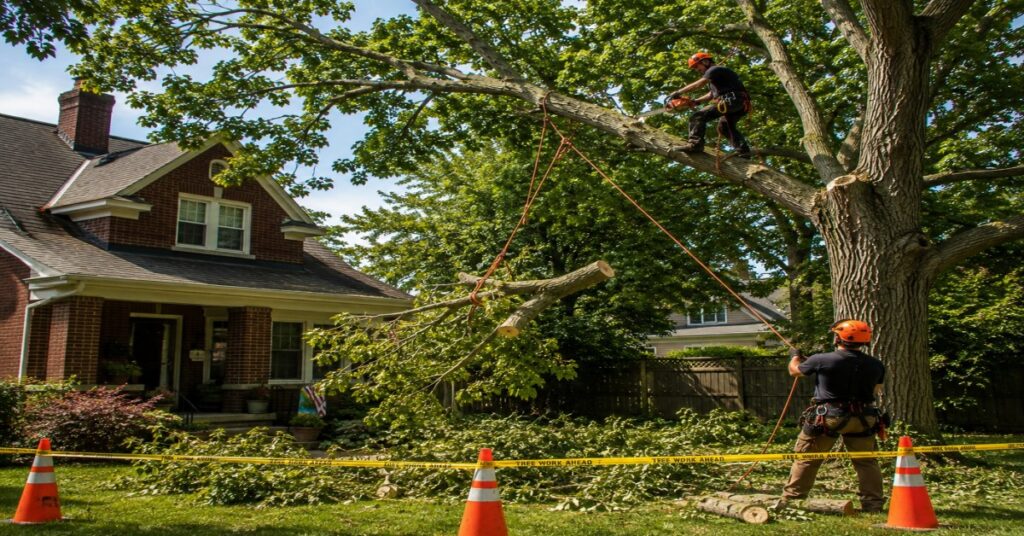
When mature oaks, maples, or pines in Western New York go unmaintained for years, a tranquil yard quickly transforms into a dangerous jungle. Consequently, knowing how to handle overgrown backyard tree trimming requires an understanding of tree biology, structural weight balance, and specialized safety protocols. In fact, large limbs hanging over rooflines, sagging near garage decks, or stretching toward power mains pose severe financial and physical risks.
Whether clearing low-hanging branches over a driveway in Amherst or thinning a heavy canopy in Cheektowaga, attempting overgrown backyard tree trimming without proper planning can permanently damage a tree or cause emergency room injuries. Therefore, this local guide breaks down how Buffalo homeowners can assess backyard risks, execute foundational pruning cuts, and recognize when to step back and call licensed arborists.
Table of Contents
- 1. The Hidden Dangers of Neglecting Backyard Canopy Growth
- 2. Essential Safety Gear & Tools Checklist
- 3. The 3-Step Cut Method for Heavy Backyard Limbs
- 4. How Much Canopy Can You Safely Trim at Once?
- 5. Critical Warning Signs: When DIY Trimming Isn’t Worth the Risk
- 6. Why Buffalo Weather Demands Regular Tree Care
- 7. Why Professional Tree Care Saves Money Long-Term
- 8. Frequently Asked Questions
The Hidden Dangers of Neglecting Backyard Canopy Growth
Ultimately, an overgrown canopy creates far more than an unkempt yard. Over time, excessive branch weight exerts tremendous leverage on weak V-shaped branch crotches. As a result, sudden limb loss occurs during summer thunderstorms or heavy winter snowfall across Erie County.
Specifically, common hazards stemming from unpruned trees include:
- Shingle Abrasion: Because of constant wind friction, branch contact strips protective mineral granules from asphalt roof shingles, thereby accelerating leaks and wood rot.
- Gutter Clogging & Foundation Damage: Additionally, dense foliage sheds leaves and twigs directly into gutter systems, which leads to dangerous water overflow near home foundations.
- Wildlife Access Routes: Furthermore, overgrown limbs extending within 6 feet of a roofline act as natural highways for squirrels, raccoons, and carpenter ants seeking attic shelter.
By reviewing comprehensive options for tree trimming and maintenance plans in Buffalo, NY, homeowners keep trees structurally sound while preventing costly structural damages.
Essential Safety Gear & Tools Checklist
Before attempting basic overgrown backyard tree trimming, arm yourself with proper personal protective equipment (PPE). For instance, never attempt ground or ladder pruning without complete head, eye, and hand protection.
Mandatory Safety Gear
- ANSI-Approved Hard Hat: To begin with, it protects against falling debris and unpredictable branch rebounds.
- Chainsaw Chaps: In addition, high-viscosity Kevlar lining stops running chainsaw blades instantly upon contact.
- Safety Glasses & Ear Protection: Meanwhile, this gear shields eyes from flying wood fragments and protects hearing against high-decibel motors.
- Steel-Toe Work Boots: Finally, steel-toe boots provide firm traction on uneven yard soil or slippery grass.
Recommended Hand Tools
- Hand pruners (for twigs under $3/4$ inch in diameter).
- Heavy-duty bypass loppers (for limbs up to $1.5$ inches thick).
- Manual fiberglass pole saw (for low-hanging branches under $2$ inches).
Most importantly, never operate a motorized chainsaw while standing on an extension ladder or step ladder. This is because ladder kickbacks are a leading cause of severe residential landscaping injuries.
The 3-Step Cut Method for Heavy Backyard Limbs
When performing overgrown backyard tree trimming, how a cut is executed matters just as much as where it is placed. In contrast to proper pruning, flush cuts tear into a tree’s natural defense collar, while leaving long stubs invites fungal infection and boring insects.
To prevent heavy limbs from tearing bark down the main trunk as they fall, always utilize the Three-Cut Method:
- Step 1 (Undercut): First, cut upward on the underside of the branch roughly 12 inches out from the trunk, penetrating $1/3$ of the limb’s thickness.
- Step 2 (Top Cut): Second, move 2 to 3 inches further out along the branch and saw downward from the top until the limb drops cleanly.
- Step 3 (Collar Cut): Third, make the final smooth cut just outside the branch bark collar—the swollen ridge where the limb meets the trunk.
Because of this precise technique, overgrown backyard tree trimming heals naturally through compartmentalization without requiring wound dressings.
How Much Canopy Can You Safely Trim at Once?
In reality, a major mistake homeowners make during overgrown backyard tree trimming is stripping away too much foliage at one time. As a consequence, over-pruning induces severe tree shock, which causes the plant to push out weak, rapidly growing “water sprouts” (epicormic shoots) that snap easily during high winds.
For this reason, follow the 25% Pruning Rule: Never remove more than $25\%$ of a tree’s total living canopy in a single season.
| Tree Age / Condition | Maximum Canopy Removal | Ideal Pruning Window |
|---|---|---|
| Young, Fast-Growing Trees | Up to 25% | Late Winter / Early Spring |
| Mature, Established Trees | 10% to 15% | Dormant Season (Nov–March) |
| Overgrown / Weak Trees | 10% max per year | Dormant Season |
Understanding the difference between tree pruning and tree trimming is critical when evaluating canopy density. While aesthetic trimming shapes outer foliage, structural pruning removes specific interior weight without stressing the tree’s health.
Critical Warning Signs: When DIY Trimming Isn’t Worth the Risk
While basic maintenance on lower branches is manageable for homeowners, certain overgrown backyard tree trimming scenarios carry extreme safety risks.
For your safety, stop immediately and hire a professional if you notice any of the following conditions:
- Proximity to Utility Lines: Above all, never trim branches within 10 feet of power lines. This is because electricity can jump across open space to ladders or pole tools. Furthermore, always review official safety guidelines from the U.S. Occupational Safety and Health Administration (OSHA) before working near electrical lines.
- Thick Structural Limbs (> 4 inches): Likewise, heavy limbs carry immense kinetic force when falling, often bouncing unpredictably off lower branches.
- Internal Fungal Decay: Similarly, bracket fungi, mushrooms at the root flare, or hollowed trunks signal compromised interior wood.
- Property Targets: In addition, branches suspended over glass enclosures, garage roofs, neighbor lines, or air conditioning units require specialized rigging gear to lower limbs safely.
Before attempting to cut high limbs yourself, carefully inspect where the overgrown branches are extending. If you notice heavy limbs making contact with your shingles or gutters, review these dangerous signs of tree branches over roof lines to prevent roof structural damage before major storms hit.
Is Your Backyard Tree Over 15 Feet or Near Power Lines?
Don’t risk a dangerous fall. Let Treeman handle heavy limbs safely.
Why Buffalo Weather Demands Regular Tree Care
Overall, properties across Buffalo, Amherst, Tonawanda, and West Seneca endure extreme seasonal shifts—from lake-effect snow accumulation to high spring wind gusts off Lake Erie.
For example, heavy foliage acts like a sail during spring storms, thereby transferring huge mechanical stress to root plates. In winter, on the other hand, heavy ice accumulation on overgrown, horizontal branches causes sudden structural splits.
Consequently, timing your maintenance during the best time to trim trees in Buffalo, NY reduces canopy drag, mitigates snow load strain, and ensures dormant-season cuts heal cleanly before harsh weather returns.
Why Professional Tree Care Saves Money Long-Term
Ultimately, handling severe overgrown backyard tree trimming without professional aerial or rigging gear often leads to property damage or bodily harm. Therefore, partnering with a licensed and insured local specialist offers clear benefits:
- Fully Insured General Liability & Workers’ Comp
- Specialized Bucket Trucks & Crane Access
- Certified Arborist Canopy Health Assessment
- Thorough Debris Chipping & Site Cleanup
At Treeman, our experienced crews bring bucket trucks, heavy-duty chippers, and professional climbing tools straight to your driveway. As a result, we resolve complex overgrown backyard tree trimming challenges efficiently and safely—leaving your lawn immaculate.
Need Help Trimming Overgrown Backyard Trees Safely?
Don’t take unnecessary risks on high ladders with power tools. Call Treeman today at (716) 466-5990 or request an estimate online for a Free On-Site Safety Assessment and Detailed Quote!
Treeman serves Getzville, Amherst, Williamsville, Clarence, Lockport, East Amherst, and surrounding Buffalo, NY communities. Licensed, insured, and committed to leaving your property cleaner than we found it — on every job, every time.
Frequently Asked Questions
What is the best season for overgrown backyard tree trimming in Buffalo, NY?
Generally, late fall through early spring (the dormant season) is best. This is because trees experience minimal sap loss, diseases and pests are inactive, and naked branch structures make structural hazards easy to spot.
How much does professional overgrown backyard tree trimming cost in Buffalo?
Typically, light pruning of smaller trees ranges from $250 to $450. On the other hand, larger mature crown reductions or heavy structural removals near houses range between $600 and $1,500+.
Will trimming overgrown branches bring sunlight back to my lawn?
Yes! In fact, strategic crown thinning removes selective inner branches, thereby letting up to 40% more natural sunlight reach your grass and gardens without sacrificing overall shade.
Can I trim my neighbor’s overgrown tree branches hanging over my Buffalo property line?
Yes, under New York property law, you can legally trim branches hanging directly over your property line up to the boundary. However, you cannot legally cross into your neighbor’s yard, and you must not prune in a way that permanently damages or destroys the tree.
How do I know if an overgrown branch is dangerous and needs professional removal?
Key danger signs include branches touching power lines, limbs hanging directly over your roof, deep cracks in V-shaped crotches, or heavy decay near main trunk joints. If a branch is over 4 inches thick or higher than 15 feet, professional rigging tools are essential for safe removal.