
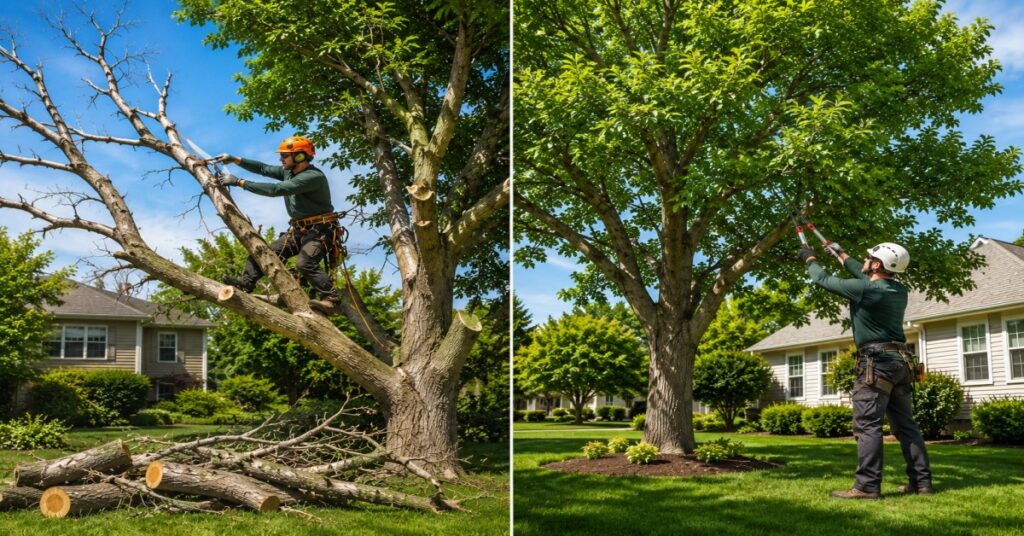
If you’ve been wondering about tree pruning vs tree trimming, you’re not alone — it’s one of the most common questions Buffalo homeowners ask before scheduling seasonal property care. While both services dramatically improve the look and safety of your yard, they serve completely different structural purposes. Tree trimming focuses on controlling the size, shape, and aesthetic neatness of overgrown branches. On the other hand, tree pruning targets the biological health and structural integrity of the tree — strategically removing dead, diseased, or weak limbs before they cause costly property damage. Knowing the difference protects your home, saves you money, and keeps your mature trees alive for generations.
Table of Contents
- What Is the Difference Between Tree Pruning vs Tree Trimming?
- What Is Tree Trimming? (Definition & Purpose)
- What Is Tree Pruning? (Definition & Purpose)
- Key Differences: Tree Pruning vs Tree Trimming
- The 5-Star Tree Care Checklist: Tools & Techniques
- When Do You Need Tree Trimming vs Tree Pruning?
- Best Time for Tree Pruning vs Tree Trimming in Buffalo, NY
- Why Proper Tree Maintenance Matters for Your Buffalo Property
- Frequently Asked Questions About Tree Care
- Ready to Schedule? Contact Treemanny Today
What Is the Difference Between Tree Pruning vs Tree Trimming?
If you’ve been wondering about tree pruning vs tree trimming, you’re not alone — it’s one of the most common questions Buffalo homeowners ask before scheduling seasonal property care. The truth is, both services improve the health, safety, and curb appeal of your landscape, but they serve entirely different structural purposes.
The core difference boils down to this: tree trimming focuses on controlling the size, shape, and aesthetic neatness of your trees and hedges. On the other hand, tree pruning targets the biological health and structural integrity of the tree — removing diseased, dead, or structurally weak branches before they cause serious property damage.
Understanding the nuances of tree pruning vs tree trimming can save you thousands of dollars in emergency removals, protect your roofline, and keep your mature trees alive for generations.
At Treemanny, we’ve handled hundreds of specialized residential tree care jobs across Getzville, Amherst, Williamsville, Clarence, and the greater Buffalo area. This comprehensive guide breaks down exactly what separates tree pruning vs tree trimming — in plain English.
What Is Tree Trimming? (Definition & Purpose)
Tree trimming is primarily an aesthetic and safety-focused service performed on a regular maintenance schedule. It is the process of cutting back overgrown, unruly branches to improve the overall shape, symmetry, and clearance of a tree or large shrub.
When a landscape goes left untended, fast-growing branches begin to look chaotic, blocking natural sunlight and encroaching on nearby structures. When assessing tree pruning vs tree trimming requirements, common reasons homeowners in Western New York call us for professional tree trimming include:
- Structure Clearance: Branches are growing too close to the roofline, gutters, siding, or low-hanging neighborhood power lines.
- Aesthetic Balance: Canopy growth looks uneven, overgrown, or visually lopsided, dragging down your property’s curb appeal.
- Property Boundaries: Large branches extend over a neighbor’s fence, a public sidewalk, or a busy driveway.
- Sunlight Penetration: Overgrown canopies completely block light from reaching your lawn, flower beds, or solar panels below.
Tree trimming is usually performed on hedges, ornamental shrubs, and live, healthy trees. It keeps aggressive growth in check and prevents minor overgrowth problems from turning into massive hazards — especially when heading into the unpredictable WNY storm seasons.
For expert seasonal tree care in the Buffalo area, learn more about our dedicated tree trimming and maintenance plans in Buffalo, NY.
What Is Tree Pruning? (Definition & Purpose)
Tree pruning goes far deeper than basic surface aesthetics. It is a highly strategic, medically necessary removal of specific branches that are dead, diseased, structurally compromised, or growing in a direction that threatens the life of the tree. When comparing tree pruning vs tree trimming, the primary goal of pruning is protection: protecting the tree from decay and protecting your family from falling wood.
Professional pruning requires an advanced understanding of tree biology, structural load distribution, and local plant diseases. It is performed with distinct architectural purpose:
- Deadwooding: Removing dead or dying branches to prevent destructive wood-rot fungi from spreading down into the main trunk.
- Crown Thinning: Carefully selectively removing secondary branches to improve internal air circulation and light penetration, reducing wind resistance during severe storms.
- Structural Training: Correcting weak, narrow branch attachments (included bark) before they split apart under stress.
- Sucker & Water Sprout Removal: Eliminating hyper-fast, weak growth at the base or joints that drains vital nutrients away from the rest of the tree.
In Western New York, analyzing tree pruning vs tree trimming requirements ahead of intense lake-effect snowstorms is critical. Heavy, wet winter snow accumulates rapidly on dense, unpruned canopies. When a tree hasn’t been structurally thinned, the immense weight causes catastrophic trunk splits. A properly pruned tree allows wind and heavy snow to pass safely through its branches, handling Buffalo winters far better than a tree left unmaintained for years.
According to the International Society of Arboriculture (ISA), proper structural pruning is one of the single best investments a property owner can make in the long-term appraisal value and safety of their real estate.
Key Differences: Tree Pruning vs Tree Trimming
To help you visualize your landscaping needs, evaluating a side-by-side tree pruning vs tree trimming breakdown highlights the core operational distinctions:
| Feature | Tree Trimming | Tree Pruning |
| Primary Goal | Canopy shape, size, and curb appeal | Biological health, safety, and structural integrity |
| What’s Removed | Overgrown, extended, or excess live branches | Dead, decaying, diseased, or crossing branches |
| Frequency | 1–2 times per year to maintain shape | As needed; typically every 1–3 years for mature trees |
| Tools Used | Power hedge trimmers, manual shears, pole pruners | Specialized pruning saws, heavy loppers, hand pruners |
| Best Time (WNY) | Spring or immediately following autumn leaf drop | Late winter / early spring (during the dormant season) |
| Application | Both trees and ornamental shrubs | Primarily mature, young, or historic trees |
The simplest way to remember the tree pruning vs tree trimming distinction: trimming shapes your landscape’s exterior silhouette, while pruning heals and strengthens its internal structure. Both services, when executed with precision, significantly increase the safety, lifespan, and beauty of your property.
The 5-Star Tree Care Checklist: Tools & Techniques
Executing these services correctly requires utilizing the proper commercial-grade equipment to ensure clean cuts that heal rapidly without leaving ragged, disease-prone tears. The standard tools used to manage tree pruning vs tree trimming include:
- Trimming Toolset: Heavy-duty gas or battery-powered hedge trimmers, hand shears, and lightweight pole trimmers. These tools are optimized to cut through thin, leafy, pliable outer growth to create straight, manicured edges.
- Pruning Toolset: Specialized bypass pruners, heavy-duty loppers for thick limbs, and razor-sharp hand-held pruning saws. For massive, structural limbs high in the canopy, certified crews utilize rigging ropes and commercial chainsaws.
- The Cut Technique: Trimming involves uniform shearing. Pruning requires cutting just outside the branch bark ridge and branch collar. Cutting too close (flush cuts) damages the main trunk; leaving too much of a stub invites wood-boring insects.
When Do You Need Tree Trimming vs Tree Pruning?
This is where many homeowners run into confusion when evaluating their property’s maintenance. Here is a definitive, straightforward checklist to help you identify which service your yard requires right now during a routine tree pruning vs tree trimming inspection.
Call for Tree Trimming When:
- Substantial branches are physically touching your roof, resting on your gutters, or wrapping around utility lines.
- Your ornamental privacy hedges and shrubs are looking messy, misshapen, or are spilling over onto public sidewalks.
- You are prepping your yard for outdoor spring hosting or fall cleanup.
- You want to rapidly maximize your home’s curb appeal before placing it on the Buffalo real estate market.
Call for Tree Pruning When:
- You spot dry, brittle, barkless, or completely hanging branches high up in the canopy.
- A major branch cracked during a recent high-wind storm but remains dangerously suspended in the air.
- The tree canopy looks remarkably sparse on one side or shows signs of top-down die-back.
- You notice deep structural cracks where major limbs meet the main trunk.
- You spot visible signs of localized disease, aggressive fungal shelf growth, or pest damage (such as emerald ash borer activity, which remains highly active across Erie County).
If you look up at your canopy and remain unsure about where your property falls in the tree pruning vs tree trimming debate, a quick visual inspection by a certified local professional is the safest path forward. Treemanny regularly services Getzville, Amherst, Clarence, Williamsville, Lockport, and all surrounding Buffalo suburbs with comprehensive on-site evaluations.
Best Time for Tree Pruning vs Tree Trimming in Buffalo, NY
Seasonal timing matters infinitely more in Western New York than it does in milder climates. Because our local trees endure severe freeze-thaw cycles and intense wind loads, scheduling your tree pruning vs tree trimming services at the correct biological window is essential for plant survival.
To help you map out your property’s care schedule safely, you can read our comprehensive breakdown on seasonal tree trimming services in Buffalo, NY and keeping your trees safe through every shifting weather front.
Late Winter / Early Spring (February – April)
This is the gold-standard window for deep structural pruning. Because local hardwoods (like our native Maples and Oaks) are completely dormant, sap loss is minimal, and the risk of pest infestation is virtually zero. Additionally, without leaves blocking the view, our arborists can clearly see the underlying skeletal structure of the tree to identify hidden defects.
Important Note: Oak trees across Erie County should exclusively be pruned before April to completely mitigate the risk of devastating Oak Wilt transmissions.
Spring and Summer (May – August)
Light aesthetic trimming is perfectly safe during the active growing season. However, you should strictly avoid making heavy, invasive structural pruning cuts during peak summer heat. The combined stress of heavy sap loss and summer drought can severely shock a tree heading into autumn. This season is best reserved for structural clearance trimming away from homes.
Fall (September – November)
Avoid major structural pruning in early autumn. During this phase, trees are actively entering dormancy and channeling energy back into their root systems. Making large cuts now can stimulate weak, late-season growth that will immediately freeze and die when winter arrives. Light canopy trimming to remove obvious storm hazards before the first snowfall is acceptable.
Winter (December – January)
Dormant winter pruning is exceptionally healthy for resilient WNY hardwoods. The ground is completely frozen solid during these months, meaning heavy tracking equipment can access your backyard without leaving deep tire ruts or compacting your lawn’s root systems.
Why Proper Tree Maintenance Matters for Your Buffalo Property
In Buffalo and its surrounding residential communities, regular tree maintenance isn’t merely a matter of keeping your lawn looking pristine—it is a critical property liability and safety issue.
Dead, decaying, or structurally weak branches dangling over a roofline, parking driveway, or children’s play area represent a ticking time bomb during our sudden wind-heavy spring storms and intense winter lake-effect snows. A single major branch failure can cause tens of thousands of dollars in structural roof punctures, smashed vehicles, or downed power lines. To make matters worse, many homeowners insurance policies will deny coverage claims if the underlying tree shows clear signs of visible, long-term maintenance neglect.
Investing in a balanced routine of professional tree pruning vs tree trimming provides measurable financial returns:
- Elevated Property Appraisal: Well-maintained, mature trees can add an estimated 10% to 15% to a home’s total market value according to data from the Arbor Day Foundation.
- Minimized Emergency Expenses: Proactive preventative care dramatically lowers the risk of needing emergency tree removal services, which cost substantially more than routine scheduled maintenance.
- Climate Resilience: Structured, balanced canopies help your trees successfully survive Western New York’s intense freeze-thaw cycles, waterlogged spring soils, and multi-ton snow loads year after year.
Frequently Asked Questions About Tree Care
Q: Is tree pruning vs tree trimming really that different?
A: Yes, they are entirely distinct services. Trimming manages outer shape, aesthetics, and clearance. Pruning removes internal hazards to protect the biological health and safety of the tree. Many Buffalo properties actually require both services performed across different trees in the same yard.
Q: How many times a year should my trees be pruned in Erie County?
A: Most healthy, mature canopy trees only require professional structural pruning every 1 to 3 years. Rapidly growing young trees or delicate ornamental varieties may benefit from more frequent checkups. Any tree impacted by severe storms should be inspected by a professional immediately.
Q: Can I handle tree pruning vs tree trimming as a DIY weekend project?
A: Small ground-level hedges, low shrubs, and minor fruit tree shaping can absolutely be managed as safe DIY projects. However, any branch growing above head height, hanging near utility lines, resting against a roof, or displaying extensive disease should be left to a licensed, insured professional team. Incorrect cuts can permanently stunt a tree’s growth or cause fatal decay.
Q: What’s the best time for tree pruning vs tree trimming in Western New York?
A: Late winter through early spring is ideal for most pruning work. Trimming can be done spring through fall, with light clearance work possible year-round.
Q: What specific geographic areas does Treemanny serve?
A: Treemanny proudly provides premium residential and commercial tree care across Getzville, Amherst, Williamsville, Clarence, Lockport, East Amherst, and the greater Buffalo metropolitan region.
Ready to Schedule? Contact Treemanny Today
Now that you understand the 5-star difference between tree pruning vs tree trimming, the next step is getting your property safely scheduled before Buffalo’s next major storm season arrives. Don’t wait for a fragile, hanging branch to turn into an expensive midnight emergency.
Treemanny is a fully licensed, comprehensively insured local tree care company dedicated to serving Western New York homeowners with elite trimming, precision pruning, and full-scale tree management. Hundreds of local families trust our prompt, professional crew to keep their properties beautifully manicured, safe, and protected through every season of the year.
Tap the Call button below to speak with our local crew directly, or click our website’s contact form to request your free, no-obligation on-site estimate today!
For complete year-round property protection, view our specialized tree trimming and maintenance plans in Buffalo, NY.
Treemanny proudly serves the homeowners of Getzville, Amherst, Williamsville, Clarence, Lockport, East Amherst, and surrounding Buffalo, NY, communities.