
Taking down a large or hazardous tree on your Buffalo property is an extensive project, making it crucial to know how to protect yard during tree removal before work begins. Whether you face an unstable oak after a Western New York winter storm or need to remove a dead ash tree threatening your roofline, your primary worry is likely the aftermath. You want the tree gone, but you do not want heavy machinery to crush your beautiful turf, destroy your flower beds, or crack your hardscaping.
Homeowners often ask us exactly how we manage to drop tons of hardwood without leaving a trail of destruction behind. The short answer is simple: elite tree care focuses on preservation, not just cutting wood.
Table of Contents
- 1. Comprehensive Pre-Work Site Assessments
- 2. Utilizing Specialized Outrigger and Turf Protection Mats
- 3. Advanced Rigging and Roping Techniques
- 4. Articulating Aerial Lifts and Advanced Equipment
- 5. Strict Debris Mitigation & Meticulous Cleanup
- 6. Protecting Your Underground Utilities and Irrigation
- 7. Clear Subcontractor and Crew Safety Briefings
- 8. Comparative View: DIY vs. Professional Property Protection
- 9. Frequently Asked Questions (FAQ)
- 10. Conclusion: Hire Buffalo’s Trusted Tree Crew
Comprehensive Pre-Work Site Assessments
Before a crew pulls a single chainsaw, our experienced team conducts an intensive site risk assessment. This goes far beyond looking up at the branches. We inspect the ground conditions, the entry points, and the proximity of delicate landscape features to design a plan that will protect yard during tree removal from day one.
Identifying Hardscape and Softscape Risks
We map out your yard’s specific pain points, including:
- Unpaved patios, flagstone walkways, and concrete driveways.
- Perennial gardens, prized shrubs, and manicured turf grass.
- Overhead power structures and architectural overhangs.
By creating a clear drop-and-haul path before work begins, our ISA-certified team guarantees that heavy sections of wood never hit vulnerable areas of your property. We tailor our structural safety plan specifically to protect yard during tree removal without causing unexpected delays.
Utilizing Specialized Outrigger and Turf Protection Mats
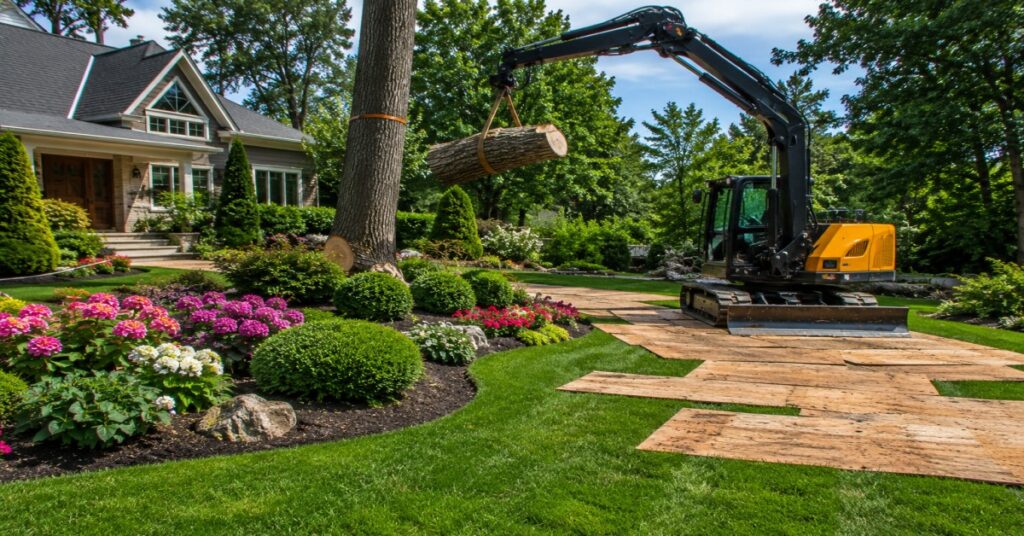
The weight of the equipment poses one of the biggest threats to your lawn during a tree service project—not the falling branches. Heavy machinery like bucket trucks or mini-loaders can leave deep ruts, compact the soil, and kill your grass roots if our team drives them directly onto soft ground. This is why crews must use specialized gear to protect yard during tree removal projects effectively.
To combat this, professional crews deploy specialized turf protection mats (often referred to as AlturnaMATS). These heavy-duty ground sheets distribute the massive weight of outriggers and tires over a broad surface area. This ensures that even if recent Western New York rain softens the ground, our machinery moves smoothly without displacing your soil or churning up your lawn. Investing in ground shielding tools remains the single best way to protect yard during tree removal when heavy trucks must enter the site.
Advanced Rigging and Roping Techniques
True arboricultural professionals rarely drop a tree in one piece unless they work in a wide-open field. In residential areas across Buffalo, we use precision rigging systems to manage the descent of every single limb. Utilizing advanced rigging allows our team to protect yard during tree removal in tight spatial conditions between houses. To see a detailed, step-by-step breakdown of how our arborists execute these safe rigging frameworks from start to finish, you can review our guide on the professional tree removal process.
Expert Insight: Our climbers use heavy-duty lowering ropes, friction blocks (Port-a-Wraps), and high-capacity pulleys to secure each section of the tree before cutting it.
Once our climber makes the cut, the ground crew carefully lowers the piece down to a designated, protected landing zone. This controlled rigging technique ensures that massive branches never free-fall into your delicate garden beds or smash your landscape lighting. It remains one of our baseline operational strategies used to protect yard during tree removal operations cleanly.
Articulating Aerial Lifts and Advanced Equipment
Technology has completely transformed how crews protect yard during tree removal. Instead of rolling massive, heavy trucks onto your grass, modern tree care providers use low-impact, articulating spider lifts. This advanced mechanical approach makes it much easier to protect yard during tree removal tasks without sacrificing accessibility.
These incredible machines feature wide, rubberized tracks that apply less ground pressure per square inch than a human footstep. They can squeeze through narrow backyard gates and reach high into the canopy without ever touching your lawn with heavy truck tires. This allows us to complete complex removals safely while leaving your yard looking exactly as it did when we arrived.
Strict Debris Mitigation & Meticulous Cleanup
The quality of cleanup defines a true professional tree care company. A massive tree produces an incredible volume of sawdust, leaves, and small twigs. Left scattered across your lawn, this debris can smother your grass and alter soil acidity. We develop our comprehensive cleaning protocols specifically to protect yard during tree removal from long-term lawn damage caused by residual wood waste.
Our ground crews work continuously throughout the project. We use specialized tarps to catch falling sawdust, and we run limbs through commercial wood chippers immediately to reduce the footprint of the raw material. Once the tree is completely down, we power-blow the area, rake the turf, and remove any stray twigs so your property remains pristine.
Protecting Your Underground Utilities and Irrigation
What lies below your lawn matters just as much as what stands above it. Many homeowners forget that heavy machinery can easily crush underground sewer lines, septic tanks, and lawn irrigation systems. To fully protect yard during tree removal, an arborist must have clear visibility of what lies beneath the sod.
As a safety-first local service, we verify the locations of your underground utilities through official safety services like UDIG NY (811) whenever a project requires heavy ground penetration or deep stump grinding. We also ask you to point out any hidden sprinkler heads or shallow drainage lines so our crew can steer clear and safeguard them entirely. Taking these underground precautions allows us to protect yard during tree removal both visually and structurally.
Clear Subcontractor and Crew Safety Briefings
A sound technical plan succeeds only when a highly trained team executes it. Before the first cut happens on your property, our job site foreman holds a dedicated safety and property briefing with the entire crew. Every team member learns exactly where the “no-go zones” sit, where delicate landscaping resides, and which paths we cleared for transporting wood. This highly disciplined communication ensures that we protect yard during tree removal at every phase of the daily project.
Comparative View: DIY vs. Professional Property Protection
| Property Element | The DIY / Uninsured Amateur Risk | Professional Protection Standards |
|---|---|---|
| Lawn & Turf | Deep tire ruts, torn roots, dead grass patches | Weight-distributing AlturnaMATS, low-impact tracking |
| Flower Beds & Gardens | Crushed plants from free-falling branches | Controlled rigging, custom-placed catch tarps |
| Driveways & Concrete | Stress cracks from heavy vehicle outriggers | Structural wood padding placed beneath stabilizers |
| Underground Pipes | Crushed PVC lines, collapsed septic fields | Utility verification and explicit machinery clearance paths |
Frequently Asked Questions
Will tree removal equipment ruin my lawn?
If driven directly over unprotected grass, heavy vehicles like bucket trucks will leave deep ruts and cause severe soil compaction. Professional tree services prevent this by mapping dedicated travel lanes and laying down weight-distributing AlturnaMATS to absorb the machinery’s weight.
How do tree companies keep branches from hitting my house or landscaping?
Crews use an advanced arborist strategy called precision rigging. Instead of dropping limbs freely, climbers secure every section with high-capacity ropes and pulleys. The ground crew then mechanically lowers each cut piece to a clear, designated safety zone.
Should I cover my flower beds before the tree crew arrives?
While professional crews use custom catch tarps to shield nearby gardens, you can clear smaller potted plants, lawn ornaments, and delicate patio furniture out of the work zone ahead of time to make the safety path as clear as possible.
Do tree removal tracks damage underground pipes or septic lines?
Yes, heavy trucks can crack shallow PVC irrigation lines or collapse septic fields. You should always point out your property’s underground systems to your project foreman during your initial consultation so the crew can map out an explicit clearance path.
Conclusion: Hire Buffalo’s Trusted Tree Crew
Safely removing a dangerous tree requires a perfect balance of raw power and delicate precision. When you know how to protect yard during tree removal, you can book your tree care projects with complete peace of mind, knowing your home investment remains safe. Choosing an amateur can cost you thousands in yard repairs, whereas selecting a high-tier crew guarantees a seamless experience.
If you look for an experienced, fully licensed, and insured team that treats your lawn like their own, we are here to help. For more details on finding a premium local provider, read our how to choose the best tree removal service Buffalo a complete guide. Ready to get that hazardous tree safely out of your yard while keeping your landscape immaculate?
Get A Free Estimate From Treemanny Today
You now know exactly what to look for when you “protect yard during tree removal”. The next step is getting a no-obligation estimate from a crew that local homeowners have trusted across Western New York.
Treemanny is licensed, insured, locally operated, and committed to leaving your property cleaner than we found it — on every job, every time.
Treemanny serves Getzville, Amherst, Williamsville, Clarence, Lockport, East Amherst, and surrounding Buffalo, NY communities. Licensed and insured.