
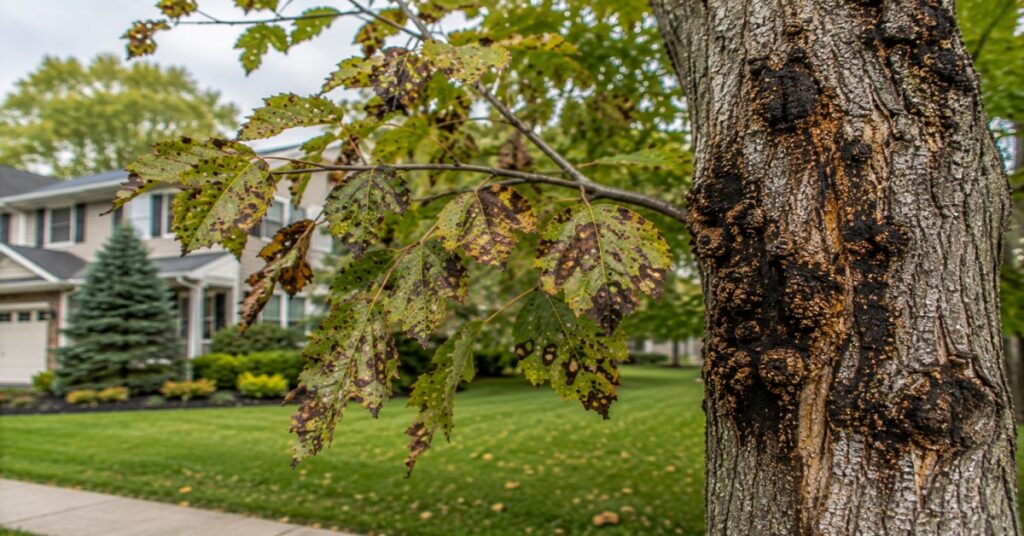
Recognizing early tree disease signs Buffalo NY property owners encounter is essential. In fact, it helps save mature trees and protects nearby roofs. Therefore, catching symptoms early helps avoid expensive emergency removals.
Western New York has a unique regional climate. Specifically, rapid freeze-thaw cycles, lake-effect snow, and wet clay soil create ideal conditions for rot. Left untreated, minor foliar stress turns into deep heartwood decay. Consequently, weakened limbs fail unexpectedly during severe regional storms.
Below is an arborist guide to critical tree disease signs Buffalo NY yards show. In addition, this guide helps spot infections early. Therefore, book professional tree inspection and tree care in Buffalo, NY before property damage occurs.
Table of Contents
- 1. Common Buffalo Tree Diseases & Visible Signs
- 2. 7 Critical Tree Disease Signs Buffalo NY Homeowners Must Spot
- 3. Treating Tree Diseases vs. Knowing When Removal Is Necessary
- 4. Preventative Tree Care Best Practices for Buffalo Properties
- 5. Protect Your Property with Tree Man NY: Certified Buffalo Tree Care
- 6. Frequently Asked Questions About Tree Diseases in Buffalo, NY
Common Buffalo Tree Diseases & Visible Signs
Identifying visible distress markers helps prevent total landscape loss. For instance, knowing key symptoms helps homeowners act quickly:
| Visible Symptom | Suspected Disease / Pathogen | High-Risk Tree Species | Action Level |
|---|---|---|---|
| Premature leaf browning & drop | Anthracnose / Apple Scab | Oak, Sycamore, Maple, Crabapple | Moderate (Corrective pruning) |
| Top-down crown dieback & wilt | Oak Wilt (Bretziella fagacearum) | Red Oak, Pin Oak, White Oak | Critical (Rapidly fatal; isolate immediately) |
| Shelf fungi / conks at root flare | Basidiomycete Wood Decay | Maple, Ash, Beech, Willow | Severe (High collapse hazard) |
| D-shaped exit holes & crown loss | Emerald Ash Borer (Agrilus planipennis) | Green Ash, White Ash, Black Ash | High Risk (Hazard removal) |
| Vertical trunk fissures & oozing | Frost Cracks & Bacterial Cankers | Maple, Elm, Fruit Trees | Moderate to High (Pathogen entry) |
7 Critical Tree Disease Signs Buffalo NY Homeowners Must Spot
Spotting the most frequent tree disease signs Buffalo NY yards develop allows homeowners to catch biological problems early. In addition, early detection prevents sudden structural failures.
- Thinning crown & dieback
- Premature leaf drop
- Brittle, dead branch tips
- Deep vertical fissures
- Peeling bark & cankers
- Weeping sap & borer holes
- Bracket fungi (conks)
- Soil heaving / lift
- Spongy, decaying roots
1. Premature Leaf Browning, Blotch, and Early Defoliation
Premature leaf drop is common in local yards. In fact, it is one of the clearest tree disease signs Buffalo NY properties show in late spring.
Foliar blights like Anthracnose thrive in cool, wet Great Lakes springs. For example, they frequently infect maples, oaks, and sycamores. Although a single infection rarely kills a tree, recurring outbreaks exhaust stored energy reserves. Consequently, this persistent stress leaves trees vulnerable to boring insects.
2. Canopy Dieback and Crown Thinning (Top-Down Death)
Crown dieback occurs when top branches lose foliage while lower limbs stay green.
In Erie County, crown thinning points to vascular wilt diseases like Oak Wilt and Dutch Elm Disease. Specifically, these fungi invade xylem vessels and block water flow to upper limbs. Therefore, recognizing these specific tree disease signs Buffalo NY trees exhibit stops disease spread through connected root systems.
3. Fungal Conks and Mushrooms Along the Trunk and Root Base
Bracket fungi (conks) or mushroom clusters on the trunk signal deep heartwood decay.
In fact, fungi digest cellulose and lignin. These natural fibers provide essential structural strength. Furthermore, in areas with dense clay like Amherst and Cheektowaga, poor drainage speeds up root rot. Ultimately, spongy internal wood destroys anchorage, causing sudden tree failure during windstorms.
4. D-Shaped Exit Holes, Bark Splitting, and S-Shaped Galleries
Thinning ash canopies require immediate bark inspection. For instance, look for 1/8-inch D-shaped exit holes, loose bark plates, and winding larval tunnels.
These marks confirm an Emerald Ash Borer (EAB) infestation. Moreover, research from the Cornell Cooperative Extension shows EAB larvae destroy the inner cambium layer. As a result, ash trees showing these tree disease signs Buffalo NY yards experience turn brittle and dangerous very quickly.
5. Deep Bark Cankers, Fissures, and Weeping Fluid
Healthy bark shields inner wood from pathogens. However, sunken patches of dead bark or oozing sap indicate bacterial or fungal infections.
In Western New York, these issues often start as winter frost cracks. Subsequently, fungi like Botryosphaeria and Cytospora enter these splits. They girdle branches and ultimately kill foliage above the wound site.
6. Sudden Structural Leaning Paired with Ground Soil Heaving
A newly developing lean is a serious structural emergency.
First, inspect the ground opposite the lean. Specifically, look for cracked soil, mounding turf, or snapped roots. These visible signs mean the root plate has separated from the ground. Consequently, saturated clay soil and root rot increase failure risks during heavy snowstorms and high winds.
7. Epicormic Sprouting Along the Lower Trunk
Dense clusters of weak green shoots on the lower trunk indicate severe physiological stress.
These growths are called epicormic shoots. Specifically, they appear when vascular disease or root rot starves the upper crown. Therefore, the tree produces low shoots as an emergency survival tactic. Overall, evaluating these subtle tree disease signs Buffalo NY landscapes show is vital for timely preservation.
Concerned About Dying or Leaning Trees?
Fungal rots, cracked trunks, and invasive borers weaken trees from the inside out. In fact, waiting for severe storm winds can lead to sudden, dangerous tree failures. Therefore, schedule a fast property hazard evaluation with our certified Buffalo tree crews today.
Treating Tree Diseases vs. Knowing When Removal Is Necessary
Not every sick tree requires immediate removal. In fact, identifying early tree disease signs Buffalo NY homeowners observe allows arborists to apply targeted solutions:
- Crown Pruning & Sanitation: Removes diseased limbs, enhances airflow, and eliminates active fungal spores.
- Vascular Micro-Injections: Delivers systemic fungicides or insecticides directly into active sapwood during spring.
- Root Zone Remediation: Decompacts heavy clay and pulls mulch away from root flares to stop collar rot.
Treatable: <30% Canopy Dieback
- Crown Sanitation Pruning
- Deep Root Soil Decompaction
- Micro-Injection Inoculation
Hazard: >40% Structural Rot
- Comprehensive Safety Inspection
- Safe, Controlled Tree Removal
- Precision Stump Grinding
When Controlled Tree Removal Is Required
Removal is necessary when internal decay exceeds 30% to 40% of the trunk. In addition, it is required when dead limbs hang over homes or power lines. Review our guide on when to remove a tree from your property for safe guidance. Thus, when severe tree disease signs Buffalo NY trees display threaten structural safety, prompt action is critical.
Preventative Tree Care Best Practices for Buffalo Properties
Managing persistent tree disease signs Buffalo NY properties encounter requires proactive, seasonal yard care:
- Follow Seasonal Pruning Restrictions: Avoid trimming oaks and elms from April through July. This follows standards from the International Society of Arboriculture (ISA) to prevent beetle-borne wilt.
- Prevent Mulch Volcanoes: Keep mulch 3 to 4 inches away from trunk bark. As a result, this prevents moisture traps that trigger fungal collar rot.
- Sterilize Trimming Equipment: Clean saws and shears with 70% isopropyl alcohol between trees. Consequently, this stops infectious cankers from spreading.
- Schedule Pre-Winter Inspections: Inspect mature shade trees every autumn. Therefore, this ensures branches can handle heavy snow and ice loads.
Protect Your Property with Tree Man NY: Certified Buffalo Tree Care
Ignoring visible tree disease signs Buffalo NY yards face can turn manageable issues into costly property emergencies. Furthermore, diagnosing recurring arboreal distress signals ensures long-term safety and healthy trees.
At Tree Man NY, our licensed and insured team provides health inspections, precision trimming, and hazardous removals. We serve Buffalo, Amherst, Getzville, Williamsville, Clarence, Lockport, and East Amherst. Moreover, we inspect root stability, detect internal rot, and keep your property protected.
Spotting Warning Signs on Your Trees?
Do not wait for the next storm to test your tree’s stability. In fact, catching early tree disease signs in Buffalo, NY saves mature shade trees and avoids costly emergency damage. Schedule an arborist evaluation today with a crew trusted across Western New York.
Tree Man NY serves Buffalo, Amherst, Getzville, Williamsville, Clarence, Lockport, East Amherst, and surrounding Western New York communities. Licensed, fully insured, and dedicated to leaving your property clean and safe.
Frequently Asked Questions About Tree Diseases in Buffalo, NY
Can tree diseases spread between neighboring yards in Buffalo?
Yes. Fungal spores travel easily through wind and rain splash. Meanwhile, vascular diseases like Oak Wilt spread underground through grafted root networks shared by adjacent trees. Therefore, understanding how localized pathogens spread helps stop community-wide contamination.
How do I know if a tree branch is dead or just dormant after winter?
Perform a quick scratch test using your fingernail on a small branch. If the tissue under the bark is green and moist, it is alive. However, if it is dry, brittle, and brown, the branch is dead.
Does homeowners insurance cover diseased tree removal in New York?
Standard policies only cover removal if a diseased tree falls and damages an insured structure. Otherwise, routine preventative removal of standing dead trees remains the homeowner’s responsibility.
Can a diseased tree be cured, or does it always need removal?
Many diseased trees can be saved if diagnosed early. Treatments like micro-injections, root decompaction, and crown sanitation stop fungal spread. However, if internal decay exceeds 30% to 40% of the trunk, safe removal becomes necessary.
When is the best time of year to treat diseased trees in Buffalo, NY?
Late winter and early spring dormancy is the best time for disease assessment and corrective pruning. In contrast, avoid pruning oaks and elms during late spring to prevent beetle-borne vascular infections.