
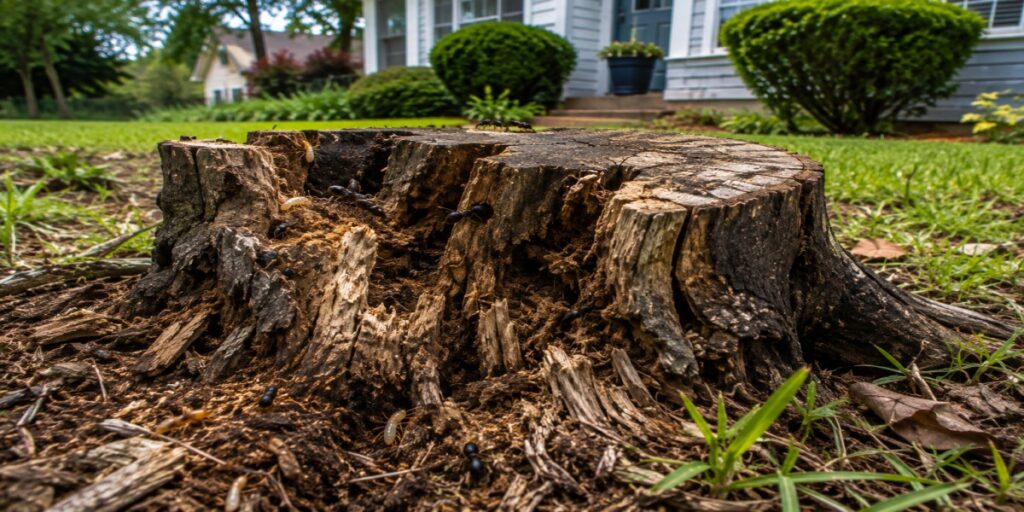
Leaving a tree stump in your lawn might seem like an innocent choice. However, as the buried wood decays under moist soil, old tree stumps attract pests like subterranean termites, carpenter ants, and rodents to your property. Do old tree stumps attract pests in a way that poses a real threat to your home foundation? Certified arborists give a resounding yes.
When decaying timber sits untreated in Western New York, wood-boring insects quickly establish thriving nests. Eventually, these subterranean colonies migrate toward your porch, deck, or house framing. Therefore, understanding why these remnants attract bugs is vital for protecting your property value and lawn health.
For comprehensive assistance with yard restoration and hazard mitigation, explore our full range of stump grinding and stump removal in Buffalo, NY.
Table of Contents
- 1. Why Old Tree Stumps Attract Pests in Buffalo Lawns
- 2. 7 Dangerous Pests Attracted to Old Tree Stumps in Western New York
- 3. The Underground Danger: How Stump Roots Feed Hidden Colonies
- 4. DIY Stump Removal vs. Professional Stump Grinding
- 5. How Treeman Prevents Pest Infestations in Buffalo, NY
- 6. Frequently Asked Questions
Why Old Tree Stumps Attract Pests in Buffalo Lawns
Tree stumps do not simply sit quietly in the grass. Instead, they undergo a slow decay process driven by moisture and fungi. As cellulose and lignin break down, the wood softens dramatically. In addition, it releases chemical scent signals that wood-boring insects seek out. This is the primary reason old tree stumps attract pests to your yard so rapidly.
When left in place, these decaying roots retain groundwater from heavy Buffalo rainfalls and snowmelts. As a result, rotting wood creates ideal damp breeding conditions beneath the surface. Populations multiply undetected before spreading to your home. Thus, taking action early helps prevent severe property damage.
7 Dangerous Pests Attracted to Old Tree Stumps in Western New York
Different species thrive inside rotting wood based on the season. Here are seven common pest species found in Erie and Niagara counties:
- Eastern Subterranean Termites: Termites consume dead cellulose. Therefore, decaying wood helps build massive satellite colonies.
- Carpenter Ants: Unlike termites, carpenter ants do not eat wood. However, decaying wood offers shelter to excavate galleries and rear their young.
- Wood-Boring Beetles: Beetles lay eggs in dying bark. Subsequently, their larvae tunnel through dead wood and weaken nearby trees.
- Rats, Mice, and Field Voles: Hollowed-out stumps offer sheltered nesting chambers. Consequently, rodents use them for winter protection.
- Snakes and Yellowjackets: Abandoned rodent burrows beneath old stumps frequently house eastern garter snakes or ground-nesting yellowjackets.
- Fungal Mycelium & Spores: Wood-decaying fungi spread through the subterranean root system. As a result, fungal pathogens threaten nearby lawns.
- Mosquitoes: Rainwater pooling in stump hollows creates stagnant breeding grounds throughout Buffalo summers.
The Underground Danger: How Stump Roots Feed Hidden Colonies
What you see above ground is only a fraction of the total wood. In fact, a tree’s root system extends two to three times the width of the canopy.
Even after tree removal, this underground root matrix stays moist for years. Because old tree stumps attract pests underground, wood-boring insects travel through subterranean decay corridors. As a result, they access building foundations without ever emerging above ground. Therefore, eliminating this threat requires removing the central stump hub completely.
According to research from the Cornell University College of Agriculture and Life Sciences, managing woody debris and removing decaying stumps is a primary cultural practice for preventing localized pest outbreaks and fungal pathogens in suburban landscapes.
Worried About Hidden Pest Nests in Your Tree Stump?
Don’t wait for subterranean termites or carpenter ants to spread to your porch or house framing. Our Buffalo arborist team offers fast, low-impact stump grinding to eliminate pest habitats permanently.
DIY Stump Removal vs. Professional Stump Grinding
Many homeowners attempt DIY removal using chemical removers, burning, or digging. However, these methods rarely eliminate the entire root system:
| Method | Effectiveness Against Pests | Root Depth Reached | Hazards & Drawbacks |
|---|---|---|---|
| Chemical Decomposition | Low (Takes 3-5 Years) | Minimal | Keeps wet wood in the ground, ensuring subterranean wood harbors insects over time. |
| DIY Burning | Moderate | Top 2–4 inches | Fire risk; leaves roots intact so subterranean wood shelters pests. |
| Manual Digging | Moderate | Shallow roots only | Extremely labor-intensive; leaves deep taproots behind. |
| Commercial Stump Grinding | High (100% Elimination) | 8–12+ inches below grade | Destroys the central hub and root collar, turning wood into sterile mulch. |
To learn more about transforming your landscape after removing a hazardous tree, read our guide on how to transform your landscape with expert stump removal in Buffalo.
How Treeman Prevents Pest Infestations in Buffalo, NY
At Treeman, our ISA-aligned team uses heavy-duty commercial stump grinders. Specifically, our machines grind wood 8 to 12 inches below the surface line. This process destroys the central root mass. Consequently, it eliminates their damp breeding habitat.
Our Complete 4-Step Stump Elimination Process:
- Site Inspection & Utility Lines Check: First, we survey the site. We contact local utility locate services to verify buried lines.
- Deep Grinding Execution: Next, our commercial machinery shreds the stump and root flare into fine mulch.
- Pest Habitat Destruction: Disruption of the root structure forces existing insect colonies out of the area before pests reach your home.
- Backfilling & Site Cleanup: Finally, we backfill the hole with topsoil or mulch. This leaves your lawn safe, level, and ready for reseeding to prevent future infestation risks.
If you are dealing with a dangerous tree that needs complete removal alongside the stump, read our emergency tree removal checklist in Buffalo to assess immediate hazards.
Frequently Asked Questions
Do old tree stumps attract pests like subterranean termites to my house?
Yes. Subterranean termites seek out buried wood. Furthermore, decaying wood provides a primary food source where colonies grow before expanding into nearby home foundations.
Can I spray pesticides on a stump instead of removing it?
No. Surface sprays offer only temporary protection. Chemical insecticides do not penetrate deep into subterranean roots where wood-boring insects nest. Therefore, colonies quickly return once treatments fade.
How deep does professional stump grinding go to kill pests?
Commercial grinders typically grind 8 to 12 inches below the turf surface. As a result, this depth destroys the stump crown and eliminates the damp habitat required by wood-nesting insects.
Should I remove the stump immediately after cutting down a tree?
Yes. Removing the stump immediately ensures decaying roots no longer harbor insects. Additionally, it prevents fungal growth and eliminates lawn care trip hazards.
Will carpenter ants or termites leave on their own if I ignore an old stump?
No. Once wood-destroying insects establish a parent colony inside a decaying stump, they continue multiplying as the wood rots. Eventually, as space runs out, they establish satellite colonies in surrounding wooden fences, decks, and house framing.
Protect Your Property from Pest-Infested Stumps Today
Don’t let lingering stump rot put your lawn and home at risk. Treeman provides fast, reliable, and professional stump grinding services across Buffalo, Getzville, Amherst, Williamsville, and Clarence, NY.
Local Office: Serving Buffalo, NY and surrounding Western New York communities including Getzville, Amherst, Williamsville, Clarence, and Lockport.