
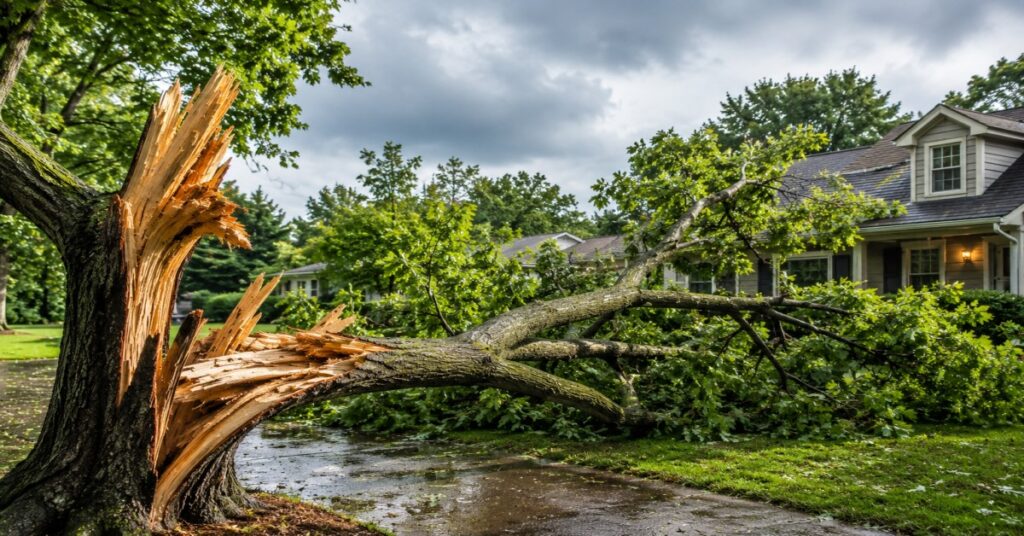
When severe weather, freezing ice storms, or intense lake-effect blizzards sweep across Western New York, homeowners frequently wake up to cracked limbs and fallen wood scattered across their yards. Knowing how to assess storm damaged tree branches is critical because making the wrong choice can permanently weaken canopy health or create severe falling hazards for your home and family.
Every major weather event presents an urgent dilemma for property owners. While some snapped twigs will naturally heal with minimal intervention, hanging limbs and fractured structural wood present immediate risks to roofs, driveways, and overhead utility lines. Understanding how to triage storm damaged tree branches safely protects your household, prevents costly property damage, and preserves your landscape investment.
Table of Contents
- 1. At a Glance: Storm-Damaged Branch Triage Matrix
- 2. Step 1: Monitor Minor Branch Damage
- 3. Step 2: Trim Broken Limbs to Prevent Pathogenic Decay
- 4. Step 3: Remove Hazardous Canopy Limbs Immediately
- 5. The Hidden Threat: Internal Micro-Cracks and Structural Stress
- 6. 5-Step Homeowner Safety Action Plan After a Storm
- 7. Frequently Asked Questions
- 8. Schedule Emergency Storm Tree Response in Buffalo, NY
At a Glance: Storm-Damaged Branch Triage Matrix
Before grabbing a ladder or pulling out a chainsaw, use this quick-reference triage table to classify branch damage on your property:
| Damage Category | Recommended Triage Action | Risk Classification | Homeowner vs. Professional Action |
|---|---|---|---|
| Small twigs & leaf tips stripped (<2 in. dia.) | Monitor & Observe | Low Risk | DIY Ground Cleanup |
| Cracked lateral limbs with clean breaks | Precision Trimming | Moderate Risk | Homeowner if reachable from ground |
| Hanging “Widow-Makers” caught in upper crown | Immediate Removal | Critical / Urgent | Professional Only (Rigging required) |
| Scaffold limb split tearing trunk bark downward | Structural Removal | High Risk | Professional Only (Crane / Bucket) |
| Branches touching or within 10 ft of power lines | Utility & Pro Clearance | Extreme Hazard | Emergency Dispatch Only (Never touch) |
Step 1: Monitor Minor Branch Damage
Not all storm injuries demand immediate cutting or heavy machinery. Mature shade and ornamental trees possess natural physiological defenses against seasonal winds. Consequently, when structural damage is confined to minor twigs and leaf loss, patient observation is the safest and most biologically sound strategy for evaluating storm damaged tree branches.
1. Intact Branch Collars with Minor Foliage Stripping
If high winds strip leaves or snap small twigs under 2 inches in diameter while leaving the branch bark ridge and branch collar intact, the tree can compartmentalize the wound on its own. Furthermore, keeping an eye on these recovering limbs over the following 60 days allows dormant buds to re-establish canopy density without human intervention.
2. Elastic Bending Without Longitudinal Wood Fractures
During heavy snow or sleet events, flexible limbs bend under significant load. However, if the branch springs back toward its natural orientation without visible bark splitting, wood fiber splintering, or base separation, no corrective pruning is required.
3. Monitoring Signs of Delayed Biological Decline
For thorough evaluation, track the branch over a 30 to 60-day window following severe weather events. Specifically, watch closely for:
- Delayed spring bud break or localized leaf discoloration.
- Fungal conks, sap weeping, or carpenter ant activity near branch unions.
- Gradual downward sagging during subsequent heavy rainfall.
Ultimately, if the limb maintains healthy foliage without signs of structural decay, you can safely preserve the limb without unnecessary cutting.
Step 2: Trim Broken Limbs to Prevent Pathogenic Decay
When limbs suffer partial breaks, ragged ends, or bark tears without compromising the parent stem, precision pruning removes disease entry points and restores canopy balance. In addition, addressing these storm damaged tree branches quickly prevents wood-rot fungi from spreading deep into the core heartwood.
1. Eliminating Ragged, Splintered Stubs
Storm winds snap wood unevenly, leaving jagged stubs that trap moisture and welcome opportunistic insects and bacterial wetwood. Therefore, making a clean pruning cut directly outside the branch bark ridge enables the tree to form healthy callus tissue. For routine canopy balancing and hazard mitigation, exploring seasonal tree trimming and maintenance plans helps prevent future storm damage before severe winds arrive.
2. Preventing Trunk Tears with the Three-Cut Method
Never attempt a single downward flush cut on a heavy damaged branch because the falling weight of the limb will peel bark down the trunk. Instead, certified crews follow ANSI A300 pruning standards endorsed by the ISA International Society of Arboriculture when removing cracked storm damaged tree branches:
- The Undercut: Cut upward on the underside of the limb 12 inches out from the trunk, cutting one-third of the way through the wood.
- The Relief Top Cut: Cut downward 2 inches farther out to safely drop the limb’s weight without tearing the bark.
- The Final Collar Cut: Remove the remaining stub cleanly just outside the branch defense zone.
Because improper pruning prevents long-term canopy rot, scheduling a certified assessment for tree inspection and tree care in Buffalo, NY ensures every damaged limb is evaluated using ANSI A300 pruning standards.
Step 3: Remove Hazardous Canopy Limbs Immediately
Certain storm damage scenarios present severe life-safety hazards and immense property liabilities that demand rapid, professional machinery. As a result, leaving unstable cracked limbs suspended aloft creates a serious hazard.
1. Dangling “Hangers” and Widow-Makers
A broken branch caught in the upper canopy is an active danger. Specifically, a minor gust of wind or temperature fluctuation can dislodge hundreds of pounds of dead wood onto roofs, vehicles, or walkways below. For this reason, homeowners should never walk underneath such precarious storm damaged tree branches.
2. Deep Trunk Splits and V-Crotch Failures
When codominant stems separate at a narrow V-crotch union, structural stability is lost. Furthermore, if more than 50% of the living crown is destroyed or the main trunk is torn open, selective branch cutting will not save the tree. In cases of extensive canopy trauma, homeowners must evaluate when is the right time to remove trees from your property to prevent total catastrophic tree failure.
3. Branches Entangled in Power Lines
Never touch, pull, or cut storm-damaged tree branches near utility wires. Wet wood conducts high-voltage electricity instantly. Therefore, keep at least 30 feet of distance, alert your utility provider immediately, and contact an emergency tree service.
Have Dangerous Hanging Branches? Get Immediate Storm Dispatch
Don’t risk personal injury or property damage under compromised limbs. Our crane-assisted crews provide rapid, same-day emergency storm hazard removal across Western New York.
24/7 emergency storm response across Buffalo, Amherst, Williamsville, Getzville, Clarence, and Lockport.
The Hidden Threat: Internal Micro-Cracks and Structural Stress
Visual ground-level checks often miss severe structural defects. For instance, severe torque and rotational forces during windstorms create internal micro-fractures in large scaffold limbs, weakening heavy storm damaged tree branches without visible exterior signs.
- Reaction Wood Shear: Hardwood species subjected to extreme wind gusts develop internal shear planes along annual growth rings that do not show external cracks initially.
- Included Bark Weakness: Pre-existing decay pockets trapped within tight branch unions fail rapidly when saturated by heavy rain or lake-effect snow.
- The Delayed Drop Phenomenon: Damaged limbs held by wood fibers under drying tension can drop unexpectedly weeks later on calm days.
To ensure safety after extreme weather, professional arborists reference Cornell Cooperative Extension tree care guidelines to calculate wind-load tolerances, determine internal defect ratios, and execute controlled rope-and-rigging removals on high-risk limbs.
5-Step Homeowner Safety Action Plan After a Storm
Follow this emergency checklist immediately following severe weather in Western New York:
- Conduct a Ground-Level Perimeter Inspection: Walk your property well outside the canopy drop line, and avoid standing beneath cracked or shifting limbs.
- Scan for Spring Poles and Canopy Hangers: Locate any branches pinned under tension by fallen debris because cutting tension wood without proper rigging causes violent recoil.
- Document Structural Damage for Insurance Claims: Take clear photos of all fallen wood and storm damaged tree branches resting on roofs, siding, or fences before moving debris.
- Cordon Off High-Hazard Drop Zones: Place caution tape or markers around driveways and walkways underneath compromised tree canopies.
- Contact an Insured Tree Care Specialist: Mobilize local tree experts equipped with crane support, bucket trucks, and commercial wood chippers.
Whenever storm impact extends beyond isolated limbs and threatens roofs or structural walls, rely on emergency tree removal services in Buffalo for storm damage and cleanup to secure your site immediately.
Frequently Asked Questions
Can storm damaged tree branches heal on their own?
Trees do not heal damaged tissue like humans; instead, they compartmentalize wounds (CODIT) by producing chemical barriers and specialized callus tissue to seal off damaged areas from fungal pathogens. Clean cuts made by professional arborists significantly help this natural sealing process.
Does homeowners insurance cover the removal of storm damaged tree branches?
Standard homeowner insurance policies typically cover branch and tree removal if the fallen limb damages an insured structure, such as a roof, garage, or fence. However, if a branch falls harmlessly on your lawn without structural impact, cleanup is generally the homeowner’s responsibility.
How much canopy damage can a tree survive after a storm?
A healthy mature tree can generally survive losing 25% to 35% of its living canopy. However, if severe wind tears away more than 50% of the active crown or splits the main trunk down to the root collar, the tree’s structural integrity is compromised, and complete removal of all remaining compromised limbs and the main trunk is usually recommended.
Schedule Emergency Storm Tree Response in Buffalo, NY
Do not risk your personal safety on ladders with chainsaws after severe weather. Tree Man NY provides 24/7 rapid emergency tree response, hazardous branch trimming, and certified property inspections across Buffalo, Amherst, Williamsville, Getzville, Clarence, Lockport, and all surrounding Western New York communities.
Tree Man NY serves Buffalo, Amherst, Williamsville, Getzville, Clarence, Lockport, and surrounding Western New York communities. Fully licensed, insured, and ready 24/7 for rapid storm cleanup and hazard mitigation.