
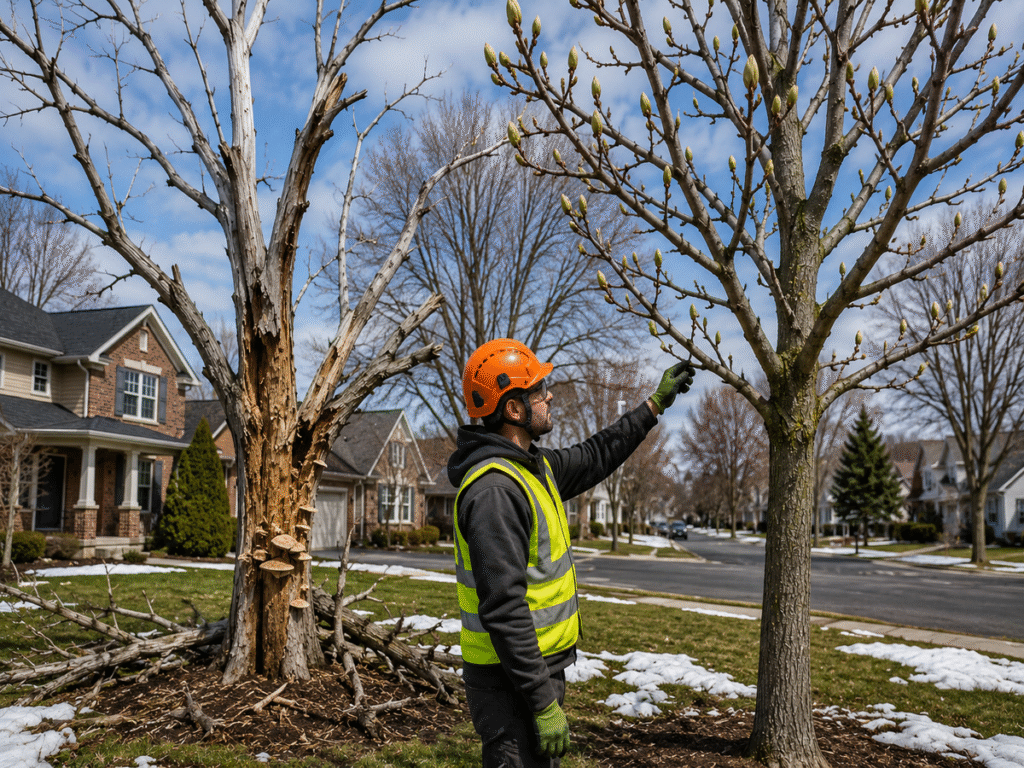
When late winter transitions into spring across Western New York, learning to tell the difference between a dead tree vs dormant tree is essential for every homeowner. After months of freezing temperatures and lake-effect snow, every mature oak, maple, and ash tree in Buffalo looks completely bare.
However, assuming a sleeping canopy is dead can lead to unnecessary tree removal costs, while confusing a decaying tree with a dormant one creates severe hazard risks during heavy WNY windstorms.
Accurately evaluating a dead tree vs dormant tree allows you to protect your property, avoid costly mistakes, and take fast action if a hazardous limb threatens your home. Here is how to perform a quick 5-second visual scratch test to determine whether your Buffalo tree is just resting or truly gone.
Table of Contents
Why Buffalo Winters Make Tree Diagnostics Tricky
Dormancy is a natural survival mechanism. Trees enter metabolic rest during cold weather to conserve water and protect their cells from freezing.
In regions like Buffalo, Amherst, and Cheektowaga, extreme freeze-thaw cycles and heavy ice loads put significant stress on landscape plants. Research from the Cornell Cooperative Extension highlights how extreme freeze-thaw cycles in Erie County can delay spring bud break. Understanding local climate impacts helps homeowners avoid making hasty removal decisions on trees that are simply taking longer to wake up after a harsh winter.
Accurately evaluating a dead tree vs dormant tree requires looking beneath the outer bark to check the health of the underlying tissue. Every proper arborist assessment of a dead tree vs dormant tree starts right at the bark layer.
7 Quick Tests to Tell if Your Tree is Dead or Dormant
Use these seven field-tested diagnostic steps to inspect trees on your property before spring growth begins:
| Layer Exposed | Color & Texture | Status |
|---|---|---|
| Moist Green Under | Bright Green / Moist | DORMANT |
| Dry Brown / Brittle | Dark Brown / Dry | DEAD |
1. The Twig Snap Test
Select small, pencil-sized twigs on various branches around the canopy. Gently bend the twig back on itself when comparing a dead tree vs dormant tree:
- Dormant Tree: Flexible and pliable. It bends smoothly without breaking easily.
- Dead Tree: Dry and brittle. It snaps instantly with a crisp crack, revealing dry, brown wood inside.
2. The Scratch Test (Cambium Layer Inspection)
Use a key, thumbnail, or small pocketknife to gently scratch away a thin layer of outer bark on a young branch during your dead tree vs dormant tree evaluation:
- Dormant Tree: Reveals a bright green, moist layer called the cambium layer. This confirms living tissue is actively transporting nutrients.
- Dead Tree: Reveals a dull brown, dry, or black layer underneath the bark.
3. Bud and Foliage Inspection
Examine the branch tips closely during late winter and early spring when checking a dead tree vs dormant tree:
- Dormant Tree: Plump, firm, and moist buds ready to break open as warm weather returns.
- Dead Tree: Shriveled, dry, or missing buds that crumble under light pressure. Dead leaves from the previous season that refuse to drop (marcescence) across the entire canopy can also signal localized dieback.
4. Bark Texture and Peeling
As healthy trees grow, their bark naturally expands and protects internal tissue. During a standard dead tree vs dormant tree check:
- Dormant Tree: Bark remains firmly attached to the main trunk and scaffold branches.
- Dead Tree: Bark becomes brittle, cracks deeply, and peels off in large sheets, exposing bare hardwood underneath.
5. Fungal Growth and Trunk Decay
Fungi and wood-boring insects feed on decaying organic tissue when assessing a dead tree vs dormant tree:
- Dormant Tree: Free of large fungal shelf mushrooms along the trunk base.
- Dead Tree: Features bracket mushrooms, shelf fungi, or heavy carpenter ant activity along the trunk, indicating internal trunk rot.
6. Root Flare and Soil Inspection
Check the ground area where the trunk meets the soil (the root flare) to complete your dead tree vs dormant tree diagnosis:
- Dormant Tree: Soil remains tightly compacted around structural anchor roots.
- Dead Tree: Soil cracking, root lifting, or fungal conks around the root zone indicate root rot and loss of anchorage.
7. Structural Lean and Canopy Balance
- Dormant Tree: Maintains steady vertical alignment and balanced branch structure.
- Dead Tree: Develops a sudden or increasing lean, often accompanied by exposed roots on the opposite side of the tilt.
Dangers of Ignoring a Dead Tree Near Your WNY Home
Misjudging a dead tree vs dormant tree poses real safety hazards for homeowners. While a dormant tree will bloom naturally as temperatures rise, a dead tree loses structural strength every week.
If your scratch test reveals dry, brown tissue or if you notice other severe warning signs that your property needs a professional tree inspection, do not wait for high lake-effect wind gusts to compromise your home. Catching structural issues early protects your roof, power lines, and neighboring properties from sudden branch failures.
- Target Risks: Brittle dead branches can drop without warning onto roofs, power lines, parked cars, or walkways.
- Severe Weather Vulnerability: Buffalo spring weather frequently brings high wind gusts. A dead tree lacks the root anchorage needed to withstand storm forces.
- Pest Propagation: Dead timber attracts wood-boring pests, termites, and fungal diseases that can quickly spread to nearby healthy landscape trees.
Safety Warning: Never attempt to prune large dead limbs or cut down standing dead trees near utility lines yourself. Dead wood is brittle, unpredictable, and hazardous to climb.
When to Call an ISA Certified Arborist in Buffalo
If your scratch test reveals brown, dry tissue across multiple major branches, do not wait for a storm to cause structural damage. For complex structural evaluations or hazardous branches hanging near utility lines, consulting an ISA Certified Arborist ensures that your trees are diagnosed according to international industry safety standards.
To help you maintain a safe and healthy landscape, our team at Treeman has built a comprehensive guide on experienced tree care professionals in Buffalo, NY, where you can explore proper pruning cycles, species-specific maintenance schedules, and seasonal yard protection strategies.
Whether you need a quick inspection or complete tree removal, working with certified experts ensures your home remains safe year-round.
Unsure if Your Tree is Dead or Dormant? Get an Expert Inspection Today
Don’t wait for the next Western New York storm to find out if a standing tree on your property is a severe safety hazard. If your scratch test revealed brown tissue or you suspect structural decay, schedule a fast, professional tree health evaluation with Buffalo’s trusted local arborists.
Treeman serves Buffalo, Amherst, Cheektowaga, Williamsville, Clarence, Getzville, East Amherst, and surrounding WNY communities. Fully licensed, insured, and dedicated to protecting your home and landscape.
Frequently Asked Questions
Can a dead tree come back to life?
No. Once the cambium layer dies and sap flow stops, a dead tree cannot regenerate. However, if only individual branches are dead while the main trunk remains green during a dead tree vs dormant tree inspection, targeted pruning can often save the rest of the tree.
How late can a dormant tree stay without leaves in Buffalo, NY?
Depending on cold spring weather, local Western New York species like Oak and Ash trees may remain dormant well into late May before breaking bud. Always perform a scratch test before assuming a late-blooming tree is dead.
Who is liable if a dead tree falls on a neighbor’s house in New York?
Under New York State property law, if a homeowner is aware of a hazardous dead tree and fails to take action, they can be held legally responsible for property damage caused if the tree falls onto a neighboring lot.
How much does a professional dead tree assessment or removal cost in Buffalo?
The cost varies based on tree height, branch location, property accessibility, and proximity to utility lines or structures. Routine evaluations on accessible yard trees are very affordable, while large, hazardous trees requiring cranes or specialized rigging involve additional labor. Contact our certified team for a transparent on-site inspection.
When is the best time of year to check if a tree is dead or dormant?
Late winter to early spring (February through April in Buffalo) is the ideal time. Without full summer foliage, branch structures, bark condition, and terminal buds are easy to inspect, allowing you to safely schedule removal or treatment before spring windstorms arrive.