
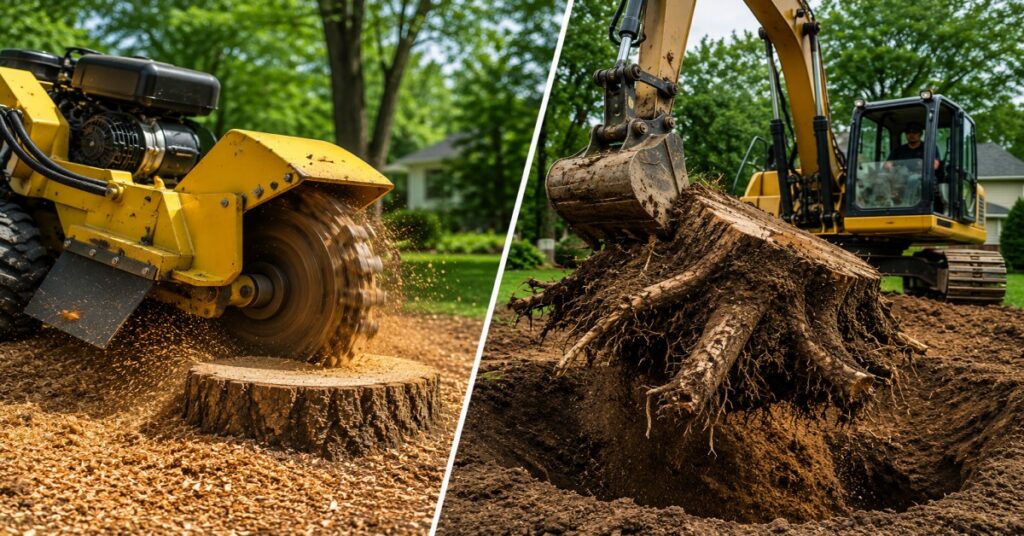
When a tree is taken down on your Western New York property, the immediate problem of falling branches or safety hazards is resolved. However, homeowners are quickly left facing an unexpected leftover issue. Specifically, the raw, unsightly timber base sits completely dead in your soil. Consequently, deciding how to handle this remnant requires evaluating two fundamentally different techniques. Undoubtedly, the debate of stump grinding vs stump removal is one of the most frequent dilemmas we guide clients through here at Treeman.
Choosing between these methods impacts your landscaping timeline, the integrity of your lawn, your remaining topsoil structure, and your financial budget. Therefore, both strategies provide specific benefits depending on what you want to achieve with your outdoor space. Accordingly, deciding on the proper yard layout means weighing the clear trade-offs of stump grinding vs stump removal before any machinery arrives on your grass.
In addition, this definitive guide breaks down the physical differences, equipment requirements, exact execution steps, and long-term land outcomes of stump grinding vs stump removal. As a result, you can confidently determine which approach serves your landscape best.
Table of Contents
What is Professional Stump Grinding?
When analyzing stump grinding vs stump removal, the grinding method stands out immediately. Specifically, it functions as a highly targeted mechanical process that turns solid, dense tree wood into usable mulch. Instead of pulling the structural framework of the plant out of the soil matrix, a specialized machine is positioned directly over the remaining wood. Moreover, this grinder is fitted with a high-speed, heavy-duty cutting wheel faced with carbide-tipped teeth.
Our experienced team sweeps the grinding wheel systematically across the surface. Furthermore, we progressively shave the wood down layer by layer. Consequently, this continuous process shatters the timber well past the visible surface level. It typically reaches depths of 4 to 8 inches below your turf grade.
The immediate output of this method is a valuable mixture of organic wood chips and clean topsoil. Meanwhile, the sprawling subterranean root architecture of the original tree remains completely undisturbed underneath the ground level. Over time, these deeper roots naturally decay within the soil biology. Ultimately, this process enriches the local ecosystem with organic matter without causing surface disruption.
What is Full Tree Stump Removal?
To contrast the mechanical shaving process, we can look at the physical excavation standpoint. Evaluating stump grinding vs stump removal from this angle reveals a much more intensive approach. In fact, full stump removal is an intensive, heavy-duty excavation procedure designed to entirely extract the tree’s foundational structure. Moreover, this option does not stop at surface-level clearing because it involves severe physical extraction.
To execute this, specialized heavy machinery must be brought onto your lawn. For instance, an excavator or a dedicated backhoe is used to systematically dig open a wide trench around the entire perimeter of the leftover wood. Next, operators must aggressively cut through the major anchoring structural lateral roots. Consequently, this is the only way to detach the main mass from the earth.
Once fully broken free, the complete root ball is lifted out of the ground using heavy rigging. However, this massive process leaves a major, deep open crater behind on your property. As a result, this large hole requires structural backfilling, grading, and dedicated soil rehabilitation before you can plant grass or use the area safely.
Stump Grinding vs Stump Removal: Core Technical Comparison
To fully understand the trade-offs inherent in stump grinding vs stump removal, homeowners must analyze how these services perform across key operational criteria. Undoubtedly, evaluating the practical constraints of stump grinding vs stump removal directly determines your project’s total physical disruption and immediate machinery requirements.
| Feature Matrix | Stump Grinding | Full Stump Removal |
|---|---|---|
| Property Footprint | Minimal; isolated to the trunk | Extensive; large excavation pit |
| Material Waste | High-quality mulch left on-site | Massive root ball requires haulage |
| Execution Speed | 30 to 90 minutes per unit | Several hours of heavy digging |
| Relative Cost | Highly budget-friendly | Higher investment due to labor |
| Future Site Readiness | Ready for topsoil and sod seed | Ready for foundations or trees |
Machinery and Physical Labor
The equipment footprint varies drastically between the two services. On one hand, grinding machinery is compact and highly maneuverable. Furthermore, it features specialized tracks designed to distribute weight evenly. This design ensures your surrounding turf remains completely safe from deep ruts. In contrast, full extraction relies on massive excavators. Therefore, if your backyard features tight gates or narrow walkways, navigating these larger machines can present significant logistical risks. Consequently, these structural issues often alter the calculus of stump grinding vs stump removal.
Cost Structures and Project Duration
When assessing stump grinding vs stump removal from a financial perspective, grinding is consistently the more cost-effective option. Mainly, because grinding demands less time on-site, it requires fewer crew members. Moreover, it completely avoids specialized external haul-off charges. Consequently, it maximizes value for residential properties. On the other hand, full removal involves significant labor and heavy equipment transportation costs. In addition, you must pay disposal fees for dumping a 500-pound dirt-encrusted root ball at a regional waste facility.
Impact on Surrounding Turf, Soil, and Foundations
Your future plans for the landscape play a vital role in your project. Specifically, they help determine whether stump grinding vs stump removal is the right choice for your property.
When to Select Grinding
If your primary goal is to restore the aesthetic appeal of your yard, grinding is highly effective. For instance, it easily eliminates mowing hazards and clears space for a pristine lawn. Furthermore, it allows you to quickly cover the area with premium soil and seed. For details on regional service coverage scales, explore our dedicated resource detailing expert tree stump removal services in Amherst NY to quickly fix your landscape footprint.
When Complete Removal is Necessary
Alternatively, extraction becomes essential if you are planning major structural changes. For example, if you intend to pour a concrete foundation for a new garage or put down an asphalt driveway, leaving underground wood to rot is dangerous. Consequently, it can lead to sinkholes and structural shifting over time. Moreover, complete extraction is also ideal if you want to plant a new tree in the exact same spot. For a closer look at neighbor-market variables, check our surrounding service analysis on top stump grinding services in Getzville NY to map out your hardscaping budget.
The Local Aspect: Handling Western New York Clay and Frost Lines
Landscaping work in our region requires deep local expertise. Specifically, the dense, compacted clay soils found throughout Buffalo, Amherst, and Cheektowaga present unique challenges compared to sandy coastal areas. As a result, this adds major local context to the decision of stump grinding vs stump removal.
During our freezing winters, moisture trapped in heavy clay soils expands significantly. Consequently, if a dead stump is left unaddressed, this severe frost-heaving action can push the wood upward. Moreover, this movement frequently disrupts nearby walkways, patios, and fencing lines. To accurately measure structural soil loading thresholds across New York types, engineers review density ratings mapped out within the USDA Web Soil Survey. Furthermore, unmanaged wood left decaying in wet soil conditions can become a breeding ground for problems. Therefore, learn more about managing these risks by reading our case files on fast stump tree removal service in West Amherst NY.
At Treeman, our crews bring years of local experience to every job. Accordingly, we adjust our industrial equipment to handle dense New York clay and challenging roots safely. Furthermore, we follow official regional engineering guidelines. Ultimately, we ensure that your underground structures remain safe, and your utility lines are protected throughout the entire process.
Frequently Asked Questions
What happens to the deep root systems after the trunk is ground down?
The deep roots stay inside the ground and naturally decay over several years. Specifically, once the main trunk is processed by arborist-grade machinery, the remaining underground root system completely loses its source of energy. Consequently, this occurs because photosynthesis stops entirely. Over a period of 5 to 10 years, native soil microorganisms, insects, and fungi naturally break down the remaining wood fibers. As a result, they turn them into clean organic matter that naturally blends back into your soil structure without destabilizing your yard layout.
Which option provides better protection against property pests?
Professional stump grinding provides highly effective protection against residential pests by eliminating their primary above-ground habitats. However, while full extraction completely physically removes all subterranean timber masses, an engineered deep mechanical grind works beautifully. Specifically, reaching 8 inches below the local grade level—combined with tight topsoil packing—completely removes the damp, exposed wood pockets that pests look for. As a result, this breaks the surface access point, completely stopping subterranean termites, wood-boring ants, and fungal mold spores from establishing an active nesting base near your home foundation. For severe infestations or large older trunks, evaluating the long-term trade-offs of stump grinding and stump removal in Buffalo, NY is your safest option to completely secure your perimeter.
Can a tree grow back or sprout new shoots after a professional grind?
Certain aggressive tree species can occasionally send up small surface sprouts if their root systems retain stored energy reserves. For example, while non-aggressive trees die off immediately after service, highly persistent regional species like Willows, Elms, Poplars, and Maples may attempt a final survival push. Consequently, they do this by suckering from remaining lateral roots. Fortunately, property owners can easily manage this minor issue by systematically cutting away new green sprouts. This action rapidly starves the underground roots of energy, permanently stopping new growth.
Does stump grinding leave a deep, dangerous hole in the middle of your yard?
No, professional grinding processes do not leave an open crater because the resulting wood mulch naturally backfills the cavity. Specifically, shredding a wood trunk creates a large volume of organic wood chips mixed with local topsoil. Consequently, it creates a clean pile that sits directly over the treated area. Property owners can choose to reuse this nutrient-rich mulch in their nearby garden beds. In addition, you can leave it inside the shallow depression to break down naturally without creating a trip hazard.
Can you plant a brand-new tree directly on top of the old grinding location?
No, you cannot plant a new tree in the exact same spot right away because the old structural root mass still takes up the underground space. Furthermore, the remaining subsurface timber blocks young roots from growing downward properly. The natural wood breakdown process also temporarily drops local soil nitrogen levels. Therefore, to ensure healthy, successful growth for a new tree, we recommend offsetting your new planting location by 3 to 5 feet for small decorative species. In addition, you should offset by 8 to 10 feet for large canopy trees to ensure plenty of access to fresh, uncompacted soil nutrients.
Need Professional Guidance for Your Property?
Avoid the physical strain and safety risks of trying to tackle heavy tree remnants on your own. Let our fully insured, locally trusted specialists handle the job safely and efficiently.
For reliable, expert care, visit our main tree stump removal Buffalo NY pillar page to schedule your on-site assessment, or reach out to our team directly to keep your property safe, beautiful, and accessible year-round.
Treeman serves Getzville, Amherst, Williamsville, Clarence, Lockport, East Amherst, and surrounding Buffalo, NY communities. Licensed and insured.