
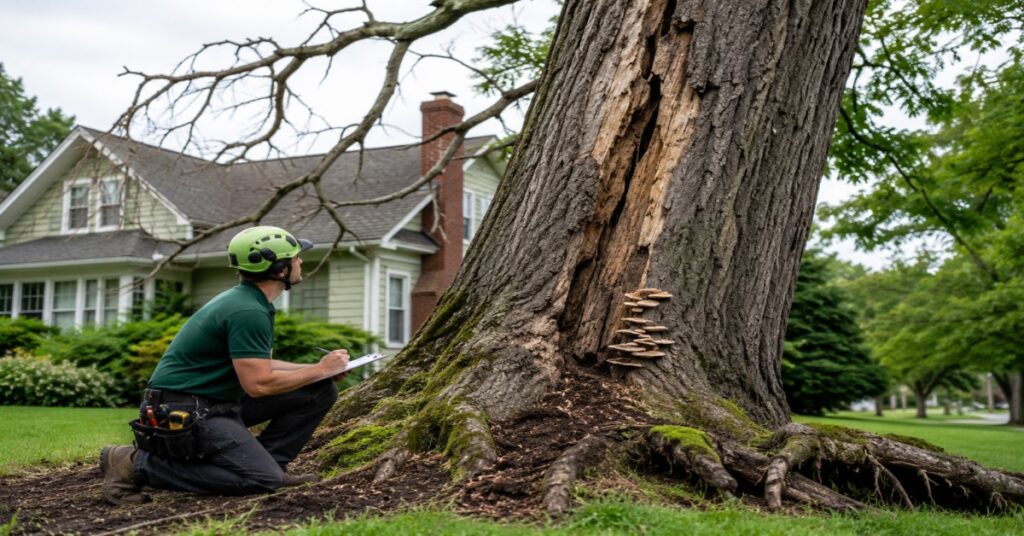
Recognizing key tree inspection signs—such as deep trunk cracks, progressive leaning, and root decay—is the most effective way for property owners to prevent catastrophic tree failure. For homeowners across Buffalo, Western New York, and surrounding communities like Amherst and Williamsville, local environmental stressors like lake-effect snow loads and extreme seasonal freeze-thaw cycles turn minor structural issues into immediate liabilities. Specifically, spotting these dangerous indicators early allows you to address structural weaknesses before a compromised canopy collapses onto your roof, power lines, or yard.
Consequently, this comprehensive guide covers the 7 most critical warning signals that homeowners consistently miss. We explain exactly what to do when you spot them. Furthermore, if you are ever unsure, the safest call you can make is to schedule a professional assessment with our team rather than guessing from the ground.
Ultimately, ignoring these subtle indicators can turn a beautiful landscape feature into a sudden property hazard overnight. Therefore, taking a proactive approach to property safety ensures you protect your investments and your family. Let’s dive directly into the primary warning signals you should look for when evaluating your trees.
Table of Contents
- Why Tree Inspection Signs Should Never Be Ignored
- Sign #1 — Visible Cracks or Splits in the Trunk
- Sign #2 — Leaning That Gets Worse Over Time
- Sign #3 — Dead or Dropping Branches
- Sign #4 — Fungal Growth at the Base
- Sign #5 — Bark That Is Peeling, Missing, or Discolored
- Sign #6 — Hollow Spots or Soft Wood
- Sign #7 — Root Damage or Soil Heaving
- What to Do When You Spot These Signs
- Frequently Asked Questions
Why Tree Inspection Signs Should Never Be Ignored
Essential Local Safety Insights for WNY Homeowners
Trees in the Buffalo area face unique stress year-round: lake-effect snow loads, high wind events, spring soil saturation, and summer heat. A tree that looks healthy from your kitchen window may be structurally compromised at its core. According to the International Society of Arboriculture (ISA), most tree failures that cause property damage are preceded by visible warning signals that went unaddressed for one or more seasons.
Early detection means more options: targeted pruning, cabling, treatment, or a planned removal on your schedule — not an emergency call after a severe storm. Our team at Treemanny provides professional diagnostic services to identify these hidden flaws, helping homeowners stay ahead of major hazards before they become costly property emergencies.
Sign #1 — Visible Cracks or Splits in the Trunk
One of the clearest tree inspection signs is a crack, seam, or split running along the main trunk or at a major branch union. These openings indicate that storm stress, disease, or winter freeze-thaw cycles have compromised the structural wood inside. Western New York winters regularly accelerate this internal damage.
Not every crack signals imminent failure. However, vertical cracks on opposite sides of the trunk (called “co-dominant stem splits”) are especially dangerous. A certified arborist can assess how deep the crack goes and whether cabling or bracing can stabilize the tree.
Sign #2 — Leaning That Gets Worse Over Time
A slight lean is not always a red flag — some trees grow at an angle naturally. What matters is whether that lean is increasing. If you notice your tree is leaning further than it was last season, or if soil near the base has begun to crack or heave, that is a serious warning indicator that structural root failure may be underway.
Recent changes can make trees especially prone to leaning. Watch for neighboring tree removal, storm-related root disturbance, or sudden soil erosion near the base. A professional evaluation can determine whether the lean is structural or cosmetic and recommend the safest next step.
Sign #3 — Dead or Dropping Branches
Deadwood is one of the most common yet overlooked tree inspection signs. Dead branches do not hold. Watch for limbs that lack leaves during the growing season, snap easily, or show no green wood when scratched. Arborists call them “widow makers” because of how unpredictably they fall.
If you are noticing multiple dead branches throughout the canopy, that pattern often points to a systemic issue. These include root damage, disease, or internal decay. Our tree inspection and removal service in Buffalo, NY includes a full canopy evaluation to identify where deadwood is concentrated and what is causing it.
Sign #4 — Fungal Growth at the Base or Along the Trunk
Mushrooms, conks, or bracket fungi growing at the base of a tree or along the lower trunk are not random. They represent the visible output of internal wood rot. This growth means a fungal network has already actively destroyed the wood for months. Fungal pathogens stand as a leading cause of structural tree failure across the northeastern United States.
If you find shelf fungi or clusters of mushrooms at the root flare or on the trunk, treat it as a serious warning signal. Call a professional before your next WNY storm season arrives.
Sign #5 — Bark That Is Peeling, Missing, or Discolored
Healthy bark is consistent in texture and color for the species. When bark peels away in large sections, shows sunken dead patches (called “cankers”), or has areas of unusual discoloration, the tree is sending a distress signal. Cankers are particularly concerning. They cut off the vital flow of water and nutrients. This issue can girdle and eventually kill the tree.
Some bark conditions are treatable with proper care. Others indicate the tree is too far along for intervention. Either way, you need an expert eye on it rather than a wait-and-see approach, especially if the tree is near a structure or play area.
Sign #6 — Hollow Spots or Soft Wood
If you knock on the trunk of a large tree and hear a hollow sound, that is a classic symptom of internal decay. A solid, healthy tree should produce a dull thud. A hollow or drum-like sound suggests the heartwood has been compromised.
Similarly, any spot on the trunk that feels soft, spongy, or crumbles under light pressure is a sign of advanced rot. Trees can survive with some internal hollowing if the outer shell of wood (the sapwood) remains intact, but this requires a trained arborist to evaluate — not a visual guess from the ground.
Sign #7 — Root Damage or Soil Heaving
Roots are the foundation of any tree, and they are mostly invisible — which is what makes root damage so dangerous. Warning signs at ground level include:
- Soil lifting or cracking on one side of the tree
- Exposed roots that have been cut, torn, or damaged
- Compacted soil from heavy equipment or vehicle parking
- Mushrooms forming in a ring pattern around the base
Root damage is a severe structural threat. Once a tree loses a significant percentage of its root system, surface care cannot save it. If your tree has had nearby construction, trench digging, or concrete work in the last few years, have it inspected even if it looks healthy above ground.
What to Do When You Spot These Tree Inspection Signs
If you recognize one or more of these warning signals in your yard, take these proactive steps:
- Do not ignore it until next season. Most tree failures that cause damage were visible 6–18 months before the event occurred.
- Clear the area. Keep people and vehicles away from the zone beneath any tree you suspect is unstable.
- Document what you see. Photos from multiple angles help a professional assess severity before arriving.
- Call a professional. Contact a licensed, insured tree care company for a proper on-site inspection. A visual assessment from the ground is not enough for compromised trees.
Treemanny serves homeowners across Buffalo, Getzville, Amherst, Williamsville, Clarence, Lockport, and the surrounding WNY area. Our licensed crew provides honest, transparent assessments — we tell you exactly what we see and what your realistic options are. Call us today to schedule your tree inspection.
Worried About a Tree on Your Property?
✓ Licensed ✓ Insured ✓ Free EstimatesTreemanny provides professional tree inspections across Buffalo and Western New York. Catch hazardous structural flaws before the next major storm hits.
Frequently Asked Questions About Tree Inspection Signs
How often should I have my trees professionally inspected?
Most arborists recommend a professional inspection every 1–3 years for healthy, established trees, and annually for trees near structures, older trees, or any tree showing stress signs. After a major storm, inspect all large trees immediately regardless of when the last inspection was.
Can a tree with visible defects be saved?
Sometimes yes, sometimes no — it depends entirely on which structural issues are present and how advanced the decay is. Cracks and lean can sometimes be mitigated with cabling and bracing. Fungal rot and hollow trunks near structures typically indicate removal is the safest path. A certified arborist will give you an honest assessment.
Is it dangerous to wait and monitor a suspicious tree?
It can be. Trees under structural stress can fail without warning, especially during wind events, heavy snow, or after heavy rainfall that saturates the soil and weakens root anchoring. The risk increases significantly if the tree is within falling distance of a home, car, power line, or area where people gather.
Does Treemanny serve areas outside Buffalo?
Yes. Treemanny provides tree inspection and tree care throughout Western New York, including Getzville, Amherst, Williamsville, Clarence, Lockport, East Amherst, and the surrounding communities.
What should I do if a tree falls or a branch breaks during a storm?
Stay indoors and away from the area until the storm passes. Do not attempt to move large debris yourself. Call Treemanny for emergency tree removal — our team responds quickly to storm-related tree situations across the WNY area.
Understanding structural hazards is the first step toward protecting your home, your family, and the value of your property. For expert tree inspection and tree care in Buffalo, NY, trust the team at Treemanny. We have been serving Western New York homeowners with licensed, insured, and honest tree care — and we are ready to help you make the right call for your yard.