
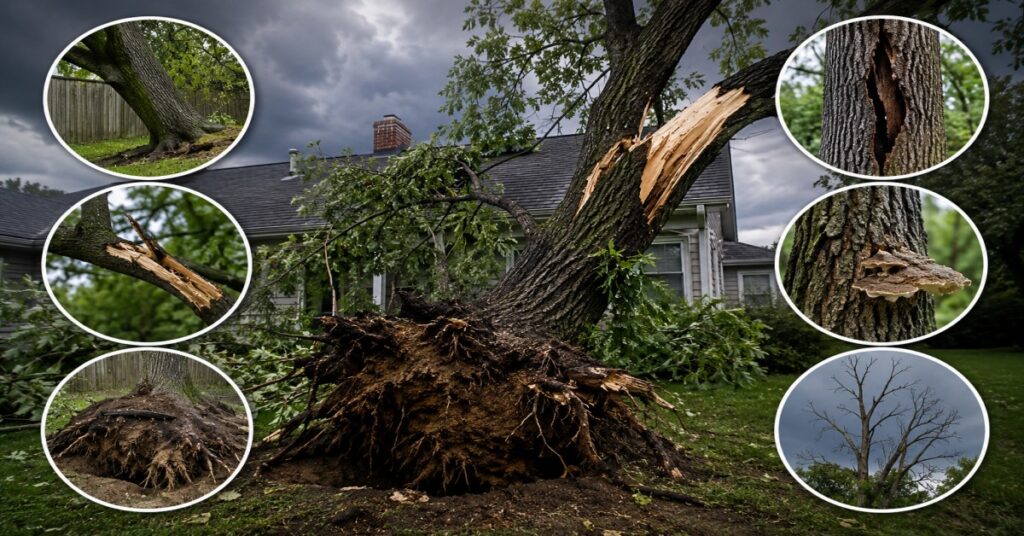
High winds don’t just knock branches around — they silently weaken a tree’s structural integrity in ways that aren’t always obvious from the ground. Knowing the dangerous tree signs after storm events is one of the most important steps a Buffalo homeowner can take to protect their property. A tree that looks perfectly fine on the outside may have a fractured root system or critically compromised branch unions that are ready to fail without warning.
Table of Contents
Why Buffalo Wind Storms Create Hidden Tree Dangers
High winds don’t just knock branches around — they silently weaken a tree’s structural integrity in ways that aren’t always obvious from the ground. In Western New York, where lake-effect storms and powerful gusts are a regular part of life, homeowners are left walking past trees every day that are one strong breeze away from falling on a roof, a car, or a person. When severe weather hits Erie County, identifying the primary dangerous tree signs after storm hazards is paramount to protecting your property and family.
Knowing the dangerous tree signs after storm events is one of the most important things a Buffalo homeowner can learn. A tree that looks fine on the outside may have fractured root systems, internal wood decay exposed by the storm, or critically compromised branch unions that are ready to fail without warning. Severe regional wind gusts twist canopy systems violently, creating invisible compression and tension failures within the timber that require immediate structural assessment.
This guide will walk you through the seven clearest warning signs that a tree has become a hazard after high winds — and exactly what to do about each one to prevent catastrophic structural failure.
7 Dangerous Tree Signs After a Storm
1. Visible Leaning That Wasn’t There Before
A sudden lean following high winds is one of the most serious dangerous tree signs after storm damage. Unlike trees that have grown at a gradual angle over decades, a newly leaning tree indicates root failure, major lateral shift, or severe soil displacement at the base of the trunk.
Look for soil heaving, broken surface lateral roots, or fresh ground cracking around the root zone, which often accompanies this sudden lean. In Western New York, our dense, clay-heavy soils can become completely waterlogged during intense rainstorms, dramatically accelerating root failure under severe wind-throw stress. If you notice a tree is tilting toward your home, driveway, or a neighboring fence, that tree needs a professional inspection immediately. Do not approach the base area alone, as the remaining anchor roots could snap under residual tension.
2. Hanging or Partially Attached Branches (“Widow-Makers”)
Arborists call them widow-makers for a reason. Broken branches that are still attached to the tree — suspended high in the canopy or caught in lower limbs — are extremely unpredictable. These hanging limbs represent clear, immediate dangerous tree signs after storm cycles, yet they are frequently overlooked by property owners looking upward from ground level.
They can fall hours, days, or even weeks after the initial storm, triggered by nothing more than a light breeze, shifting thermal currents, or the added weight of morning dew. After any significant wind event in Buffalo, scan the entire canopy of every tree on your property from multiple angles. If you see large limbs hanging at unusual angles or still attached at a torn, splintered point, stay away from that area entirely and contact a certified tree removal service right away to safely mitigate the overhead hazard.
| 🚨 Safety Crossroad: Post-Storm Risk Assessment | |
|---|---|
| IMMEDIATE EMERGENCY HAZARD | MONITOR & SCHEDULE ASSESSMENT |
|
|
3. Exposed or Lifted Root System
When high winds uproot a tree partially, the root plate may lift on one side while the trunk remains somewhat upright. This is one of the clearest dangerous tree signs after storm situations — the tree has lost its primary structural anchor and can topple at any moment without warning.
Mature canopy species common across older Buffalo neighborhoods, such as large Silver Maples and Northern Red Oaks, are particularly vulnerable to root plate shifting when subjected to sustained 50-mph gales. Even if the tree looks mostly upright, do not assume it is safe. Partially uprooted trees are structurally compromised, and attempting to walk near them, stake them back, or cut low branches while the root plate is in this volatile state is extremely dangerous.
4. Deep Cracks or Splits in the Trunk or Major Limbs
Storm-force winds place enormous lateral stress on trunks and branch unions. This immense pressure can create long, deep vertical cracks that may not be immediately visible from a distance. Get low, look along the trunk from the ground level upward, and carefully check major branches where they meet the trunk.
Cracks that run parallel to the grain of the wood, or “co-dominant stems” (two main trunks of similar size growing close together) that have split apart under wind pressure, are absolute indicators of imminent structural failure. Pay close attention to signs of “included bark” within these splits—where bark has grown inward, weakening the physical union over years. These structural flaws mean the tree cannot heal itself fast enough to remain safe, turning minor wind-driven fissures into major dangerous tree signs after storm damage.
5. Bark Stripping and Exposed Heartwood
Winds don’t just break branches — they can twist the main trunk itself, peeling away long strips of protective bark and exposing the raw, internal cambium and heartwood underneath. While bark stripping can occur from flying debris, deep spiral cracking or massive shedding indicates severe torsional mechanical stress during the storm.
A tree with large areas of stripped bark, especially around the critical root flare or mid-trunk, may look alive but can decline and fail rapidly in the months following the storm. These deep bark abrasions represent secondary dangerous tree signs after storm damage, as they immediately open the inner wood to rapid fungal decay, structural rot, and destructive insect infestations.
6. Broken Leader or Top Damage
The “leader” is the main central branch that forms a tree’s upward growing tip and establishes its structural symmetry. When high winds snap the leader, the tree loses its structural axis and natural growth pattern. While this doesn’t always mean immediate danger, it dramatically increases the risk of future storm failure and can lead to multiple competing leaders that are structurally weaker and highly susceptible to wind-shear.
If the top third of the tree is missing, shredded, or hanging precariously over your property, it creates an imbalanced canopy that leaves the remaining limbs highly vulnerable to the next wind storm. When evaluating these specific dangerous tree signs after storm events, call an experienced tree care professional to assess whether the canopy can be safely trimmed back or if the entire specimen needs to come down for safety.
7. The Tree Is Leaning Over Structures, Power Lines, or High-Traffic Areas
Location matters enormously when evaluating post-storm tree risk. A storm-damaged tree in the middle of an open field or back woodlot is far less urgent than one that has shifted toward your home, a power line, a neighbor’s property, or anywhere children play.
When any of the above dangerous tree signs after storm damage are combined with a hazardous target zone underneath, the risk level escalates significantly. This is no longer a “wait and see” situation — it is an active emergency that requires immediate professional intervention before structural collapse occurs.
What to Do When You Spot These Warning Signs
- Step 1 — Keep people away: Establish a clear safety perimeter around the drop zone. Mark off the area around the tree so no family members or neighbors walk beneath it.
- Step 2 — Do not attempt DIY stabilization: Do not attempt to pull, cut, or stabilize the tree yourself. Even cutting a single seemingly minor branch on a storm-stressed tree can instantly shift weight distribution, releasing thousands of pounds of stored kinetic energy and causing immediate failure.
- Step 3 — Call a professional team: Enlist the services of a licensed and fully insured tree removal company. If electrical lines are compromised, remain clear of the area and immediately contact your local utility provider at National Grid Upstate NY Outage Central to isolate the power grid before any tree mitigation work commences. For all other hazardous situations, secure an emergency tree care deployment immediately.
- Step 4 — Document the damage safely: Take photos and videos from a safe distance for your homeowner’s insurance claim records.
If you’re in the Buffalo area and need a same-day assessment, the team at Treemanny’s tree removal services in Buffalo, NY responds quickly to storm situations across Western New York.
Why You Should Never Attempt DIY Storm Tree Removal
It might be tempting to grab a chainsaw after a storm and start clearing fallen limbs and debris. But dealing with a tree exhibiting active dangerous tree signs after storm stresses puts it in an entirely different category from routine yard work. Internal wood tension, hidden barber-chair cracks, compromised root anchors, and unpredictable weight shifts make even “small” cleanup jobs extremely lethal without professional training and commercial rigging equipment.
Licensed arborists are trained to read a tree’s complex structural failure points before making a single cut. They use advanced rigging systems, commercial aerial lifts, and coordinated removal techniques that simply aren’t available to the average homeowner — and they carry comprehensive liability insurance that protects you and your property if anything goes wrong during the extraction.
For more guidance on choosing the right help, see our complete guide to how to choose the best tree removal service in Buffalo — it covers what to look for, what questions to ask, and how to verify a company is properly licensed and insured.
Treemanny: Buffalo’s Emergency Tree Removal Team
At Treemanny, we’ve seen every type of storm damage Western New York can dish out — from devastating lake-effect ice storms to summer microbursts and high-velocity gale winds. Our crew is highly trained, fully insured, and available for emergency calls across Buffalo, Amherst, Williamsville, Getzville, Clarence, Lockport, and the surrounding WNY communities.
When you spot the dangerous tree signs after storm damage we’ve outlined above, don’t wait to act. A tree that falls on a home can cost tens of thousands of dollars in structural damage and insurance deductibles. A tree that falls on a person is far worse.
Need Immediate Help? Contact Our Buffalo Storm Response Crew Now
Frequently Asked Questions
How do I know if a tree is dangerous after a storm?
Look closely for new leaning, hanging canopy branches, exposed or lifted roots, deep trunk cracks, bark stripping, and any hazardous positioning over structures or high-use areas. These represent the primary dangerous tree signs after storm events in Western New York that require professional evaluation.
Can a storm-damaged tree survive?
Sometimes, yes — but only a certified arborist can determine this safely. Minor canopy damage without structural trunk compromise can often be corrected with professional pruning and crown thinning. Major root plate damage, deep trunk splits, or significant recent leaning typically require full tree removal.
How fast should I act after noticing storm damage?
You should act within 24–48 hours if the tree is near a structure or high-traffic area. Contact emergency professionals immediately if branches are hanging directly over target areas, the tree is leaning toward power lines, or the root zone has actively shifted.
Does homeowners insurance cover storm-damaged tree removal?
Most standard policies cover removal when a tree falls on an insured structure like a house or garage. Coverage for hazardous-but-standing trees varies by provider. Document all dangerous tree signs after storm impacts thoroughly and call your insurer as soon as possible.
Who should I call for emergency tree removal in Buffalo?
Contact a licensed and insured company like Treemanny that specializes in rapid emergency response and has crews familiar with Western New York storm conditions. Learn more about choosing specialized tree removal services in Buffalo, NY.