
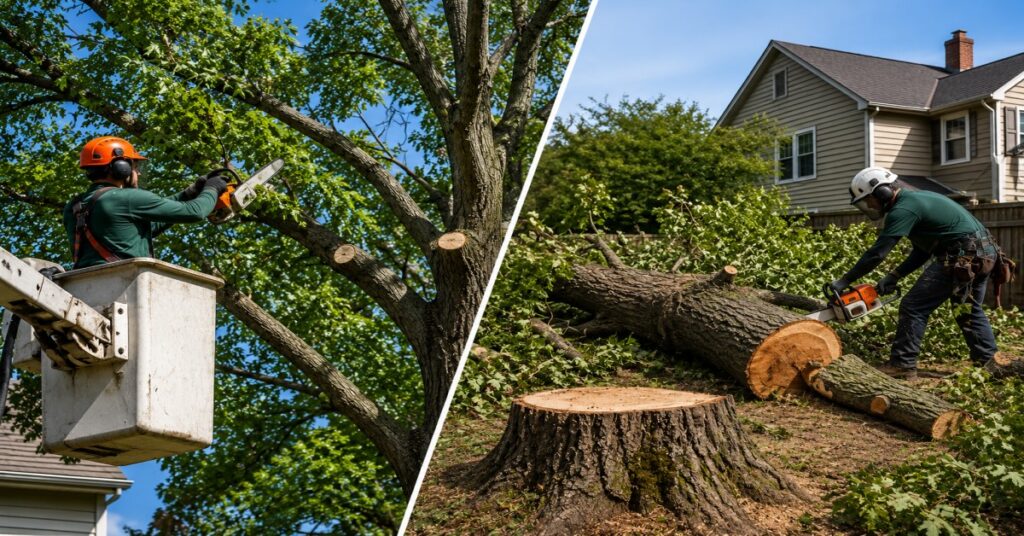
If you have a problem tree on your property, the first question most Buffalo homeowners ask when weighing tree removal vs tree trimming is: Do I need it completely cut down, or just cleaned up? Getting the answer wrong can cost you money, damage your property, or put your family at risk.
Understanding the real difference between these services isn’t just a matter of cost — it’s a matter of knowing what the tree actually needs and what your property’s safety demands. In this guide, the experienced crew at Treemanny breaks down exactly when each service is the right call, so you can stop guessing and start acting with confidence.
Table of Contents
- 1. What Is Tree Trimming — and When Should You Use It?
- 2. What Is Tree Removal — and When Is It the Only Option?
- 3. Visual Diagnostic Guide: Is Your Tree Diseased, Damaged, or Dead?
- 4. Tree Removal vs Tree Trimming: 5 Key Differences
- 5. Signs You Need Tree Removal, Not Trimming
- 6. Signs You Need Tree Trimming, Not Removal
- 7. Can a Tree Be Trimmed Instead of Removed?
- 8. What Buffalo Homeowners Ask About Tree Removal & Trimming (FAQ)
What Is Tree Trimming — and When Should You Use It?
Tree trimming is the controlled removal of specific branches to improve a tree’s shape, health, and safety. It does not mean cutting the whole tree down — it means strategically reducing problem areas while keeping the tree alive and structurally sound.
Tree trimming is typically the right service when:
- Branches are hanging over your roof, driveway, or utility lines — overgrown limbs near structures are one of the most common reasons Buffalo homeowners call us.
- The tree’s canopy has become unbalanced or overcrowded, blocking sunlight or causing branches to rub against each other.
- Dead or weak branches are present but the rest of the tree is healthy.
- You want to improve curb appeal or prepare the tree for Western New York’s winter storms.
When done right, professional tree trimming extends a tree’s life, improves airflow through the canopy, and reduces the risk of storm damage. Our tree trimming services in Buffalo, NY are designed to keep your trees healthy for years — not just clean them up for the season.
Pro Tip from Our Crew: Early spring and late fall are the best times to trim most trees in the Buffalo area. Dormant trees heal faster and pests are less active. If you’re unsure whether your tree needs a trim or a full removal, running a professional analysis on tree removal vs tree trimming markers is always the safest first step.
What Is Tree Removal — and When Is It the Only Option?
Tree removal is the complete cutting down and extraction of a tree from your property. It’s a more significant undertaking than trimming, and it’s not something that should be approached casually.
The takeaway is that tree removal is absolutely necessary in several situations. Delaying it can lead to property damage, injury, or emergency situations — especially in a region like Western New York, where lake-effect storms and heavy snowfall regularly push compromised trees past their breaking point. When evaluating structural limits, comparing tree removal vs tree trimming pathways becomes vital.
Our team handles full tree removal services in Buffalo, NY safely and efficiently, including cleanup, stump options, and debris removal.
Visual Diagnostic Guide: Is Your Tree Diseased, Damaged, or Dead?
Before looking at the overall structure, look closely at the bark, the trunk, and the base. Minor leaf spotting or a single broken branch usually just requires a quick trim. However, if you spot any of the following visual red flags, the tree’s internal structure is actively failing. When homeowners weigh tree removal vs tree trimming options, checking these visual indicators can settle the debate immediately.
1. Fungal Conks and Mushrooms at the Base
If you see hard, shelf-like fungi (known as conks) or clusters of mushrooms growing directly out of the root flares or the lower trunk, this confirms internal heartwood rot. The fungus is feeding on the dead wood inside the tree, meaning the base is turning hollow and brittle.
2. Deep Trunk Cavities and Woodpecker Activity
A small hole from a missing limb is normal. But a deep, hollow cavity in the main trunk means the tree has lost its structural core. If you notice heavy woodpecker activity concentrated on the main trunk rather than upper branches, they are drilling for boring beetles that are destroying the wood from the inside out.
3. Deep Bark Cracks and Cankers
Look for “seams” running vertically down the trunk where the bark has split completely through to the inner wood. Sunken, dead areas of bark (cankers) indicate localized tissue death. If a single crack goes all the way through the trunk, or two cracks occur on opposite sides, the tree is at immediate risk of splitting in half during heavy winds.
Diagnostic Breakdown: Healthy vs. Structurally Failing Trees
- Trunk Condition
- Tree Trimming Candidate: Displays solid bark, minor superficial scratches, and fully intact inner wood.
- Tree Removal Candidate: Features vertical cracks splitting into the core, missing bark patches, or leaking sap.
- Fungal Presence
- Tree Trimming Candidate: Shows only harmless moss or lichens growing on the outer bark surface.
- Tree Removal Candidate: Features shelf-like conks or mushrooms growing out of the root flare or lower trunk base.
- Canopy Health
- Tree Trimming Candidate: Displays thinned out or overgrown leaves with only a few dead upper branches.
- Tree Removal Candidate: More than 50% of the entire canopy is completely bare during peak summer weeks.
- Trunk Structure
- Tree Trimming Candidate: Possesses a single, strong main leader trunk growing completely upright.
- Tree Removal Candidate: Features co-dominant, V-shaped stems that are actively splitting apart at the main seam.
Tree Removal vs Tree Trimming: 5 Key Differences
When comparing tree removal vs tree trimming, five factors consistently determine which service is right for your situation:
1. Tree Health
Trimming works when a tree is fundamentally healthy. If disease, rot, or pest infestation has spread through the trunk or major root system, no amount of trimming will save it — removal is the only safe answer.
2. Structural Integrity
A tree that is leaning, has a split trunk, or shows signs of root failure is a structural hazard. Trimming the crown won’t fix a compromised base. These trees need to come down before they fall on their own.
3. Location and Risk to Property
If a tree is positioned directly over a home, fence, power line, or outdoor living space, the risk calculation changes. A healthy tree in a low-risk location? Trim it. A deteriorating tree positioned over your garage? Remove it.
4. Cost vs. Long-Term Value
Trimming is typically less expensive upfront and preserves the tree’s long-term value on your property. Removal has a higher initial cost but eliminates ongoing risk and maintenance. When a tree needs frequent emergency interventions, choosing long-term removal over a temporary trim often saves money.
5. Emergency vs. Planned Service
Storm-damaged trees, trees that have already partially fallen, or trees with large snapped limbs often require emergency removal — not a scheduled trimming appointment. Emergency tree removal in Buffalo is a specialized service that requires immediate response and proper equipment.
Signs You Need Tree Removal, Not Trimming
If any of the following apply to your property, evaluating tree removal vs tree trimming realities will show that you need a professional removal assessment rather than a basic trim:
- The trunk is hollow or has large cavities: A hollow trunk lacks the structural strength to support the tree safely — especially under snow load or wind.
- More than 50% of the tree is dead or dying: At this threshold, trimming the live portions rarely restores viable health.
- The tree is leaning suddenly or at an angle greater than 15 degrees: A sudden lean that develops overnight often signals immediate root failure.
- Fungal growth (mushrooms or conks) is present at the base: This typically indicates internal rot that has compromised the root system or lower trunk.
- The tree was severely damaged in a storm: Major limbs have broken or the crown has split wide open.
- Roots are lifting foundations or walkways: Surface root damage rarely reverses and the tree’s structural integrity is often already compromised.
- The tree is completely dead: Dead trees lose structural integrity unpredictably — they do not need trimming; they need to come down promptly.
In all of these cases, our certified team can assess the situation, walk you through the structural options, and handle tree removal safely — protecting your home, your family, and your yard in the process.
Signs You Need Tree Trimming, Not Removal
If the following points describe your current backyard situation, balancing tree removal vs tree trimming costs will point to trimming as the right — and more cost-effective — choice:
- The tree is healthy overall with isolated dead or crossing branches.
- Branches are growing toward your roof, gutters, or power lines but the tree itself is structurally sound.
- The tree hasn’t been trimmed in 3–5 years and the canopy is overgrown.
- You’re preparing for storm season and want to reduce wind resistance or the risk of falling limbs.
- The tree looks unbalanced or overgrown but shows no signs of disease, decay, or root damage.
- You want to improve sunlight in a shaded area of your yard or home.
Regular professional tree trimming is one of the smartest investments Western New York homeowners can make. It extends the life of mature trees, reduces storm damage risk, and keeps your property looking sharp year-round.
Can a Tree Be Trimmed Instead of Removed?
In short, the honest answer depends entirely on the underlying condition of the tree.
A common mistake homeowners make when pondering tree removal vs tree trimming is requesting a trim when a full removal is actually necessary for safety. In some cases, trimming a severely compromised tree can make the situation more dangerous by removing the counterbalancing weight that is keeping a structurally failing tree upright.
This is exactly why a professional inspection matters before any work begins. At Treemanny, we don’t recommend removal unless it’s genuinely warranted — but we also won’t let a tree go on a “trim schedule” when it needs to come down for safety reasons. Knowing the rules of tree removal vs tree trimming helps protect your wallet and your property line.
If you’re unsure which service applies to your situation, the safest and most cost-effective first step is a professional on-site evaluation. Our team serves Buffalo, Amherst, Getzville, Williamsville, Clarence, Lockport, and communities throughout Western New York.
What Buffalo Homeowners Ask Most Often (FAQ)
Q: Is tree trimming the same as tree pruning?
Trimming and pruning are related but different. Trimming focuses on controlling size, shape, and aesthetics. Pruning is more targeted — removing specific branches to improve the tree’s health and structure. Both are part of a complete tree inspection and tree care in Buffalo, NY plan.
Q: How often should I have my trees trimmed in Buffalo?
Most healthy trees benefit from professional trimming every 3–5 years. Trees near structures, power lines, or with fast growth patterns may need attention more frequently — especially before and after Western New York’s storm season.
Q: What does tree removal cost in Buffalo?
Costs vary based on tree size, location, accessibility, and whether stump removal is included. The best way to get an accurate number is through a free on-site estimate. Treemanny provides transparent, no-pressure assessments with no obligation.
Q: Can I trim my own trees?
Small ornamental trees and low, easily accessible branches can sometimes be handled by homeowners with the right tools. However, any work involving a ladder, large limbs, or branches near your home or power lines should always be handled by a licensed, insured professional. The risk of injury or property damage is simply too high to cut corners.
Q: What happens to the stump after tree removal?
After a tree is removed, you’ll be left with a stump. Treemanny offers full stump grinding and stump removal services so your yard is left clean and ready for use. Left untreated, stumps can become tripping hazards, pest attractors, and yard maintenance nuisances.
Ready to Get the Right Answer for Your Property?
Choosing between tree removal vs tree trimming is always easier with a professional set of eyes on the problem. At Treemanny, our licensed and insured crew has been helping Buffalo-area homeowners make the right call — safely, affordably, and without unnecessary upsells. Whether you have a tree that needs a careful trim or one that’s become a serious hazard, we’re ready to help.
👉 Learn how to choose the best tree removal service in Buffalo, NY — our complete homeowner’s guide walks you through everything you need to know before hiring any tree crew.
Serving Suburbs: Buffalo, Amherst, Getzville, Williamsville, Clarence, Lockport, East Amherst, and all of Western New York.
For additional guidance on tree safety and care, the International Society of Arboriculture (ISA) publishes free homeowner resources including when to prune, signs of tree hazards, and how to hire a qualified arborist — a trusted external reference for any tree care decision.