
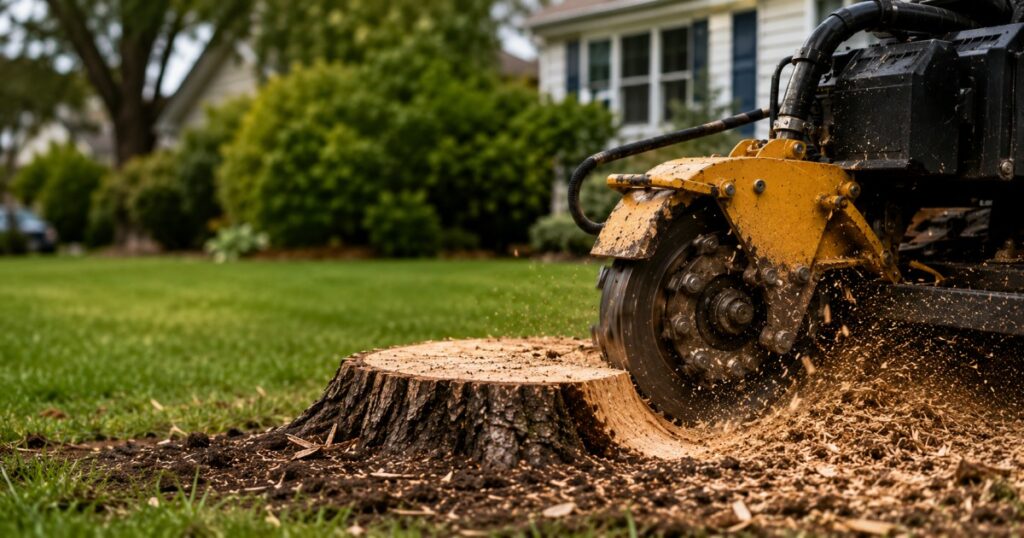
You just had a tree taken down. The crew did a great job. But now there’s a stump sitting in the middle of your lawn, and the grinder is warming up. Before the work starts, a critical question worth asking is: how deep should stump grinding go?
It sounds like a minor detail, but the depth of the grind actually matters quite a bit. Too shallow and you’ll be looking at a mound of wood chips that fights your lawn mower every season. Too deep isn’t usually a problem—but it adds time and cost when it’s not necessary. Getting the job done right the first time is a vital part of managing your landscaping properly, which is why choosing professional tree stump removal in Buffalo, NY is the best way to ensure your yard is completely cleared and ready for whatever you plan to build or plant next.
This guide covers the standard depths used by professional crews, the environmental factors that alter those measurements, and how to determine the right choice for your specific yard.
| QUICK ANSWER: How Deep Do We Grind? Standard stump grinding depth is 6 to 12 inches below ground level. For most residential lawns in Buffalo and WNY, 8 inches is the sweet spot—deep enough to allow topsoil and reseeding, without unnecessary extra time or cost. If you’re planning to pour concrete, build a deck, or replant a tree in that exact spot, 12 to 18 inches is recommended. 📞 NEED A QUICK ESTIMATE? Skip the guesswork. Call the Treeman NY team today at (716) 466-5990 for a fast, free consultation, or text us a photo of your stump to (716) 466-5990 for an instant estimate. |
The Industry Standard for How Deep Should Stump Grinding Go
Most professional tree crews grind stumps to a depth of 6 to 12 inches below the soil surface. That range isn’t arbitrary—it comes from years of field experience and aligns with guidance from organizations like the International Society of Arboriculture (ISA), which sets professional standards for arboricultural work across North America.
- At 6 to 8 inches: The stump is well below the surface and the remaining root collar cannot regenerate new growth.
- At 10 to 12 inches: You’ve got enough clearance to backfill with quality topsoil, get healthy grass established, and run a standard lawn mower without any interference.
For most homeowners, anything in this range handles the job cleanly. When evaluating how deep stump grinding should go, our honest answer is: it depends entirely on what you plan to do with the ground afterward. That answer might look a bit different for a backyard in Amherst than for a front yard in Williamsville with a concrete walkway already close by.
5 Factors That Determine Your Grinding Depth
The 6-to-12-inch range is a baseline guideline, not a rigid rule. Several variables affect the process, and our professional crew assesses these factors to customize their approach before the machine even starts.
1. Your Post-Removal Plans
This is the most important factor when deciding how deep stump grinding should go. If you simply want grass to grow back and the stump removed from view, an 8-inch depth is usually enough.
However, if you are looking to pour a concrete pad, build a deck, or install underground irrigation, you’ll want the grinder to reach 12 to 18 inches below grade to remove the bulk of the subterranean root mass. Leftover roots can shift as they decay, which can compromise the stability of anything built directly above them.
2. The Size and Species of the Tree
Larger stumps—especially from oak, maple, or elm—have thicker root systems that extend wider and deeper than smaller ornamental trees. The stump diameter also determines how wide the grinder needs to swing across the top before the crew can work downward effectively. A 36-inch oak stump is a completely different job than a 10-inch flowering cherry.
3. Surface Root Coverage
Some stumps have extensive surface roots that fan out well beyond the visible trunk base. These roots are usually within 4 to 8 inches of the surface, creating tripping hazards and lawn mower damage. To address how deep should stump grinding go across the entire project area safely, your crew may need to focus on a wider grinding radius—not just going deeper—to clear the entire surface root zone.
4. Underground Utilities
Before any grinding begins, underground utilities must be marked through your local 811 call-before-you-dig service. In many parts of Buffalo, Erie County, and WNY, gas, electric, and water lines are buried relatively shallow. If utilities are close to the work area, the depth limits for stump grinding must stay conservative—typically 6 to 8 inches maximum—to avoid any contact with critical lines below.
5. Equipment Access and Machine Capability
Most professional stump grinders are heavily built to handle deep, aggressive cuts. When utilizing commercial machinery, a crew can easily reach 12 to 18 inches below grade. Our team at Treeman NY uses professional-grade equipment suited for both open yards and tight-access areas common in older Buffalo neighborhoods. You can see photos of our commercial machinery tackling tough local yards on our Google Maps profile.
Charting Your Ideal Use Case
| Planned Use After Grinding | Recommended Depth | Notes & Next Steps |
| Lawn / Grass Regrowth | 6–8 inches | Backfill with topsoil, reseed after settling. |
| Garden Bed / Mulch Area | 8–10 inches | Allows for deeper soil amendment and planting. |
| Replanting a New Tree | 12–18 inches | Removes root mass. Contact Us for a precision deep-grind quote. |
| Concrete Pad / Driveway | 12–18 inches | Critical depth; root decay beneath concrete causes severe cracking. |
| Deck / Structure Foundation | 12–18 inches | Settling roots can shift structures. Requires complete clearance. |
| Near Underground Utilities | 6 inches max | Always call 811 before grinding begins. |
📖 Resource: For full details on our local tree clearing solutions across Western New York, explore our comprehensive stump grinding and removal services in Buffalo, NY.
| GET AN INSTANT OVER-THE-PHONE ESTIMATE Don’t risk damaging shallow WNY utility lines or burning out a weak rental machine. Let the pros handle it safely.→ Request a Free Estimate |
What Happens After the Stump Is Ground?
Once the grinder finishes, you’re left with a depression filled with fine wood chips and sawdust mixed into the soil. A lot of homeowners are surprised by the volume of material this creates—a medium-sized stump can produce a couple of large wheelbarrow loads of chip debris.
The standard cleanup process involves removing the bulk of that chip mix, filling the hole with clean topsoil, and tamping it down. You’ll want to allow a few weeks before seeding because the ground will continue to settle slightly as the remaining organic material below begins to decompose. Professional agricultural extensions note that minor surface settling over the first season is completely normal and easy to address with a quick top-dress of soil.
The roots that remain deep underground will not grow back into a new tree. Once the root collar is removed below grade, the tree has no mechanism to regenerate. Those remaining lateral roots simply break down safely over several years with no meaningful impact on your lawn above.
How Deep Should Stump Grinding Go in Buffalo’s Soil Conditions?
Western New York soil has some unique quirks. In many parts of Buffalo, Amherst, and the surrounding Erie County towns, the clay-heavy subsoil can make stump removal slower and more labor-intensive than in regions with sandy or loamy ground. Because clay retains moisture and restricts deep root penetration, local tree species often grow wider rather than deeper—spreading horizontally to find oxygen near the surface.
For WNY properties, this means a local stump frequently requires extensive lateral grinding—clearing a wider radius across the surface root zone—rather than just plunging straight down. Our crew accounts for this when assessing how deep should stump grinding go in Clarence, Lockport, East Amherst, and other towns where older-growth maples and oaks are common. If you’ve got a big old silver maple stump in your backyard, expect the job to cover more surface ground than the visible stump diameter suggests.
Lake-effect snow and freeze-thaw cycles also play a role over time. Roots near the surface in WNY shift slightly each winter as the ground heaves and thaws. That’s why getting a professional assessment on how deep should stump grinding go the first time matters much more here than it does in milder climates.
A Quick Word on DIY Stump Grinding
Rental stump grinders are readily available at equipment rental shops around Buffalo, and you can technically rent one to tackle the job yourself. However, a few honest insights from our field experience are worth keeping in mind before you lose your weekend to a stubborn stump:
- Power Differences: Rental units are generally smaller and less powerful than commercial machines. They’ll get the job done on a soft, smaller stump—but on a 20-inch oak that’s been established for decades, you’re looking at several hours of grueling work with a machine that may struggle to reach the target depth.
- Hidden Costs: The rental fee, your weekend time, fuel, and potential damage charges if you hit a buried rock can add up to near-professional rates quickly.
- Safety Hazards: Stump grinders throw heavy debris at high speeds. Without the right commercial protective equipment and experience reading how a stubborn stump will behave under tension, you’re taking on real physical risk.
The Bottom Line: Save your weekend and avoid the backache. Our commercial grinders can finish in 30 minutes what takes a rental machine all afternoon. Contact us at (716) 466-5990 for a quick, hassle-free price check.
| Get a Stump Grinding Quote in Buffalo & WNY Treeman NY proudly serves Buffalo, Amherst, Williamsville, Getzville, Clarence, Lockport, East Amherst, and surrounding Western New York communities. Whether it’s one problematic stump or an entire commercial lot layout, we’ll assess the situation and give you a straight answer on depth, cost, and timeline—no pressure, no vague estimates. See Our Work: Check out our latest project photos and 5-star customer reviews directly on our Google Business Profile and Google Maps Listing. Request a Free Estimate: Call us right now at (716) 466-5990 or visit treemanny.com/contact to secure your spot on our schedule this week. |
FAQ
How deep should stump grinding go for a standard lawn?
For a standard lawn, an 8-inch depth below grade is typically perfect. That depth completely removes the visible stump and enough of the root collar to prevent regeneration. After backfilling with topsoil, you can easily reseed the area. If you want a quick price to clear your lawn, call our team at (716) 466-5990.
What happens if a stump is not ground deep enough?
If you settle for a shallow cut, it leaves a raised mound of dense wood chips close to the surface. This prevents healthy grass roots from establishing, creates an uneven area that’s difficult to mow, and can sometimes allow suckers or sprouts to push up from residual root material.
How deep do professional stump grinders go?
Most professional-grade stump grinders are capable of reaching 12 to 18 inches below the soil surface. The actual depth used on your property depends on your future landscaping plans, stump size, and proximity to buried lines.
Do I need to call 811 before stump grinding?
Yes. Calling 811 before any digging, excavation, or grinding is required by law in New York State. This ensures underground gas, electric, and water lines are clearly marked. At Treeman NY, we always confirm this safety step has been taken before bringing heavy machinery onto your lawn.
Is stump grinding the same as stump removal?
No. Stump grinding chips the main stump down to a specific level below grade and leaves the deep root system to decompose naturally. Full stump removal completely excavates the entire massive root ball out of the ground—a much more intensive and costly process reserved for areas where concrete foundations or new trees must be placed in that exact spot. Talk to our team at (716) 466-5990 to figure out which solution fits your budget best.